These paramedics do more than emergency calls. Idaho wants more of them. This grant could help.
Aug 10, 2026 | 6:15 am ET
Description
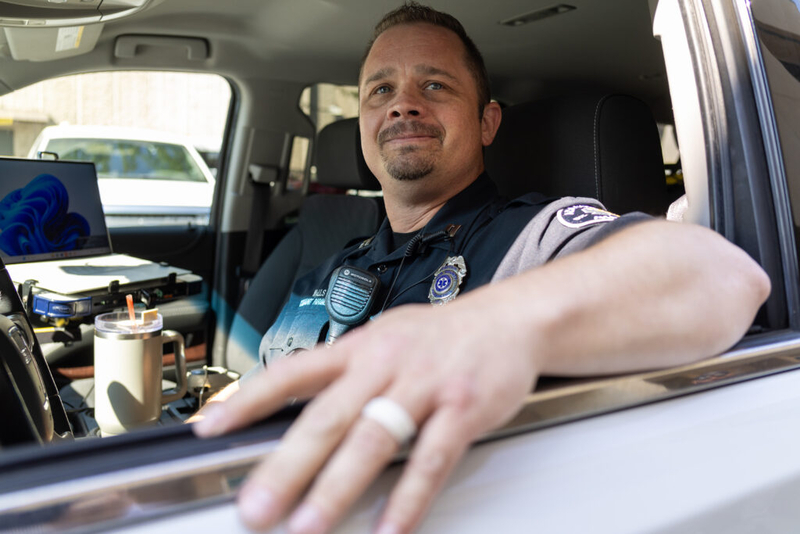
Dave Walls is a community paramedic at Ada County Paramedics, one of few EMS agencies that adopted a program to embed paramedics to help patients manage chronic health conditions. (Photo by Kyle Pfannenstiel/Idaho Capital Sun)
Dave Walls remembers winning an argument with Medicaid.
At first, the state-run public assistance program wouldn’t cover an in-home caregiving service for a patient that he was helping out. But after he pointed out coverage guidelines on the state’s website, Walls said the state’s tune changed.
“That feels almost as good as a code save,” referring to when emergency responders save someone from a heart attack, said Walls, who has worked for almost three years as a community paramedic in Ada County, Idaho’s most populated county.
It wasn’t a typical call for paramedics, who usually deal with emergency medical situations. But it’s part of the norm for community paramedics, a specialized type of paramedic or EMT that helps people manage chronic conditions in the hopes of preventing future hospitalizations — and even bigger bills.
And as Idaho seeks to tap into millions of dollars in federal grant funding through the One Big Beautiful Bill Act dedicated to rural health care access, Wayne Denny, the leader of Idaho’s Bureau Emergency Medical Services, or EMS, wants to use some of it to expand community health EMS providers into rural communities across Idaho. And he hopes it can be a critical infusion to Idaho’s EMS system, which is experiencing a shortage amid funding struggles. Some also see promise in expanding community paramedics in a largely rural state that has long had a doctors’ shortage.
“This very possibly will kind of serve as that seed money that we were going to need to start getting the system built out. Because we really think that if if we can get this foundation created and demonstrate that the model that we’re suggesting has value and that it will end up saving money in the end,” Denny said in an interview, adding that the investment could allow EMS agencies to demonstrate that the model works to help ease the process of getting coverage from health insurers.
What are community health EMS providers?
Across the U.S., more than a third of emergency department visits are not urgent, according to a 2013 study that’s been cited by the Centers for Disease Control and Prevention.
That’s where community EMS providers step in.
They are EMTs trained to handle chronic health conditions and non-urgent health conditions. They often visit patients who frequently call for ambulances or patients recently discharged from the hospital, and they may even do house calls to draw labs for somebody who lives far away from clinics. And they might do a laundry list of other things: like connect patients with resources for how to navigate the health care system or programs, such as medical transportation, and even share resources for a new diagnosis, like dementia, or how to make their homes more accessible by walkers.
In Idaho, a public transit program can take you to the doctor. If it has enough funding.
In the Magic Valley, an area of southcentral Idaho, James Rhom has seen the impact of community health workers. He said the hospital has less demand for the emergency department, freeing up beds, and fewer patients recently discharged from the hospital need to be readmitted.
Rhom manages the EMS team at Magic Valley Paramedics.
He said the shift to community health EMS from traditional EMS was “an eye opening experience.”
“As a paramedic, I knew … there’s something more going on here, right? You’d go out and … someone’s sick, and then there’s an emergency or a minor injury or illness or something, and you’re like, ‘There’s something here that I’m missing that I just can’t piece apart about how they got to where they are today,’” Rhom said.
But in community health EMS work, he said there’s more opportunity to understand what’s driving health outcomes.
“When you sit down with a patient, you can really go back and sit down with them, and they may have been calling 911 six, eight, 10 times over the last couple months,” Rhom said.
The Magic Valley program, founded in 2019, covers Twin Falls, Jerome and Gooding counties.
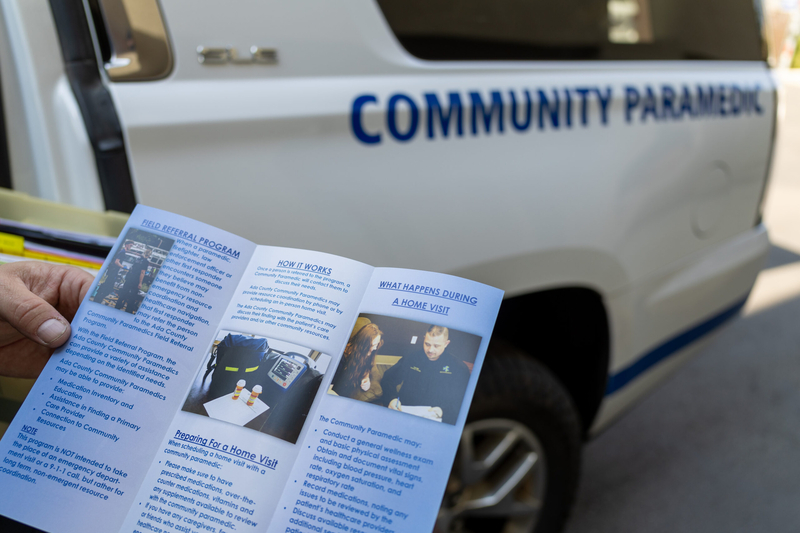
In Ada County, the community health paramedic program has been up and running for more than a decade. Mark Babson signed up early.
“I always have thought that EMS — paramedics and EMTs — have been underutilized in that larger health care system delivery model because of that connection to community,” he said in an interview.
Then he helped get Walls on board.
In 2012, Babson frequented the Starbucks that Walls managed. Hearing Babson’s stories as a paramedic, and the agency’s goals of innovating the EMS system, helped convince Walls to go back to school and become a paramedic.
Today, Walls’ calls look different than a typical paramedic. He isn’t showing up in an ambulance; he drives a GMC Yukon branded for Ada County Paramedics. And he doesn’t have a partner.
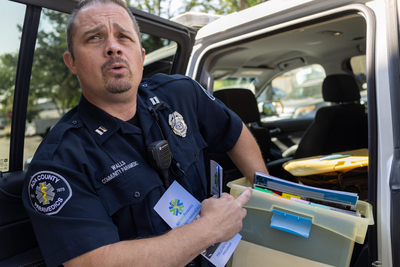
“We’re very much more of a nondescript, just a guy with a bag that’s walking in,” Walls said. “… Sometimes we get to spend time that a normal EMS provider wouldn’t have, and sometimes it might be time that a specialist or a primary care physician may not have either.”
“Sometimes it can be as simple as, ‘I just don’t know how to get to my doctor’s appointments anymore,’ or ‘I’m going to lose my home because I’m on … limited income and I don’t know who to reach out to to find support for my power bill,’ or ‘I’m on oxygen, and they’re going to turn my power off. What do I do?’” he said.
And he acknowledges that community paramedics fill a niche.
“The days of the doctor coming to your door are fewer and far between,” Walls said.
The pitch to fund more community health EMS providers
Right now, only a handful of EMS agencies in Idaho are doing community health EMS work — such as in Ada County and the Magic Valley, said Denny, who leads the state’s EMS Bureau. But he hopes to place at least one community health EMS provider in every Idaho county that lacks one.
Denny is still waiting to iron out details about his proposal to expand community EMTs – like how much money he’ll need. But he previewed the idea last month to a panel of state lawmakers tasked with overseeing how the state spends the rural health funds.
He told lawmakers that the EMS Bureau, which is now part of the Idaho Military Division, hopes to tap into the rural health funds to bolster Idaho’s 911 system — by modernizing the state’s communications center, and shift local dispatchers toward next-generation 911, a more sophisticated system. And he hopes to bolster the EMS workforce, by expanding community health EMS providers, non-clinical community health workers that he said serve as patient navigators, and placing at least one-paid EMS provider in each of Idaho’s 44 counties.
That’s in hopes of chipping away at the state’s EMS shortage, which is a largely volunteer workforce and isn’t required to be funded by the state, Idaho Public Television reported.
And he touted the promise of community health work.
“We’ve already demonstrated, in some of the work that we’ve done over the years, is that if you pay us $10 to do prevention, we’ll save you $100 on the ER,” Denny told members of the Legislature’s Rural Health Transformation Committee.
But Idaho is on a clock to spend the money. The funds must be doled out by Oct. 30, or the federal government will claw them back.
Boise, ID