Nebraska education commissioner says 5% spending cut won’t apply to school funding formula
Aug 07, 2026 | 6:00 am ET
Description
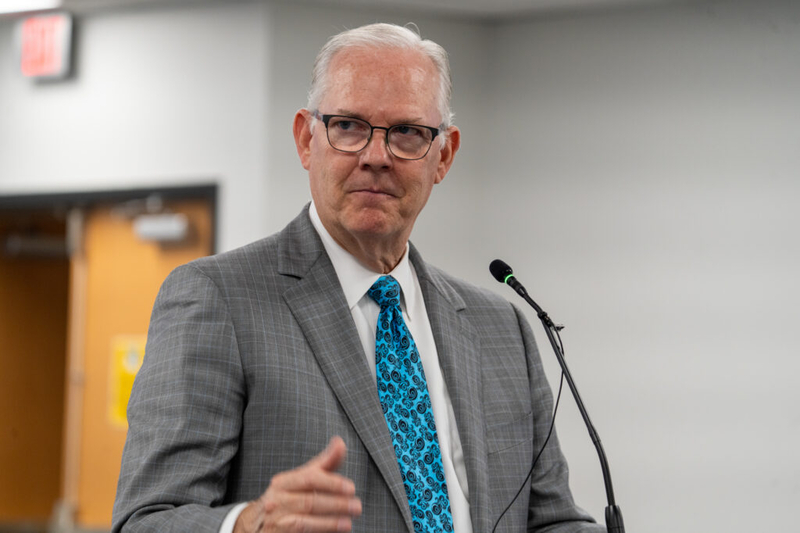
Nebraska Education Commissioner Brian Maher of Lincoln talks to reporters after the first meeting of the School Financing Review Commission. Aug. 12, 2025. (Zach Wendling/Nebraska Examiner)
LINCOLN — Nebraska’s education commissioner said a 5% spending cut Gov. Jim Pillen requested from all state agencies won’t apply to the state’s school funding formula.
Commissioner Brian Maher provided an update on the Nebraska Department of Education’s response to the governor’s spending memo at a State Board of Education meeting Thursday. While portions of the memo will not impact the department, he said, it will require them to cut roughly $2.3 million in the agency’s current budget.
Pillen issued the memo in July, asking state agencies to immediately cut spending by a minimum of 5% on a month-to-month basis, which is expected to be in effect for both the current budget and the next biennium starting July 1, 2027. Maher noted the memo does not have the enforcement power that a statute or executive order holds, but it does signal the state’s long-term budget woes with multiple projected deficits on the horizon.
After meeting with members of the governor’s office, Maher said department officials learned that the 5% cut would not apply to the more than $2 billion in state aid going to schools, including Tax Equity and Educational Opportunities Support Act (TEEOSA) funds. It also would not apply to roughly $93 million in federal funding allocated to the department.
What’s left over is about $46.5 million in general fund dollars going to the department. Finance Officer Bryce Wilson said about $21 million of that amount is fixed costs that cannot be pulled, and parts of the remaining $25 million are also earmarked for specific purposes.
“Once we start throwing all those things together, it is not an easy task to come up with a 5% reduction for the department,” Wilson said.
There are five different “buckets” of legislative funding that could be pulled from, Wilson said. The largest is administrative costs, which was appropriated roughly $36.5 million between the state’s general fund and various cash funds. Others include the state’s vocational rehabilitation program and services for the deaf, blind and visually impaired.
No decisions about the cuts were made at the meeting. Maher said in addition to examining the funding buckets, department officials are following the governor’s advice to increase scrutiny on travel expenses and eliminate “nonessential activities.”
“I would tell you I don’t have any (activities) to say,” Maher told the board. “But we’re having some conversations on some things that we’re looking at, saying ‘Does that really help further the cause of the Nebraska Department of Education?’ And I think that’s probably a good conversation that you should have.”
Pillen’s memo also requested a hiring freeze across state agencies, but Maher said the governor’s representatives told them that order likely doesn’t apply to the Education Department. However, Maher said he intends to follow the request through a “measured approach.”
This means department officials will be looking at every vacant position and determining whether it should be filled or whether positions could be combined.
“While we may not have to do those things right now, I think it’s more a matter of should we do those things right now,” Maher said.
Lincoln, NE