Attorneys and advocates cheer Michigan Supreme Court decision demanding new Line 5 permit review
Aug 03, 2026 | 5:22 pm ET
Description
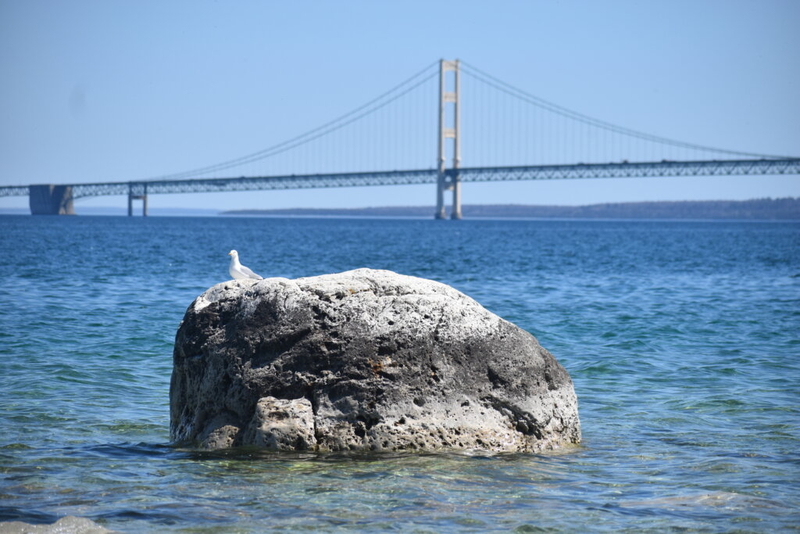
Ceremonial rock in Mackinac Straits prior to Anishinaabek water ceremony at McGulpin Point, Mackinaw City. May 2021 | Laina G. Stebbins
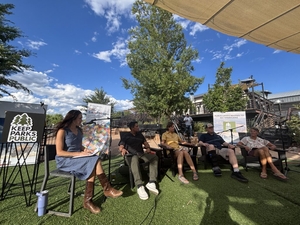
Following the Michigan Supreme Court’s Friday ruling striking down state energy regulators’ decision to permit the Line 5 tunnel project, pipeline opponents convened to celebrate the decision and talk about the next steps.
The controversial pipeline runs from Superior, Wisconsin to Sarnia, Ontario, with a 4.5-mile segment of dual pipelines running through the Straits of Mackinac, where Lake Michigan and Lake Huron meet.
Bay Mills Indian Community President Whitney Gravelle, Michigan Climate Action Network Executive Director Denise Keele and several attorneys who challenged with Michigan Public Service Commission’s permitting decision told reporters the courts’ ruling marked a victory for the tribal nations, environmental advocates and attorneys who advocated for a broader review of the environmental harms that could come from the project.
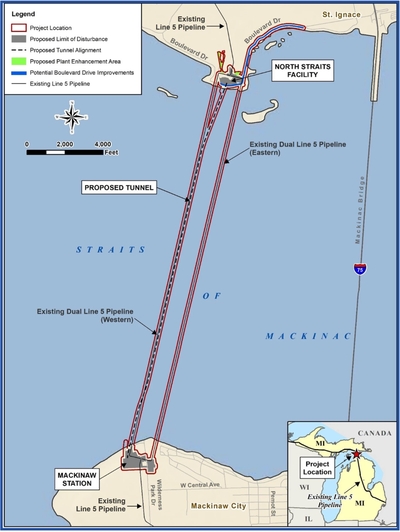
The Commission, which oversees natural gas and pipelines within the state, granted Line 5’s owner, Enbridge, a permit to move forward with its plans to replace its dual pipelines operating within the Great Lakes with a new segment placed in a utility tunnel beneath the lakebed.
Enbridge has championed the tunnel as a solution to concerns that the pipeline could rupture, spilling oil and natural gas liquids into the ecologically sensitive Straits of Mackinac, where Lake Michigan and Lake Huron meet. However, pipeline opponents say the tunnel project would still harm environmental and cultural resources.
In their decision Friday, the Michigan Supreme Court determined the Public Service Commission had failed to consider alternatives to the Line 5 tunnel project, and had improperly limited the scope of the environmental review by preventing intervenors from submitting information detailing the project’s environmental impacts and examining the public need for the petroleum products Line 5 transports.
“The court rejected the commission’s framework of analysis and sent this back to the drawing board,” said Adam Ratchenski, a senior attorney for Earthjustice who argued on behalf of the Bay Mills Indian Community, the Little Traverse Bay Bands of Odawa Indians, Grand Traverse Band of Ottawa and Chippewa Indians, and Nottawaseppi Huron Band of the Potawatomi.
“It didn’t say go back and do a little more,” Ratchenski continued, “It said go back and do it right this time, and we’ll be fighting every step of the way to make sure that happens. The case sets a precedent that will result in better protection for Michigan’s air, water, and natural resources, and critically for the communities and creatures that rely upon them. That’s a great thing for everybody, and we should celebrate it.”
Moving forward, Gravelle said the commission can now review the full 641-mile scope of Line 5, as opposed to the four-mile segment located in the Straits, noting that the pipeline has spilled more than a million gallons of oil along its route.
In a statement to Michigan Advance, Enbridge Spokesperson Ryan Duffy said the company is reviewing the court’s legal opinion and assessing its legal options.
“The Court’s decision is unfortunate in that it adds an additional delay to the permitting process for the Great Lakes Tunnel, which is designed to protect the Great Lakes and ensure the ongoing safe, reliable and efficient delivery of energy to our region,” Duffy said.
While Enbridge could appeal the decision to the U.S. Supreme Court, Riyaz Kanji, who represented Flow Water Advocates in their appeal of the permit, argued the company lacks the legal basis, given that the case deals with state law like the Michigan Environmental Protection Act.
“These are quintessential Michigan legal issues, and the Michigan Supreme Court has the final word,” Kanji said, noting that this leaves the Public Service Commission as the next step.
Ratchenski anticipated that the commission could hold a new hearing on the permit sometime in 2027.
Alongside the permit from the commission, Enbridge needs to secure permits from the Michigan Department of Environment, Great Lakes and Energy and the U.S. Army Corps of Engineers in order to move forward with construction of the tunnel project.
However, as Michigan moves to meet a 100% clean energy standard by 2040, Keele questioned the logic of investing further resources into the more than 70 year old pipe line.
“It just defies common sense to invest in a fossil fuel pipeline that endangers our greatest freshwater resource amid rising global temperatures,” Keele said. “We are in this fight to ensure that we at least recognize the reality of climate change and fully consider the likely impacts from increased greenhouse gas emissions.”
Lansing, MI