New Mexico public lands panel decries ‘greed’ behind push to remove Chaco buffer, shrink monuments
Aug 03, 2026 | 2:37 pm ET
Description
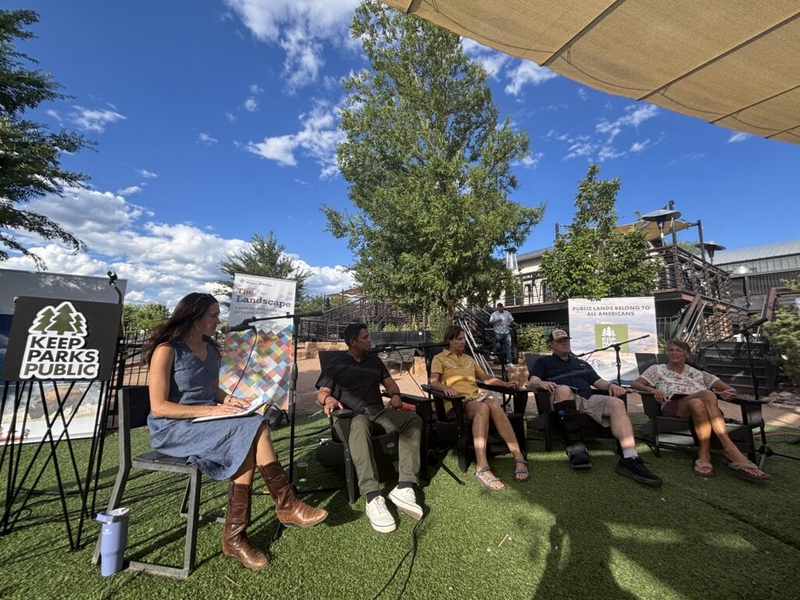
Public lands advocates on July 30, 2026, gathered in Santa Fe to outline their efforts to preserve public lands in New Mexico against threats from the Trump administration. Left-right: Center for Western Priorities Communications Manager Kate Groetzinger, Native Lands Institute Founder and CEO Keegan King, Conservation Lands Foundation Vice President Charlotte Overby, National Wildlife Federation leader Andrew Black and Coalition to Protect America’s National Parks member Elaine Leslie. (Julia Goldberg/Source NM)
Leaders of New Mexico conservationist and Indigenous groups on Thursday decried the many threats President Donald Trump’s administration poses to public lands in the state, including through rolling back environmental regulations, shrinking national monuments and excluding the public from meaningful input.
The Center for Western Priorities convened a group of local panelists in Santa Fe for a live podcast taping as part of its “Keep Parks Public” campaign. The panelists called on Trump to maintain the 10-mile buffer zone around Chaco Canyon; preserve the state’s Kasha-Katuwe Tent Rocks National Monument; and ensure Indigenous voices are heeded in decisions about public lands.
Taken together, the Trump administration’s actions regarding public lands in New Mexico and across the West point to the possibility of a large-scale public lands selloff, one motivated by “greed” for more extraction, including of oil, minerals and timber, said Elaine Leslie, a member of the Coalition to Protect America’s National Parks.
“If you look at what’s there and surrounding those parklands, there’s resources for extraction, and I just think you have to follow the money,” Leslie said. “That’s what this is all about.”
Since Trump took office in January of last year, his administration or allies in Congress have sought to sell off up to .75% of public lands and made mining for uranium and other potential energy sources a national “emergency.” The administration has also initiated the reversal of rules that protect “roadless” areas in national forestlands and allow conservation as a beneficial use of federal land.
Panelists listed certain areas as in particular need of protection, including the Gila Wilderness, Otero Mesa, the Pecos Watershed, Chaco Canyon and the Rio Grande Del Norte Monument. Legislation is in the works from New Mexico’s congressional delegation, they said, regarding all of those sites.
Hope for their passage rests largely with the upcoming mid-term elections and the possibility of Democrats retaking majorities in the U.S. House of Representatives and U.S. Senate, said Leslie, who served for 25 years in the National Park Service.
Still, legislation regarding protecting the Caja Del Rio, a 107,000-acre expanse west of Santa Fe with historical, cultural and ecological significance, recently received a congressional subcommittee hearing.
New Mexicans protest outside BLM office over proposal to undo Chaco Canyon mining protections
“Now it won’t pass this year because of the shape Congress is in, but we will see it continue to move,” said Charlotte Overby with the Conservation Lands Foundation. “And every time it moves through a committee and gets another hearing, that’s another march toward progress.”
Keegan King, founder and CEO of the Native Land Institute, said he, along with Pueblo leaders, recently had a respectful conversation with Bureau of Land Management Director Steve Pearce about the rollback at Chaco Culture National Historic Park. But whether the administration will heed Indigenous leaders or hundreds of thousands of comments from the public at large regarding the matter remains to be seen, he said.
“We’re hopeful that Director Pearce and Secretary [Doug] Burgum hear that plea from the American public, and that this is not just a checkbox of, ‘OK, we’re opening up public comment,’ but we’re actually going to listen to that comment,” he said.
Santa Fe, NM