Data center approvals in Texas halted until audits completed, Gov. Greg Abbott says
Aug 03, 2026 | 2:12 pm ET
Description
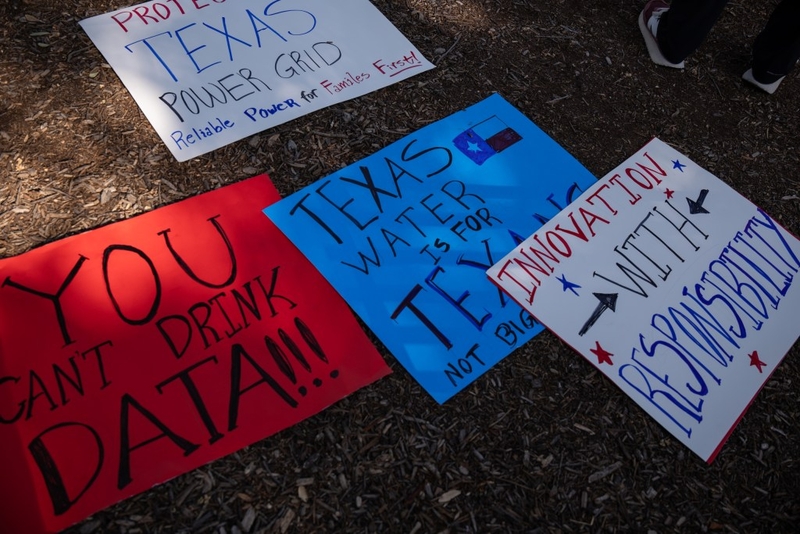
Signs are scattered on the ground at a rally against data center development across the state on the Capitol grounds in Austin on July 27, 2026. (Kaylee Greenlee for The Texas Tribune)
Amid growing public backlash to the rapid buildout of data centers across Texas, Gov. Greg Abbott on Monday announced a moratorium on the approval of data centers until regulatory agencies can audit proposed data centers seeking connection to the state’s electric grid.
It is unclear how long the audit will take, but Abbott is asking the Public Utility Commission of Texas and the Electric Reliability Council of Texas to ensure data center developers provide information on tax breaks they will receive; power use and generation; water use and cooling operations; efforts to reduce impacts on local communities; and ownership of the facility. Any projects that fail Abbott’s ordered “comprehensive verification and audit” should be denied connection to the grid, the governor said.
Abbott’s letter to the PUCT and ERCOT directs them to conduct the audit on all data centers advancing through ERCOT’s interconnection queue, or the line for energy intensive projects seeking connection to the electric grid. ERCOT is currently tracking more than 1,800 projects in the queue, representing over 474 gigawatts of electricity, or more than five times the grid’s record for peak demand, according to ERCOT. Approximately 90% of the new power requests are data centers, Abbott said.
ERCOT and the PUCT are already conducting a review of some of the projects in the queue through a process known as “batch zero.” It is unclear if Abbott wants agencies to audit those projects or all those currently in the queue.
“Our top priority is to protect Texans’ safety and quality of life,” Abbott wrote in a statement. “Any project that fails to comply with the requirements set forth by the PUCT and ERCOT, and by state law, must be denied connection to the Texas grid. Simply put, Texans must come first.”
The Texas Tribune has identified 335 data centers operating in Texas. The state is currently the second largest market for the facilities in the country, behind Virginia, and is poised to take the top spot. The Tribune has identified at least 248 planned data centers coming to the state, although hundreds more in lesser development phases have lined up in the power queue.
Lawmakers have spent much of this year seeking clarity about the facilities’ electricity use, water use and access to tax incentives as the Legislature considers tighter regulation of the industry.
Abbott cited the failure of some data centers to comply with a recent PUCT’s survey measuring water and power usage as the reason the audit was needed because it hinders the agencies’ ability to make informed decisions.
Developed by the PUCT in collaboration with the Texas Water Development Board, the survey collects information about a data center’s water consumption, cooling systems, water sources, electricity demand and whether facilities are connected to the state’s electric grid or have their own on-site power source such as a gas-fired power plant. The responses are meant to inform long-term state water planning.
State law requires the PUCT to share the data with the water development board and state environmental regulators and to submit a report to the governor and the Legislative Budget Board by the end of the year.
Rep. Brad Buckley, R-Salado, a member of the House Natural Resources Committee called survey participation “pretty pathetic” during a June hearing. Of the 377 companies PUCT staff said it notified when the survey was launched, 28 submitted responses.
Also in June, Abbott directed the PUCT and ERCOT to require data centers fully fund the costs of electric infrastructure needed to serve them and take other measures to reduce electricity costs to residents.
On July 17, PUCT Chair Thomas Gleeson responded to Abbott with his own letter outlining efforts the agencies have already taken and calling on the Legislature to grant them more authority to regulate the industry.
The PUCT did not respond to questions about the scope of the audit, saying the agency would work with ERCOT to ensure Abbott’s new directives are carried out.
Abbott’s proposal may disrupt ERCOT’s ongoing rework of its approval process for projects in the interconnection queue, requiring large-load projects to provide more detailed information before they can advance. The new rules for the first set of projects under consideration, known as “batch zero,” were approved by the PUCT in June. The agencies are currently working to develop a more permanent set of rules for projects still in the queue.
An ERCOT spokesperson said the grid manager is reviewing Abbott’s order and will postpone the batch zero transmission planning study that is currently underway.
Environment Texas, an advocacy group that has called for tighter regulation of the industry, said Abbott’s order is asking the right questions but called on him to order a special session so the Legislature can begin passing new laws.
“AI has real promise, but it shouldn’t come at the cost of our water, our air, and our neighborhoods,” the group’s executive director Luke Metzger wrote in a statement. “Now that the state is asking the right questions, it needs to use the answers to develop safeguards that protect Texans.”
This is a developing story. Check back for updates.
Alejandra Martinez contributed to this report.
Austin, TX