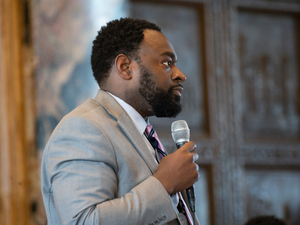
David Valadao lost in the last anti-Trump blue wave. Will farmers help him win this time?
Jul 31, 2026 | 8:10 am ET

Description
In summary
As a dairyman, David Valadao has endeared himself to the agricultural communities, even building cross-party support among Democrats. But with costs soaring and Trump so unpopular, voters might not be as willing to look beyond the “R” beside his name.
To many Central Valley farmers, Rep. David Valadao is simply “David.”
As a dairy farmer, born and raised in Hanford, “David” is relatable. He knows how fickle and financially uncertain the farming business can be, having once declared bankruptcy to absolve his family farm’s delinquent loans.
Valadao’s farming bona fides have repeatedly helped the Republican incumbent win re-election in a swing congressional district where Democrats have a significant voter registration advantage.
But this year, as Republicans fight to keep control of the U.S. House amid a bad economy and an unpopular president, the cross-party appeal of “your local farmer” might not be enough to keep Valadao in office.
“Unfortunately, David Valadao’s vote could be the one that gives Trump the power,” said Don Cameron, a longtime Fresno County farmer who lives in Valadao’s district.
“I wish it wasn’t David Valadao, because he’s a good guy,” said Cameron, a registered Democrat who has also voted for Republicans. “I just wish the current administration was more moderate and more supportive of agriculture.”
Valadao has consistently declined CalMatters’ interview requests. A Valadao spokesperson, Paige Ash, told CalMatters that the congressmember was not available to answer questions for this story.
Hoping to oust Valadao this year is Democrat Randy Villegas, a community college professor and school board trustee running an economic populist campaign with support from the Working Families Party and progressive mainstays like U.S. Sen. Bernie Sanders of Vermont and Rep. Alexandria Ocasio-Cortez of New York. He advanced from the June primary after his surprise defeat of the more moderate, establishment-backed Democrat, Assemblymember Jasmeet Bains.
Since he was first elected to Congress in 2012, Valadao has only lost once, during Trump’s first midterm in the “blue wave” of 2018, when Democrats netted 40 seats and control of the House. Two years later, Valadao won the rematch against his successor, Democrat T.J. Cox. He is also the last remaining Republican who voted to impeach Trump after rioters stormed the U.S. Capitol on Jan. 6, 2021.
Villegas is not a farmer, but he’s courting the industry. He argues that since farmworkers are the engine that powers the Central Valley’s economy, it’s past time for a son of Mexican immigrant farm laborers to represent that community in Congress.
“Everybody and anybody knows somebody who works in agriculture in the valley,” Villegas said. “And anybody in the valley will tell you that workers and agriculture are struggling right now because of Valadao and this administration.”
‘The sole dairyman in Congress’
From the day he was born, Valadao was destined to be a dairy farmer.
His father Eduardo, the youngest of eight, grew up in the Portuguese Azores helping his brothers and father run their family’s dairy farm. Eduardo knew he wanted to raise his own children the same way, teaching them the value of hard work and collaboration.
Just a few years after immigrating to California, Eduardo and his wife Maria purchased their first cows, and several years later, their own farmland. Raised on his family’s farm in Hanford, a teenage David Valadao was expected to buck hay and feed the dairy cows every morning before school, he previously told the Los Angeles Times.
“David Valadao is on our side,” proclaims his first television advertisement this year, alongside a clip of him walking through a tree nut farm with an unnamed farmer.
Valadao has also branded himself as a bipartisan leader who works across the aisle, especially with other Central Valley lawmakers like Reps. Jim Costa and Adam Gray, both Democrats.
“In the Central Valley, we care a whole lot more about ag and water than partisan politics,” Valadao said in a promotional video posted on his official congressional YouTube account last December.
He consistently wins financial support and endorsements from powerful industry groups, including more than $30,000 from national and state committees for dairy, chicken and sugar producers, recent campaign finance filings show. Shannon Douglass, president of the California Farm Bureau, recently praised Valadao for urging House Republican leadership to allocate more federal emergency support dollars for growers of “specialty crops” such as fruits, vegetables and tree nuts — the bulk of what California farmers produce.
“Farmers are happy with him, and they sure as hell are going to take him any day over someone that would seem to be a socialist and who doesn’t have any ag credentials,” said Rob Stutzman, a Republican strategist.

But while Valdao’s farming roots appear to be an asset, the congressmember’s track record with other issues important to the district, such as healthcare and food assistance, are likely a liability.
Democrats especially have excoriated Valadao for casting what would become the decisive vote to pass President Donald Trump’s budget bill. The law signed last year slashed an estimated $28.4 billion from California’s Medicaid program, known as Medi-Cal, stripping health insurance from an estimated 3.4 million Californians.
“He’s looking out for his billionaire buddies,” said Villegas, speaking of Valadao. “He doesn’t actually care about the agricultural industry here in the valley.”
The law also effectively cut about 20% of funding for the Supplemental Nutrition Assistance Program, also known as SNAP, or food stamps — a program whose fate is largely shaped by the House agriculture committee on which Valadao serves.
Soaring costs compound farmers’ struggles
Farmers are accustomed to financial struggles.
Volatile prices for crops and the rising costs of inputs like fertilizer have produced a steady decline in the number of independent and family farms, many of which have combined into larger farms or been sold to corporate owners, private equity or hedge funds. While the total number of farms in California decreased by about 20% from 2002 to 2022, the size of the average farm increased by more than 5% during that time, according to the most recent U.S. Census of Agriculture.
The Trump administration’s unpredictable tariff scheme and the ongoing war in Iran — especially the resulting closure of the Strait of Hormuz — have only sowed more uncertainty.
“It’s been a difficult 16 months,” said Cameron, the Fresno County farmer, who noted that surging fuel prices have hit the industry at a particularly difficult time. “We use a tremendous amount of diesel for harvest, and it just puts another stress on us.”
The American Farm Bureau Federation, the country’s primary advocate for farmers and ranchers, wrote a letter begging Trump to send the U.S. Navy to escort crucial fertilizer shipments out of the Middle East.
“We are deeply concerned that failure to act could lead to disruptions to the food supply chain not seen since 2022 when food price inflation reached 40-year highs,” wrote Zippy Duvall, the group’s president.
Valadao has repeatedly blamed the high price of fuel on energy policies implemented by California’s Democratic-controlled Legislature in Sacramento, such as the state’s gas tax and restrictions on oil drilling, rather than the war in Iran.
“We’ve always had the highest fuel prices in California, and it’s not because of a war that started two weeks ago,” he told a local Bakersfield television station in March. He also told the station, “To pretend that Iran is the first reason why fuel prices are going up is false.”
Non-white and non-English-speaking farmers have been hit especially hard. More than 65% of Valadao’s district is Latino, according to the California Target Book.
Historically, the U.S. Department of Agriculture has played a key role in helping underrepresented groups successfully break into farming through loan and grant programs. American farmers are overwhelmingly white, male and over the age of 55, according to data from the department’s agriculture census, and California is no exception.

But since the Trump administration’s overhaul of the federal bureaucracy, advocates for groups representing nonwhite farmers say it’s been much more difficult to get help from the USDA.
“Our members were complaining that the USDA offices, their local USDA offices, would tell them they don’t fit the definition of a farmer now,” said Benny Corona, a Tulare County organizer with Latino Farmers and Ranchers International. “They felt like they were being put through a lot of hurdles that weren’t there before.”
Corona, who supports Villegas in the congressional race, said the national group tries to schedule meetings with members from both parties, but Democrats seem much more open to hearing their stories.
“I don’t really think Republicans are really interested in promoting and investing in Latino farmers,” Corona said. “We don’t have a relationship with Valadao.”
Villegas and Democrats hope Valadao’s continued denial of the impacts of tariffs and the Iran war strikes constituents as wildly out of touch. That would be enough to overcome any cross-party appeal, argues Republican political consultant Mike Madrid.
“I think he’s very likely to lose this year,” Madrid said. “The fundamentals are too anti-Republican, too anti-Trump for anyone to care.”
Sacramento