New data forecasts not enough workers to fill new Wyoming jobs
Jul 27, 2026 | 6:22 am ET

Description
Photo courtesy of WyoFile
Many Wyoming businesses already struggle to hire and retain workers. Recent data from the U.S. Bureau of Labor Statistics and Wyoming Department of Workforce Services project more challenges ahead as Wyoming jobs increase and the unemployment rate rises.
It’s not a case of no jobs. Instead, it’s too many jobs without enough people to work them.
Labor statistics
Wyoming has continually lost mining jobs, which includes the oil and gas industry, over the last several years. This isn’t new, as employment in the mining sector peaked in the fourth quarter of 2008 and has declined since.
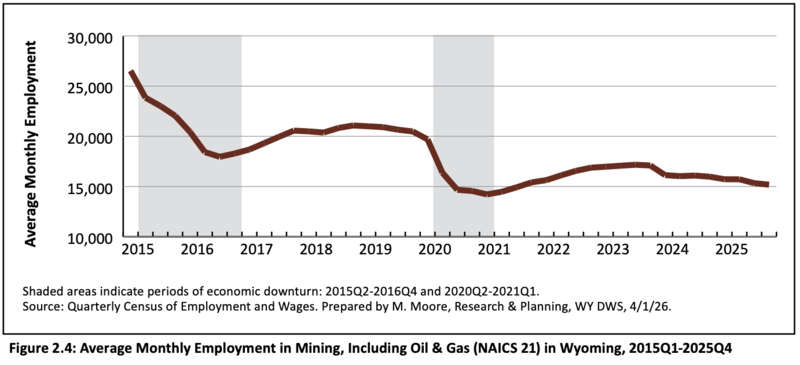
However, according to the 2026 Wyoming Workforce Annual Report the number of jobs in Wyoming has remained unchanged due to growth in other fields. What has changed? The unemployment rate — or the percent of people unemployed out of the total labor force.
Wyoming’s unemployment rate increased from 3.1% to 3.4% between 2024 and 2025, and has stayed at that rate since, according to Workforce Services.
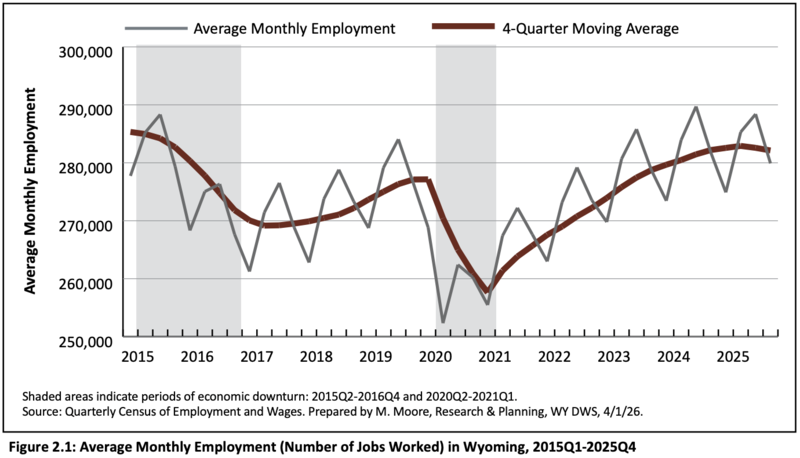
“People aren’t working for whatever reason: They’re in school or they’re taking care of a loved one or they’re for whatever reason they’re just not participating in the labor market here in Wyoming,” said Michael Moore, a research supervisor for the Workforce Services Research and Planning Division. “And so that way, we have a smaller pool to draw from with workers.”
Business impact
This smaller pool of workers is a challenge for businesses. Currently there are more jobs than workers, which hinders hiring and employee retention, Wyoming Business Alliance President Renny MacKay explained.
“There are challenges getting the talent that businesses need.
And so then that affects the ability for business to put in a new bid on a new project, to bring in more revenue or something,” MacKay said.
Part of these challenges can be attributed to Wyoming’s decreasing labor force, MacKay said. Wyoming’s aging population, combined with an exodus of young people from the state, makes it more difficult for businesses to fill job openings. While some people from other states have moved to Wyoming, it isn’t enough to fix the labor shortage.
The Wyoming Business Alliance identified several factors that make it harder for businesses to hire employees. A lack of affordable housing, a need for more educational opportunities and difficulties securing childcare impact workforce numbers.
Problems and solutions
Housing is one of the hurdles to working in Wyoming. Some employers will make a job offer and have it accepted only for a person to not be able to find housing, specifically affordable and available housing.
To solve this, the Wyoming Business Alliance advocates for less regulations around zoning and permitting to make it faster and easier for developers to build housing. This past session, the Legislature passed House Bill 2, “Fast Track Permits Act,” which sets specific deadlines for local governments to respond to residential building permit applications.
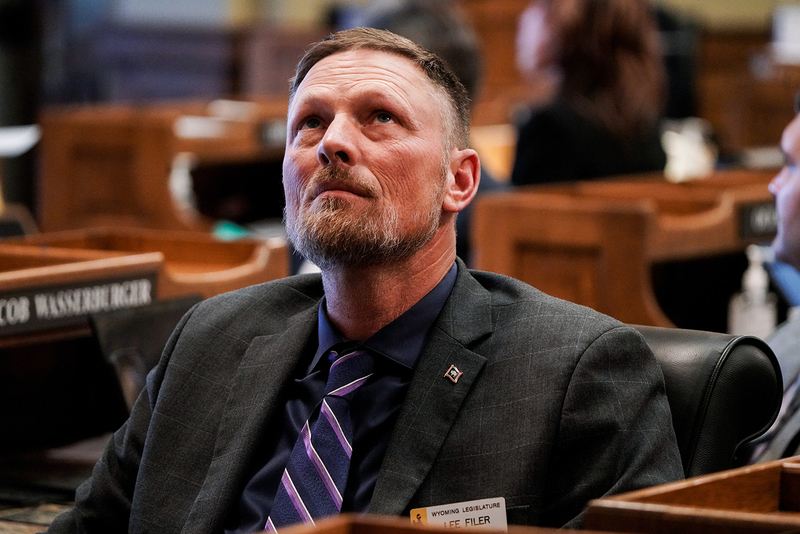
Another problem is a mismatch between the jobs employers are trying to fill and the skills people have. Sometimes the right training programs aren’t offered in Wyoming or there are too few spots available.
Gov. Mark Gordon created the Wyoming Innovation Partnership to help solve this problem. The partnership works to establish training programs in nine different categories including healthcare, energy and agriculture. Some of the programs develop degree programs at community colleges and the University of Wyoming.
Affordable childcare is also a problem. Some families can’t afford childcare, leading people to care for their children instead of entering the labor force. According to MacKay, it’s more affordable to open a childcare business out of a home, but zoning regulations can prohibit it. Currently the Wyoming Business Council, Wyoming Community Foundation, the Department of Family Services and Department of Workforce Services are exploring solutions.
Wyoming outlook
Wyoming is projected to gain over 6,000 new jobs from 2025 to 2027 and over 28,000 new jobs from 2024 to 2034. The largest increase in jobs is predicted for the construction industry and specifically the speciality trades. The arts, entertainment and recreation industry is predicted to have the largest percent increase in jobs with agriculture following close behind.
Since the COVID-19 pandemic, much of Wyoming’s job growth has been in the construction industry, Moore said. Many of these jobs are temporary and vanish once the construction projects are completed.

Workforce Services’ Research and Planning Division puts out long and short-term Wyoming job market projections. The projections are based on historical trends going back decades. More emphasis is given to recent years, so if the projections are prepared during an economic downturn, the projections show slow growth or job loss. If they’re prepared during rapid economic growth, more job growth will be projected. Projections do not account for unforeseen events, such as economic collapse, a pandemic or natural disaster. Taking those limitations into account, these projections help businesses and workers make informed decisions.
“That really gives people a way to dig in and get an idea of what jobs are in demand and what the requirements are to enter jobs,” Moore said.
“The occupational projections in particular have a lot of value to them because those also include what it typically takes to enter an occupation, what education you need, what training you need, what type of experience you may need.”
Cheyenne, WY