Restoration artists craft ‘the next phase of history’ in the South Dakota Capitol rotunda
Jul 17, 2026 | 5:19 pm ET
Description
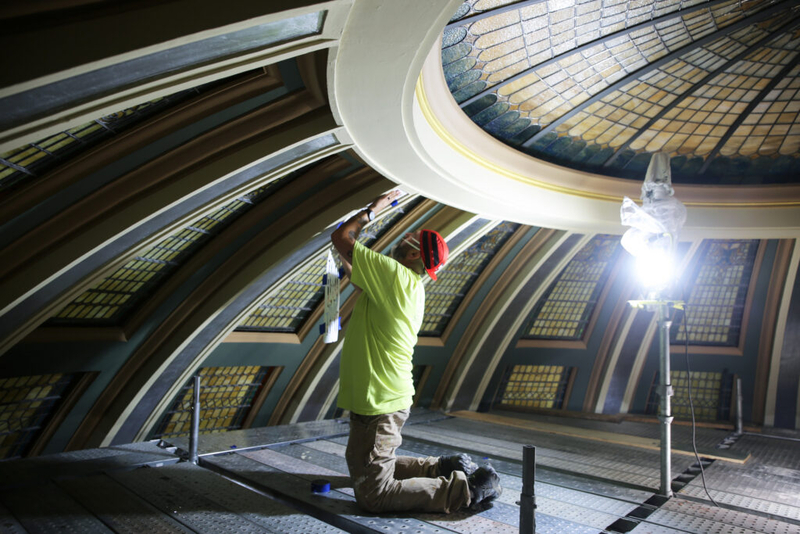
Restoration artist and foreman Philip Atilano, of Conrad Schmitt Studios, lines up a stencil at the apex of the dome of the South Dakota State Capitol building during restoration work on July 7, 2026. (Photo by Meghan O'Brien/South Dakota Searchlight)
Listen to an audio version of this story produced by reporter Meghan O’Brien. For broadcasters: See below for downloadable versions with host scripts.
PIERRE — While tour groups, state employees and lawmakers make their way around scaffolding on the second floor of the South Dakota Capitol building, artists including Philip Atilano climb around at nearly 100 feet above — painting, measuring and working to restore the rotunda and dome to its former beauty.
“It’s a humbling experience. It’s almost like we’re the next phase of history,” Atilano said.
But with years of experience under his belt as a professional restorer for Conrad Schmitt Studios in Wisconsin, Atilano said he’s not nervous or stressed about caring for such a historic structure.
“I look at it like we’re here because we should be here,” he said.
Plaster cracks, goose droppings, and an un-Flaming Fountain: the SD Capitol conundrum
Since 2019, South Dakota lawmakers have provided $13 million for Capitol projects including the dredging of Capitol Lake, repairs of cracking plaster, the ongoing paint restoration work, and the creation of a fund to save for a full restoration and renovation that could cost at least $150 million. That rough estimate came from the Bureau of Human Resources and Administration, which is responsible for maintaining the Capitol.
The last full restoration was conducted ahead of the 1989 state centennial, nearly 40 years ago. Construction of the Capitol was completed 116 years ago in 1910.
Recent cracking and damage to ceilings and walls pushed state officials to take a closer look at the building’s needs. That search revealed outdated utilities, like the building’s climate control system, said Leah Haugan, who oversees special projects for the bureau.
“If you go down in the basement, you’ll see that the utilities that run through the ceilings on the basement levels are the utilities that have been here since the beginning,” she said. “We just keep disconnecting those and adding more, so there’s a whole lot of things that need to be updated and repaired.”
That’s why some of the earliest work is in the rotunda, where there aren’t any utilities to repair before painting, Haugan said.
Current restoration work: Like ‘night and day’
Annually from January through March, the Capitol is buzzing with activity as state lawmakers debate policy, lobbyists linger in the halls and stakeholders testify on legislation. After the legislative session wraps, state employees, other elected officials and visitors still use the building on a daily basis.
That’s important to keep in mind for Darin Seeley, the commissioner of the bureau.
“It was designed, in many parts of the Capitol, for how work was done 120 years ago,” he said. “This is both a historic piece and an operating facility.”
Last year, heavy rains and leaks in the ceiling left plaster around galleries and chambers cracked and damaged. That and other aging plaster has since been repaired.
Wall paint, decorative details, and artwork have faded, and lighting has become less visually appealing over time, too. That’s where Atilano’s team comes in.
“It was so dark and dreary in here, initially, for a rotunda. It just didn’t scream ‘state Capitol’ as much as it will now,” Atilano said. “What we’re doing now, it’s going to blow people’s minds. I think people that were used to it before, now they’re going to see it, and I think it’s going to be night and day.”
The first phase of the current restoration work was to repair plaster. The second stage was restoring the painted details along the ceiling of some of the hallways throughout the building.
Now, Atilano’s team is painting the ornamental pieces that cap the columns — called capitals — in the rotunda. It’s a four-step process, said painter Alyssa Johnson: a base coat, followed by a gold coat of paint, staining, then 23-karat gold leaf on the tips of the capitals “for a little extra pizzazz and sparkle,” she said.
“The techniques haven’t really changed. We’re doing the same stuff that was done hundreds of years ago,” Johnson said while working on a platform in the rotunda. “This is like taking that tradition, and feeling like I’m part of this longer flow of art.”
This is Johnson’s first time working on a restoration project that isn’t a church, she said, but there are a lot of similar elements like stained glass, mural work, arches and other decorative elements. Usually, though, the churches are shut down during restorations.
“I’m working right at the level people are walking by, and I almost felt like a zoo animal a little bit, but it was fun,” she joked. “I’ve never had an audience like that before.”
Atilano has been working on the stenciling for painted details near the peak of the rotunda, 96 feet above the floor.
He and his crew have added paint that, from afar, appears to be petrified wood. Greens, browns and reds blend and swirl over columns along the upper rotunda to create the illusion for visitors below. He was also placing stencils that, when painted, will look more like plasterwork than paint.
“I think people are really going to be able to sit in the center of the rotunda, look up and see something that they never saw was here before,” Atilano said. “I think everything will be much more inviting, warm and welcoming.”
The third stage of restoration will bring legislators and members of the judicial and executive branches together to better understand the needs of each group. It’s a large undertaking, Seeley said.
“When you come at it and think about what needs to be done, it’s why the planning has to happen,” Seeley said, “why it’s so critical that we come at this with a full plan in mind, and not piecemealing the building and its renovation.”
The 1989 restoration, including Sharpies
During the restoration ahead of the 1989 statehood centennial, minimum-security inmates had a hand in some aspects of the project, Haugan said. It helped the state save on labor costs.
“They’re very talented artists that were there, and they came and they did beautiful work, and we don’t want to diminish the work that they did by re-restoring it,” she said. “We just would like it to be historically correct.”
For more information on the Capitol restoration project, check out the newest episode of Searchlight Report, a podcast from South Dakota Searchlight.
Johnson saw signs from that earlier work, including artwork stenciled using permanent markers.
“Nothing wrong with Sharpie,” Johnson said. “I just wouldn’t put it on a state Capitol building. “It seems a little bit irreverent, but it’s obviously held up well, because it’s as old as I am — that work was done about the same time I was born.”
She also found initials carved into a capital — an ornate piece at the top of a column — as she painted it.
“That’s kind of another tradition, is people either leaving little Easter eggs or initials or drawings, but in a spot where only another worker will ever see it,” she said.
Johnson plans to leave her mark with new layers of paint rather than a signature.
“Those things accumulate over time, and they just kind of add character,” she said. “It’s just part of its history now.”

Pierre, SD