FDA lowers orange juice sugar standard — officials say it will boost Florida citrus
Jul 17, 2026 | 6:32 pm ET
Description
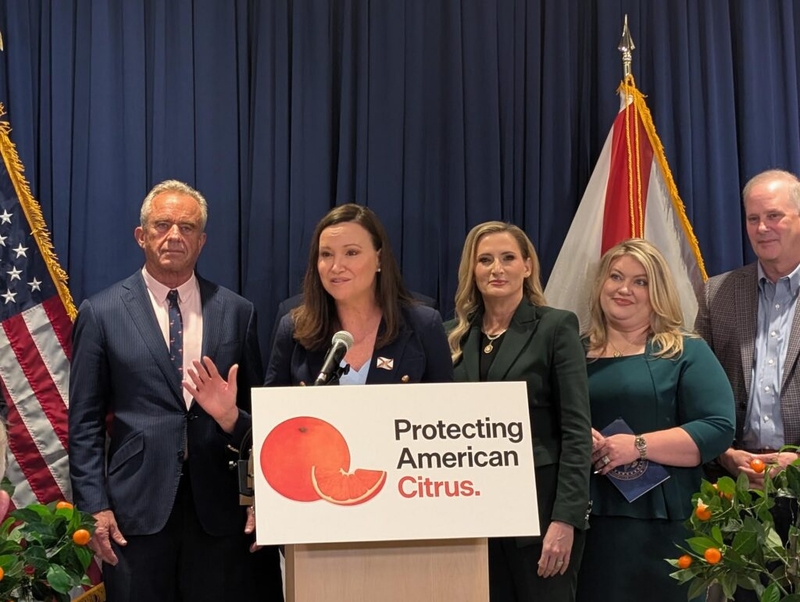
Florida Republican U.S. Sen. Ashley Moody speaking in Lakeland on July 17, 2026, with HHS Sec. Robert F. Kennedy (left) and U.S. Reps. Laurel Lee and Kat Cammack and Florida Agriculture Commissioner Wilton Simpson. (Photo by Mitch Perry/Florida Phoenix)
LAKELAND — Florida’s once thriving citrus industry has declined precipitously over the past two decades, but state agriculture officials believe the downward trajectory may have plateaued, and expressed enthusiasm Friday regarding a federal rule change they say will provide a much needed boost to the struggling sector.
U.S. Health & Human Services Secretary Robert F. Kennedy Jr. announced the change at Bonnet Springs Park in Lakeland. The Food and Drug Administration (FDA), he said, was lowering the federal standard for pasteurized orange juice, a change designed to give U.S. citrus growers and juice processors more flexibility after years of crop losses tied to disease and severe weather.
“This overdue reform will reduce our dependence on foreign imports, unleash American agriculture, and save the industry more than $50 million every year, ” Kennedy said.
The rule change would reduce the minimum soluble-solids requirement for pasteurized orange juice from 10.5% “Brix” to 10%. In orange juice, Brix is the scientific unit used to measure the percentage of soluble solids (primarily natural fruit sugars) relative to water.
Officials say the Brix level for Florida oranges has steadily declined over the past few decades due to severe weather and citrus greening (also Huanglongbing or HLB, another disease). That’s made it more challenging for citrus producers to meet that minimum standard.
“This commonsense change allows processors to rely more heavily on Florida-grown oranges, instead of being forced to blend with imported juice, simply to satisfy an outdated regulatory requirement,” said Jeb Smith, president of the Florida Farm Bureau.
The campaign to get the FDA to take action began with a citizen petition submitted by the Florida Citrus Processors Association and Florida Citrus Mutual in 2022. A year later, Central Florida GOP U.S. Rep. Scott Franklin and South Florida Democratic U.S. Rep. Debbie Wasserman Schultz introduced the Defending Domestic Orange Juice Production Act, which called for the rule change that went into effect Friday.
That measure was co-sponsored by every member of the Florida congressional delegation. Florida Republican U.S. Sens. Ashley Moody and Rick Scott sponsored the Senate version of the legislation last year and, last August, the FDA formally introduced the rule that was finalized Friday.
Officials maintain that the lower Brix threshold is unlikely to affect the taste of orange juice or substantially change its nutritional value.
Hurricanes, real estate development, and the disease known as citrus greening have contributed to a 95% citrus industry decline in Florida. According to the U.S. Department of Agriculture, Florida farmers produced nearly 300 million boxes of citrus in 2004. By 2025, harvests yielded about 14.5 million boxes.
Victory lap
Moody, on the ballot for the first time this fall as a senator, took a victory lap of sorts during the press conference.
“When Gov. DeSantis appointed me to the Senate seat, I said I’m going to go to Washington and fight for this state, and for our industries, and fight for our families, and take a machete to the administrative bureaucracy that is actually working against the prosperity of our families,” she said.
Also attending the press conference was Florida Agriculture Commissioner Wilton Simpson and U.S. Reps. Laurel Lee (the event took place in her congressional district) and Kat Cammack.
“This is the thing that we have needed to do,” said Cammack. “Stop importing Brazilian citrus. Put Florida farmers first.”
The July Florida orange production forecast released last week rose from 12.2 million boxes estimate in April to 12.92 million in July, a 5.9% increase.
While officials expressed optimistism about the industry’s future, the harsh reality of citrus greening hasn’t gone away, and it has led one of Florida’s largest citrus packinghouses to close its doors.
Riverfont Packing Co. in Indian River County, which has been around for 65 years, is shutting down, TCPalm.com reported this week.
“It’s heartbreaking news for me personally,” Dan Richey, the company’s CEO, told WTTB radio last week. “Our strategy did not work. The decline in our older trees was much faster than we anticipated. The rapid disease got us quicker than we thought.”
Jay Waagmeester contributed to this report.
Tallahassee, FL