Redistricting legislative seats mid-cycle not constitutional, legal analysts say
Jul 17, 2026 | 5:57 pm ET

Description
The dome of the Montana State Capitol pictured on March 28, 2026. (Jordan Hansen / Daily Montanan)
The Montana Constitution does not allow for the state to reconvene the commission to draw new legislative district between cycles, according to an analysis by the Legislative Legal Services Office.
In a memo provided to the State Administration and Veterans Affairs Interim Committee last week, legal analysts with the state said the constitution lays out how the redistricting commission is selected in the session preceding the decennial federal census, and dissolved after its work is done.
“Since the commission has been dissolved once it complied with that redistricting plan, and presented it, and it became law under those timelines, under the previous sections, we no longer have that commission, so it cannot be brought back,” said Legislative attotrney Andria Hardin.
The question about a mid-cycle redistricting arose during a May meeting of the committee, when Republican Rep. Lukas Schubert of Kalispell asked about its feasibility.
Schubert had asked the 2020 Districting and Apportionment Commission to appear before the committee to discuss eliminating districts favorable to Native American populations, following the Louisiana v. Callais decision before the U.S. Supreme Court that significantly limited majority-minority districts.
Shortly after that decision, two Republican state lawmakers, Rep. Braxton Mitchell of Kalispell and Rep. Terry Nelson of Stevensville, wrote a press release saying Montana should immediately get rid of “state legislative districts around Native American reservations that are blatantly gerrymandered.”
Their argument was that the redistricting commission, comprising two Democrats, two Republicans, and an independent commissioner selected by the state Supreme Court, drew maps favoring Democrats by “producing predetermined racial and political outcomes.”
As an example, they held up Senate District 8, which stretches from Browning, on the Blackfoot Reservation, to St. Ignatius on the Flathead Reservation.
“Does that genuinely keep communities of interest together? Senate District 16 is even worse: its lines create a bizarre muskrat-shaped district,” the release stated. “This is blatant gerrymandering, plain and simple.”
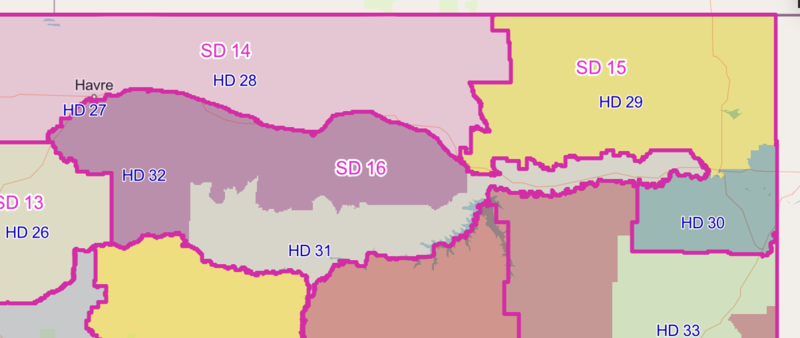
Both of those senate districts, the four corresponding house districts, are represented by members of the Montana American Indian Caucus, which counted 12 members during the 2025 session.
The Montana Legislature last session had 7.3% of all members listed as Native Americans, while the state as a whole is estimated to have a self-identified Native American population of around 6.4%. Another 4.8% of Montanans self-identify as two or more races, according to the latest census estimates.
During the state administration committee meeting, Schubert questioned the legal analysis, asking whether the constitution specifically forbade mid-cycle redistricting.
“The Constitution does not say that explicitly that this is the only process, or that there can be no redistricting outside of the once every 10 years,” he said.
Hardin said the memo had been drafted by an attorney with legislative services who has handled redistricting in the past, and that the “legal conclusion there” is that the way redistricting is laid out in the Constitution is “the only method for it.”
Helena, MT