Lawyers say immigration courts are a ‘deportation machine’ as detainees increasingly denied bond
Jul 14, 2026 | 7:01 am ET
Description
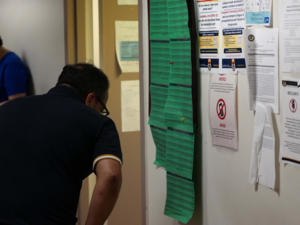
Judges overseeing immigration courts in places like Elizabeth are increasingly denying bond to nearly every detained immigrant who comes before them, part of the Trump administration’s mass deportation push. (Photo by Anne-Marie Caruso/New Jersey Monitor)
Federal judges are increasingly denying detained immigrants the chance to remain free as their cases wind through the court system, a pattern attorneys say has accelerated under the second Trump administration.
The judges are siding more and more with federal prosecutors who argue that immigrants facing deportation pose flight risks or lack legal standing to even receive a bond hearing. One immigration attorney characterized courts now as a “deportation machine.”
The shift has left migrants who entered the country without authorization languishing in detention centers with little practical recourse, even those with longstanding community ties, no criminal records, and pending applications for legal status.
“They have the right to get a fair bond in front of an impartial adjudicator. That does not happen anymore,” said Adriana Mitchell, a Philadelphia-based attorney who often appears in Elizabeth and Newark immigration courts.
Lawrence K. Le Roy, an immigration attorney based in Newark, said the courts have become a “horror show.”
“It’s going to take years to undo a lot of this,” he said.
Controversial NJ judge now overseeing immigration cases in Elizabeth
From the mid-1990s until 2025, undocumented immigrants detained by federal authorities, regardless of how they entered the country, were typically entitled to a bond hearing before an immigration judge who would weigh whether that person posed a flight risk or danger to the community. Judges had broad discretion, and U.S. Immigration and Customs Enforcement was able to set an initial bond, which at times would allow detainees to avoid a court appearance.
But that changed when the Trump administration shifted its interpretation of who is entitled to a bond hearing. A memo issued last year by the acting ICE chief directed immigration judges to stop holding bond hearings for people who “entered without inspection,” meaning they didn’t present themselves to a border official or pass through a designated port of entry.
And in September 2025, the Board of Immigration Appeals — an administrative court under the Department of Justice that is responsible for interpreting and applying immigration laws — made that shift official by ruling that if someone was not formally admitted or inspected by an immigration officer, immigration judges do not have the jurisdiction to consider or grant bond.
That ruling involved a Venezuelan man who crossed into the U.S. without authorization in 2022 and obtained Temporary Protected Status, but was detained after that status expired. The Board of Immigration Appeals affirmed that even if someone had lived in the U.S. for several years, they’re seen as an “applicant for admission” if they were never properly admitted or paroled.
Entry without inspection is one of the most common charges in ongoing immigration cases, according to the American Immigration Council, which found that in 2024, it was used in over 1 million of the 1.76 million immigration cases that year.
Some courts have struck down the no-bond policy as unconstitutional. On Monday, the U.S. 5th Circuit Court of Appeals, which oversees federal cases in Louisiana, Mississippi, and Texas, gave the Trump administration a temporary win on the issue as the full court prepares to hear a challenge to it (a three-judge 5th Circuit panel had previously ruled in favor of bond hearings).
Judge Cory T. Wilson, a member of the 5th Circuit who dissented from the earlier ruling, said immigrants who entered the U.S. illegally have only a limited ability to challenge their admission process on constitutional grounds and are not entitled to a bond hearing.
“Today’s decision deputizes every district court in our circuit to refashion the removal process as it sees fit, inviting even more chaos into our circuit’s overwhelmed immigration dockets,” Wilson, a Trump appointee, wrote in his dissent.
Democratic lawmakers have criticized the administration’s practice. U.S. Rep. Rob Menendez (D-08) said Democrats in Congress have little power over immigration judges as long as Republicans are in the majority.
“You see them stacking the immigration courts with people that understand the mission — the mission to deny people bond and to, frankly, limit any resemblance of due process,” he said.
During what’s known as “masters hearings” on a recent day in Elizabeth Immigration Court, nearly all detained immigrants appearing in 50 hearings over two days were denied bond. It didn’t matter whether someone had committed a crime, been in the country for decades, applied for asylum, or had sick family members.
In the only case where a man was permitted bond, his attorney argued there would be “significant hardship” if he were removed. The man, who lives in Morristown with his partner and child, had sole custody of his son because the child’s mother had psychiatric issues and subjected the son to domestic violence and sexual abuse, which stunted the child’s growth and left him non-verbal. The man had no criminal record and had lived in the U.S. since 2015, his attorney added.
In that case, Judge Tamar Wilson said the man’s “unusual hardship” met the necessary extenuating circumstances and set his bond at $5,000. She said his risk of flight was reduced because of the issues his son faces.
In another case that day, an attorney argued that her client should be released from detention at the Moshannon Valley Processing Center in Pennsylvania, where he has been held since his arrest after being pulled over for tinted windows on his car. She pointed to his connections to his church, letters from the community, a fixed address where he lives with his 13-year-old child, and his fears of returning to Mexico over harm that could be done to him. Officials with the U.S. Department of Homeland Security countered that the man had a “long history of ignoring the law,” noting his illegal entry in 1999 and failure to pay child support in 2013.
Wilson denied his bond, saying the man had never been harmed in Mexico and fear alone does not make someone eligible for asylum. He “made a life for himself” over 20 years, which makes him a flight risk that no amount of bond would mitigate, she said.
The standards that judges once used to assess a migrant’s flight risk may now be used against them, Le Roy said.
Le Roy said he had a recent client who was arrested outside a Home Depot by ICE. The man had no criminal record, was in the process of finalizing his legal status, had a U.S. citizen wife and two U.S.-born children. The judge denied him bond, finding him a flight risk.
“How do you get more substantial roots, community and residential ties, than a U.S. citizen wife, U.S. citizen children, and a house that he owns?” Le Roy said.
The judge’s stated reason, he said, was that his client had completed the first step of the green card application — the marriage petition — but hadn’t yet filed the second step, a waiver for unlawful presence, because he was still saving money to pay his previous attorney.
It’s a pattern Le Roy said he’s observed in Newark and Elizabeth immigration courts, but it isn’t unique to New Jersey. He also fights similar battles in immigration courts in Georgia, Louisiana, New Mexico, Texas, and Pennsylvania.
“It’s rampant. It’s endemic,” he said.
Le Roy has been an immigration attorney for 45 years. He said the recent changes have left him “worn out.”
“The volume, the frustration with getting results and having my hands tied constantly worse and worse, misapplication of laws, hidden agendas,” he said.
Trenton, NJ