State lawmakers urged to step up resistance to Trump’s detention and deportation tactics
Jul 14, 2026 | 7:00 am ET
Description
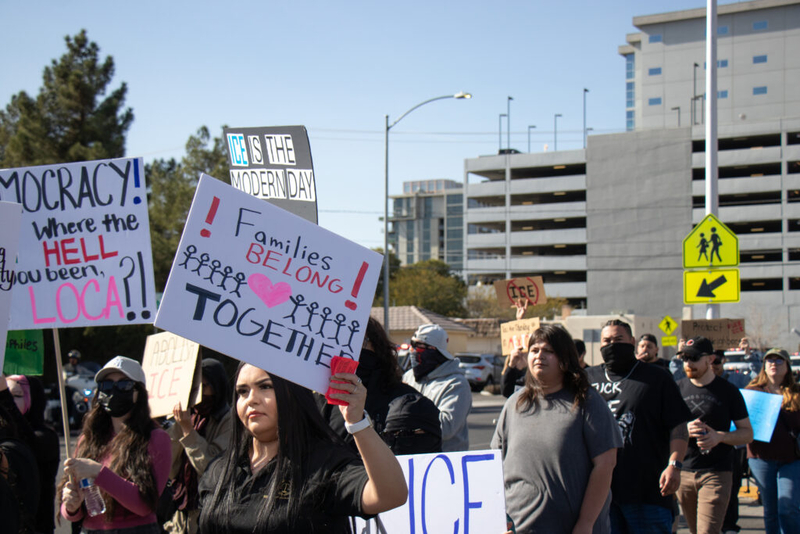
Protesting Trump's immigration detention and deportation policies in Las Vegas on Jan. 30, 2026. (Photo: Matthew Mondschein/Nevada Current)
Nevada lawmakers need to do more to protect sensitive locations like hospitals, courts, and schools from being targeted in federal immigration operations, civil rights attorneys and immigration groups say.
A surge in immigration enforcement and detention over the last 18 months in Nevada has left people afraid to leave their houses to attend church, receive medical care, or go to school, state lawmakers were told last week.
Efforts to rein in U.S. Immigration and Custom Enforcement at the federal level have largely failed under a Republican-controlled Congress.
The ACLU of Nevada, UNLV Immigration Clinic and Make the Road Nevada, all members of the Nevada Immigrant Coalition, addressed the interim Committee on Government Affairs last week about ways state lawmakers can respond to a rise in deportations and detentions.
“State and local governments … often say that it is a federal issue, and for the most part, that is true,” said Noé Orosco, a coordinator for the Nevada Immigrant Coalition. But “there are things that the state Legislature can influence in terms of the environment of the enforcement.”
Some recommendations presented include restricting local law enforcement’s ability to enter 287(g) detention agreements, increasing resources to legal counsel, ensuring places like medical facilities and schools are protected from enforcement without judicial warrants, and passing laws to prevent federal agents from wearing masks.
Democratic state Sen. Edgar Flores, who chairs the committee, said the committee is considering several bills addressing immigration based on recommendations from the community.
The committee is expected to vote in August on which proposals to submit as bill draft requests for the 2027 Legislation Session which starts Feb. 1.
During public comment prior to the coalition’s presentation, people detailed incidents of having loved ones disappear without warning after an arrest, being unable to locate family members in immigration detention, or struggling to obtain legal paperwork to be in compliance with immigration law. One woman said a mother of two died after being released from detention in the middle of the desert.
“Our neighbors and friends are afraid to take their children to school, to seek medical attention, to go to worship, or even to attend their routine immigration check-ins,” Orosco said, reiterating many of the stories told to lawmakers.
Aggressive enforcement and detention policies have not only violated civil liberties but shaken the community, said Athar Haseebullah, the executive director of the ACLU of Nevada.
“We’re talking about single moms who don’t know where their husbands ended up,” he said. “We’re talking about children who have called in to say that they don’t know where their parents are. We’ve we’re talking about people who are calling us from out of state to say that individuals have been transferred into ICE custody in Nevada. This is not a normal approach to law.”
The committee invited representatives from the Department of Homeland Security and CoreCivic, a private prison company that operates the Southern Nevada Detention Center.
Flores said they pulled out of the meeting last minute without an explanation.
Enforcement and incarceration representatives not being present “is concerning because they are operating within our jurisdiction,” Flores said during the hearing. “We cannot address issues and concerns if they don’t show up to a community forum and engage in meaningful dialogue with the objective of transparency.”
DHS officials, he added, are being asked to attend an August hearing.
“It is critical for this body to understand the impact of these decisions and this lawlessness that’s occurring, so that you can ask the right questions and run the right legislation you need to be effective policymakers,” Haseebullah said.
Immigration arrests have surged since 2025 under President Donald Trump.
Attorneys and community advocates are still assessing information about operations in Nevada and the extent state and local governments cooperate with ICE.
“The best place to get information on what those numbers look like is from law enforcement, because we don’t have access to that information unless we pay an exorbitant cost because of our public records laws,” Haseebullah said. “They don’t make those readily available to organizations like mine or to the rest of the public.”
In an effort to try and figure out the extent the Nevada Department of Motor Vehicles cooperates with ICE, the ACLU filed a lawsuit last August alleging the DMV heavily redacted, and delayed, records requested by the organization.
Haseebullah decried the fact that a state government agency had been allowed to withhold records and not face any type of punishment.
“My ask is that you expand the concept and the ability for organizations to bring litigation, so that we can hold these government institutions accountable regardless of who’s in charge,” Haseebullah said.
Lawmakers were also asked to examine local law enforcement participation in 287(g) policies.
The agreement allows police to issue civil immigration warrants and detain individuals up to 48 hours beyond their scheduled release so that federal agents may take them into custody.
“This body has never, not one time, provided legislative authorization for any local government or police department to enter into a 287(g) agreement,” Haseebullah said.
Ten states explicitly prohibit or limit 287(g) agreements, Orosco said, suggesting Nevada should be one of them.
Feds ‘rebelling against … constitutional order’
Haseebullah and Michael Kagan, director of the UNLV Immigration Clinic, also condemned federal immigration agencies’s refusal to cooperate with federal court orders.
A key component of President Donald Trump’s mass deportation policy has been the mandatory detention of undocumented residents.
U.S. District Judge Richard Boulware of Nevada struck down the policy in March, allowing detainees to petition the courts for bond hearings.
Earlier this month, Boulware said in two separate orders that the federal agency had defied the March court decisions, writing that “the government is rebelling against the basic principle underlying our constitutional order.” He ordered 17 people who filed lawsuits to be released from detention.
Federal agency disregard for court rulings is “an extremely disturbing situation that I frankly never thought I would see as an American attorney,” Kagan said.
DHS being in “open defiance” of a federal court was the “definition of a constitutional crisis,” Haseebullah said.
“The Department of Homeland Security will continue to faithfully implement the immigration laws passed by Congress,” the agency wrote in a statement to Nevada Current. “This legal position was the nail in the coffin for Biden’s catch and release policies. That is why the left and their activist proxies on the judiciary are resisting it so vigorously. President Trump and ([DHS] Secretary [Markwayne] Mullin are now enforcing the law as it was actually written to keep America safe.”
However, as Kagan noted, DHS did not appeal the court’s orders.
Though the state can’t dictate federal detention policies, there are ways lawmakers could solicit more oversight of facilities, said Christian Gonzalez Perez, the supervising attorney for Make the Road Nevada.
“In order for these detention centers to operate, they need to have a license from the state,” he said. “That’s one of the oversight powers that the Legislature can act on to have oversight” and exert some “authority over how these detention centers violate, abuse, or don’t have great conditions for people that are detained in the centers.”
Las Vegas, NV