Sharply differing views, but unanimous ruling in election residency case
Jul 14, 2026 | 12:06 am ET
Description
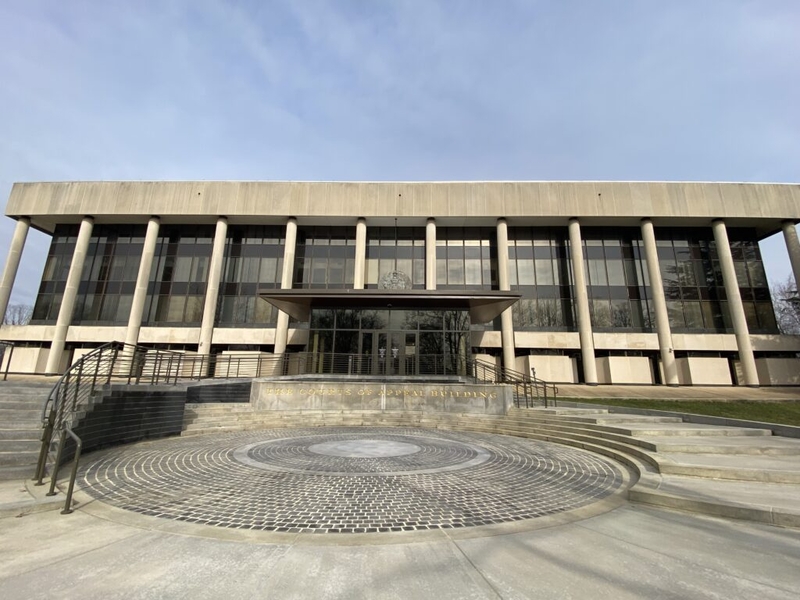
The Supreme Court of Maryland issued a unanimous opinion in a case involving the residency of John Dove Jr., who had filed to run for the House of Delegates but was later ruled ineligible. (File photo Bennett Leckrone/Maryland Matters)
Maryland’s highest court unanimously removed an Anne Arundel County candidate from the primary ballot, but an opinion published Monday shows division in how the court arrived at that decision.
Monday’s opinion explained the reasoning behind the court’s April decision that declared John Dove Jr. ineligible to run for House of Delegates District 12B. The majority, in its 40-page opinion, said Dove was ineligible because he misrepresented his address when he filed to run.
That “false statement about his residential address on his certificate of candidacy invalidated the certificate. ”
But Justice Peter Killough, in a five-page concurrence that walks a fine line with a dissent, disagreed with how the court arrived at its decision, and argued his colleagues punted on the most important question — when a candidate has to establish residency in a district.
“I write separately because the Court arrives there by finding a material misrepresentation the trial court refused to make, and by avoiding the question this case was brought before the Court to decide; namely, whether the constitutional residency requirement deadline was May 3, 2026,” Killough wrote.
Killough agreed Dove was ineligible to run, but disagreed with the majority’s “reasoning, and I would not have reached this result by the path the Court takes — if at all.”
Erek Barron, an attorney representing Dove, said he and his client “respect the court’s decision.” He said the two opinions issued by the court highlight “an important point: this case involved a difficult and unresolved election-law timing issue, not dishonesty.”
Justice Department threatens Maryland’s top election official with criminal charges
Dove, who had a home in Gambrills, changed his voter registration to a home owned by his father-in-law in Pasadena, where he filed to run in the Democratic primary against District 12B Del. Gary Simmons (D-Anne Arundel).
Simmons challenged Dove’s candidacy in court, claiming Dove failed to meet the residency requirement. Legislative candidates must live in a district for six months prior to an election: Simmons’ attorneys argued that the six-month clock was tied to the June 23 primary, while Dove’s attorneys said it was tied to the general election, giving Dove until May 3 to move into the district.
Dove, during a hearing in Anne Arundel Circuit Court, testified that he and his wife intended to renovate the Pasadena home and move in by the May deadline. But the circuit court determined that Pasadena was not his residence and ordered him off the ballot.
In her opinion for the court Monday, Justice Shirley M. Watts wrote that the majority reached “the same conclusion” as the circuit court when it determined the Pasadena address was not Dove’s residence.
“Regardless of whether one believes that it was too early to determine whether Mr. Dove met the constitutional requirements for office — which is a different issue than the question of whether Mr. Dove provided truthful information in completing the certificate of candidacy — the circuit court correctly determined that the Caldwell address [in Pasadena] was not Mr. Dove’s domicile, residence, or his place of abode, i.e., that Mr. Dove made a material misrepresentation on his certificate of candidacy,” Watts wrote.
Watts’ opinion focused on Dove’s representation that he lived at the Pasadena address when he had yet to move in.
“When a candidate makes a material misrepresentation on a certificate of candidacy, such as a misrepresentation about the candidate’s residential address, refusal of acceptance of the certificate is warranted and the candidate’s certificate of candidacy is not valid,” Watts wrote.
Watts said election law requires that, given “a choice between specifying the address that appears on the voter registration list or the candidate’s current address, the statute requires that the candidate accurately provide the individual’s current address.”
What Mr. Dove may have had wrong was the law: when he was obliged to be a District 12B resident. What he stated was the truth. The Court has converted a mistake about a legal deadline into a misstatement of fact, and a candidate’s accurate answer into a false one. A litigant who is wrong about the law is wrong. He is not a liar.
But Killough said Dove had made a “good faith” mistake about a legal deadline — a legal deadline the majority failed to address. Killough wrote that Dove erred in his interpretation of the law but was honest about where he lived.
“Rather than hold that Mr. Dove was mistaken about the deadline, it [the majority] held that he was false about his address. But the address was true,” Killough wrote, adding that registering to vote at the Pasadena address “allowed him to list it.”
“What Mr. Dove may have had wrong was the law: when he was obliged to be a District 12B resident. What he stated was the truth,” Killough wrote. “The Court has converted a mistake about a legal deadline into a misstatement of fact, and a candidate’s accurate answer into a false one. A litigant who is wrong about the law is wrong. He is not a liar.”
Barron on Monday reiterated that Dove thought the deadline to move was May 3.
“Justice Killough recognized that the trial court did not find bad faith, deception, or an intent to mislead, and that a mistake about a legal deadline does not make someone a liar,” Barron said in his text. “The majority resolved the case on narrower grounds and expressly avoided deciding whether residency must be perfected at filing or by the constitutional six-month deadline. That leaves an important question open for future candidates, election officials, courts, and voters.”
That’s a question Killough said the majority should have decided in this case.
“Residency challenges of this kind recur in every election cycle, and they evade review because the calendar overtakes them before this Court can rule,” he wrote. “The Court had the question squarely before it. It should have answered it.”
Robbie Leonard, an attorney who represented Simmons, wrote in an email Monday that the justices “didn’t decide the deadline question because they said they didn’t have to. Once they found misrepresentation on the certificate of candidacy, then they didn’t have to go further.”
“The Court found that Mr. Dove made a misrepresentation of his address when he filed his certificate of candidacy to run for office. I agree with the Court’s conclusion,” Leonard wrote. “The evidence at trial was clear that he simply used the address in an attempt to become eligible in a district where he didn’t live.”
Leonard also said that the majority decision “could open the door for a perjury charge and maybe the State’s Attorney for Anne Arundel County should read this opinion and consider that.”
Barron did not directly respond to questions about whether Dove might face a potential perjury investigation. He did say that the lack of a decision on when a candidate must establish residency leaves the issue for lawmakers — or a future court — to resolve.
“This dispute was ultimately about the timing and legal effect of residency under Maryland election law, issues of substantial public importance that may be better addressed by clear legislative guidance than by case-by-case adjudication under compressed election deadlines,” Barron wrote.
“The General Assembly may wish to clarify when residency must be established, what address information must be supplied during the filing process, and how election officials should address candidates who are in the process of moving before the constitutional deadline.”
Leonard said he expects more legal challenges in the future.
“Since the original ruling, many individuals have contacted me to look into the residence of several candidates and elected officials,” Leonard wrote. “This case is not a one-off. When people decide they want to run for office, they should read this opinion and get their houses in order.”
Annapolis, MD