Idaho’s transgender bathroom ban is now the law. How will police enforce it? That’s still unclear.
Jul 13, 2026 | 6:25 am ET
Description
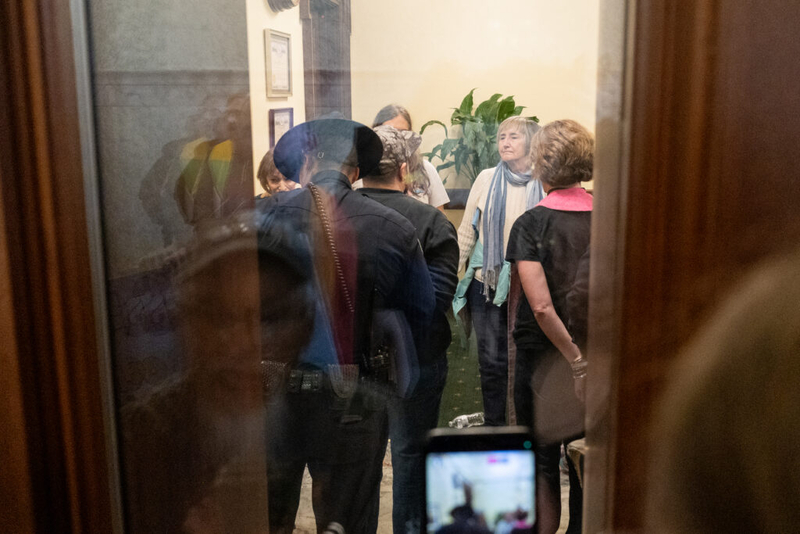
An Idaho State Police trooper handcuffs Nikson Mathews, a trans rights advocate, in the Idaho governor’s office during a sit-in protest after the governor signed the bathroom ban into law. To the right, the Rev. Sara LaWall is handcuffed on Wednesday, April 1, 2026. The protestors were arrested on trespassing charges. (Photo by Kyle Pfannenstiel/Idaho Capital Sun)
As parts of Idaho’s criminal transgender bathroom ban are now in effect, how far will law enforcement officers have to go to enforce the new law?
What if officers don’t believe a person’s gender markers on IDs?
Will they inspect people’s naked bodies to prove their biological sex? Do they need a warrant for that?
Will they use DNA testing to prove someone’s sex? At what point in an investigation under the law will that testing take place?
These questions echo concerns that high-ranking law enforcement officials shared with state lawmakers on the bill, which some said would be difficult to enforce and might require invasive methods. Now, more than a week into the law taking effect, some are confronting the realities of how they’d handle reports of the law being broken.
To respond to allegations that someone is breaking the law, Idaho Fraternal Order of Police President Bryan Lovell said, officers might start by asking people their gender directly, and seeing what’s on their ID cards.
What could happen after that could vary, he said.
“It’s going to depend on the circumstances as to how much more invasive that … may or may not need to be,” said Lovell, who stressed he couldn’t speak on behalf of law enforcement agencies or individual officers. “We don’t — we don’t have a test or a scanner or anything else that we can just go up to someone and you know take a picture and go, ‘Oh, this is your gender.’”
Canyon County Prosecuting Attorney Chris Boyd said he can see some challenges exist for law enforcement officers who are trying to enforce the law.
In some situations, he said there might be easy proof of someone’s biological sex, like through a person’s own admissions and “obvious” physical observations. But he acknowledged it might be more difficult in instances in which someone has undergone hormone treatments. He said officers might need a search warrant to inspect someone’s body.
“You would have to have some kind of procedure, and it’s an invasive procedure, so it would require potentially a search warrant, to observe someone physically underneath their clothes. That would be a very difficult, not impossible, but very difficult thing to do,” Boyd said.
Federal judge asks Idaho’s attorney about how the law’s enforcement would work
In a hearing for a lawsuit challenging the new law last month, a federal judge asked how the law would be enforced.
In his response, Idaho’s attorney put the onus on bathroom users, not law enforcement.
For a Boise family of medical providers, Idaho criminal trans bathroom ban was the last straw
“… The question here is only do I know which bathroom to go into, not what is hard for law enforcement to find out if I violated the law,” Idaho Solicitor General Michael Zarian told the judge.
After the hearing, ACLU of Idaho attorney Emily Croston told reporters that the state hadn’t clearly laid out how the law will be enforced.
“I don’t think the state has an answer for how you identify someone’s biological sex,” she said. “… Are we just going to look at folks as they enter a restroom and determine whether we think they look enough like a man or a woman? That’s ridiculous.”
Since then, the bathroom ban has gotten more complicated.
In response to the lawsuit, the judge’s partial block of the law allows trans people to use multi-user restrooms that align with their gender identity — if a single-user facility isn’t available nearby.
“It’s sort of a Band-Aid on a bullet hole-type situation,” said Scar Rulien, a board member for Trans Affirm, a nonprofit that published a list of safe bathrooms for transgender people in preparation for the law.
The injunction, he said, “is great, and it’ll definitely help a lot of people. But it’s not exactly the help that will be life-saving, or exactly the help that we need in this current moment.”
How the judge’s partial block complicates the law
The law, passed this year through House Bill 752, creates criminal charges for people who “knowingly and willfully” enter a bathroom or changing room designated for the opposite sex, with some exceptions. The law applies in government-owned buildings and places of public accommodations, like private businesses.
A first offense carries a misdemeanor, punishable by up to one year in prison. A second offense within five years is a felony, punishable by up to five years in prison.
The American Civil Liberties Union, which brought the lawsuit, says that Idaho’s bathroom ban is the only state ban that extends to private businesses — and that Idaho’s ban has the steepest penalties out of the three states that have criminal bathroom bans.
The judge’s partial block only affects the law’s application in bathrooms, not changing rooms.
The block allows transgender people to use single-user restrooms that align with their gender identity, or to use a multi-stall bathroom when a single-user facility isn’t available on the same floor.
To Rulien, the partial block raises more questions about how the law will be enforced: How do you enforce the law if a trans person uses a multi-occupancy restroom without knowing there’s a single-user restroom on the same floor?
“How are you going to prove that they didn’t know? How are you going to prove that the bathrooms weren’t in use? Are we really going to get down to the nitty gritty already? And you’re looking at cameras to figure this out?” he said.
For now, Rulien said he tells people to use gender-neutral restrooms for their safety “if they feel most comfortable with it.”
Why some law enforcement groups opposed the bill in the Legislature
Republican lawmakers who supported the bill argued it was needed to protect women and girls in private spaces. Some cited an instance at a YMCA in Sandpoint where a lifeguard reported that she found “a biological male using the women’s locker room facilities.” Local news outlets reported the person who entered the locker room is transgender.
“It prevents discomfort and voyeurism escalation and assaults, while preserving single-user options and narrow exceptions so no one is denied access for emergency aid,” the bill’s sponsor, Rep. Cornel Rasor, a Republican from Sagle, told lawmakers on the House floor earlier this year.
Rasor could not be immediately reached for comment on how the law will be enforced.
Some transgender people told lawmakers that the bill will force them to risk their safety by going into bathrooms with people that they don’t look like.
“Every single day when I’m out in public, I have to decide: Do I feel like going to jail today, or do I feel like being attacked?” Nikson Mathews, a trans man with a beard, told lawmakers earlier this year.
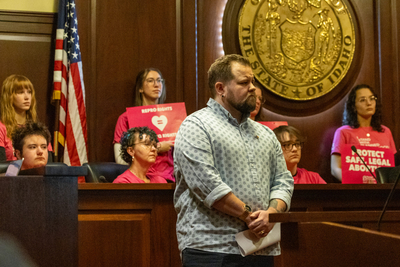
And some law enforcement groups, including the Idaho Fraternal Order of Police and the Idaho Chiefs of Police Association, said the bill would be difficult to enforce.
In a committee hearing in March, Moscow Police Chief Anthony Dahlinger, representing the police chiefs association, testified against the bill, saying it would place Idaho law enforcement in “impossible situations.”
“House Bill 752 would place an unrealistic and absurd burden on Idaho law enforcement officers to somehow know or be ready — be able to readily identify, visually, the biological sex of another human being,” Dahlinger testified.
Lawmakers didn’t amend the bill before passing it this year.
At that same legislative hearing, Rep. Chris Mathias, a Boise Democrat and former law enforcement officer, asked the first question.
“How does your prosecutor think that this crime is enforceable as a criminal penalty?”
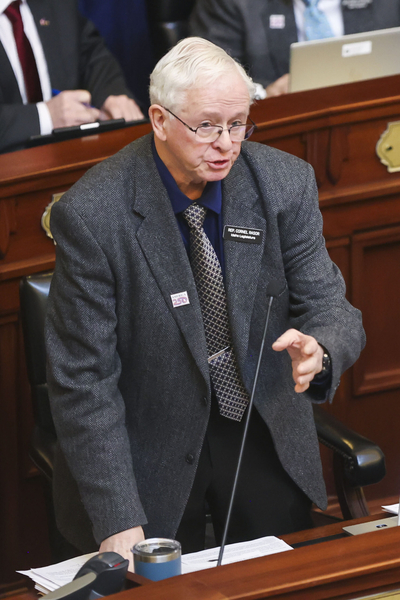
“He assured me,” Rasor replied, “that because of the knowing and willful phrase, it gives prosecutors an option to do this.”
Then Mathias asked how law enforcement would arrest people.
“How are they going to determine the sex of the individual? And how are they going to know that the person did it willfully?” he asked.
“That will, as I was explained to by my prosecuting attorney, that will occur during the arrest process, as the officer questions the suspect and works through the arresting procedure,” Rasor said. “I don’t have a specific answer. I’ve never been arrested.”
After Mathias pressed more on how officers would determine someone’s sex, Rasor said pieces of identification, like driver’s licenses, could work, along with law enforcement’s “questioning process.”
Months later, Mathias said he isn’t sure how the law will be enforced.
“There might be a good answer. I’m just saying, ‘I haven’t heard it yet,’” he said in an interview.
Reached early this month, Dahlinger, with the police chiefs association, said he wouldn’t comment on how the law would be enforced, because the law is being litigated in court.
Lovell, president of the Idaho Fraternal Order of Police, said in an interview last month that he doesn’t know how law enforcement officers determine people’s sex “without being invasive.” But he said if other crimes are at play, then the calls could be “handled in another way.”
Bracing for Idaho’s new ban, group maps safe bathrooms across the state for trans people
“If you’re dealing with a disturbance or someone intoxicated or trespassing or something, that may be the thing that fixes the problem ultimately, because we wouldn’t have a way to meet the elements of going into the wrong bathroom,” Lovell said.
But he said he doesn’t believe that using DNA tests to determine someone’s biological sex — a possibility, at some point, hinted at by the Attorney General’s Office in a court hearing — is a “practical solution.”
“I don’t know (if that’s) … an efficient or practical use of your law enforcement resources in that situation, when there’s probably other ways to mitigate that problem more efficiently and more effectively. Like, depending on what they’re doing, if it’s a trespass or a disturbance or other things,” Lovell said.
And he doubted that law enforcement officials would require people to undress.
“I don’t foresee that we could force somebody to physically show us that they are one gender or another without some sort of warrant or some sort of other exigent circumstance that I can’t think of right now, for this level of crime,” Lovell said.
Idaho Attorney General’s Office denies its attorney said law enforcement could use DNA testing to enforce the law
In a court hearing last month, the federal judge, Chief U.S. District Judge for the District of Idaho Amanda K. Brailsford, pressed the state’s attorneys about how the law would be enforced.
Repeatedly asked by the judge how enforcement would work, Zarian, the state’s solicitor general, suggested that enforcement would be easy “because there is DNA testing” to determine someone’s biological sex. Later, when pressed by the judge about whether trans people would need to consent to DNA testing, Zarian added that he doubted that people would be asked to undergo DNA testing on the spot.
Under Idaho law, DNA testing largely requires a warrant.
But the Attorney General’s Office now says that Zarian didn’t say that.
In a written statement, agency spokesperson Damon Sidur said that Zarian “never said that law enforcement would enforce the law through DNA testing.”
“In arguing that H.B. 752 is not unconstitutionally vague, the Solicitor General repeatedly explained that the question is not how law enforcement officers would determine a person’s sex during an encounter. The legal question is whether an ordinary person can know in advance what conduct the law prohibits and whether there are objective standards that prevent arbitrary convictions,” Sidur said. “He argued that there was no such risk because sex is an objective characteristic with definite boundaries.”
“He then explained that if someone who complied with the law were wrongly prosecuted, that person could conclusively rebut the prosecution’s case by presenting evidence of his or her sex, such as a driver’s license, an original birth certificate, or DNA evidence,” Sidur said. “Those were examples of evidence a defendant could present in court, not methods for enforcing the law.”
In his answer where he brought up DNA testing, Zarian did not clarify at which point in the investigative or prosecutorial process DNA testing could be used, according to a transcript obtained from the court.
Just before this exchange, the transcript shows that the judge explained how relying on ID cards would be tricky.
Earlier, Brailsford noted that most of the trans Idahoans who were suing over the law had ID cards that aligned with their gender identity. Before she posed another question about how the law would be enforced, she brought up a hypothetical: A law enforcement officer might not accept an ID that said someone was female if that person “appear(s) to have features of a man.”
Then, for a second time, she asked about how law enforcement would enforce the law.
“Like how do you unify the enforcement across the state?” Brailsford asked.
“Well, that will go to the initial determination that officers make. But when we talk about arbitrary enforcement, we need to know that the problem is: Is this in or out of proscribed conduct?” Zarian said.”And it would be easy, at some point in this process, to prove biological sex because there is DNA testing, for example. XX and XY will be able to decide who falls in which biological sex; or if as they presume biological sex means sex assigned at birth, at some point in the process you’ll be able to provide your original birth certificate and describe the sex assigned at birth, for example.”
The judge cited Zarian’s comments in her June 16 decision to partially block the law, writing that, “Defendants responded to this issue during oral arguments that law enforcement could use DNA testing to prove biological sex.”
Sidur, the Attorney General’s spokesperson, told the Sun in a statement that the Sun and the court’s opinion “mischaracterized the State’s position …”
The Attorney General’s Office did not agree to an interview, or provide answers to a list of questions about how enforcement of the law or DNA testing would work.
Boyd said in an interview that he could see DNA tests being needed at some point in certain situations, like when someone has had gender reassignment surgery. But he said the tests can cost around $3,000.
“You could see that it could be very costly and may make it difficult to enforce,” Boyd said in an interview last week. “I think anytime you ask officers to do search warrants, you’re asking them to do extra work for a misdemeanor.”
At the court hearing, Zarian said people in Idaho aren’t allowed to change their driver’s license to show something other than their biological sex. But he acknowledged that law enforcement could face some challenges.
“… There will be ways this could happen in certain circumstances where it’s difficult for an officer to tell, but that won’t always be the case,” he said, according to the transcript. “But still, knowing what is prohibited, we can connect those dots and what will actually end up being criminalized fairly simply.”
The law includes an exception for people in ‘dire need’ of using the bathroom. That’s ‘near impossible’ for law enforcement, official says.
Lovell said officers could respond to calls on this law like they do other laws: Determine whether to issue a citation or make a referral to a prosecutor for potential criminal charges. Boyd stressed that prosecutors wait for facts in a case to show up before “we make a judgement call.”
To respond to complaints made under the law, Lovell said officers would try to figure out what happened, including seeing whether any of the law’s exceptions apply, like for rendering medical aid, doing custodial services and more.
But at least one exception carved out in the law might further complicate enforcement: When someone is “in dire need of urinating or defecating and such facility is the only facility reasonably available at the time of the person’s use.”
That exception, Lovell said, is “near impossible for us.”
“We’re not going to be there when that happens. We’re going to be there after the fact,” he said. “And how do you go back and physically determine that that was the case at the time, given those circumstances and taking into consideration the location of other restrooms and things like that.”
That exception is also “a heavy factual lift” for prosecutors, Boyd said.
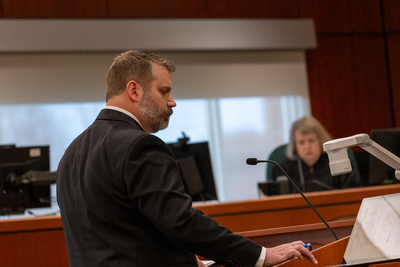
“The person would essentially assert that … as an affirmative defense. And then the prosecutor would need to prove beyond a reasonable doubt that they were not in dire need, which I couldn’t perceive being a very difficult thing to do as a prosecutor,” Boyd said.
But he said that exception is narrowed somewhat by language requiring that the facility they use in an instance of dire need being “the only facility reasonably available at the time of the person’s use.”
Lovell also worries that the bill’s exceptions could make it hard for law enforcement to catch people who intend to cause harm.
“If someone really intends to go in there and cause harm to someone, there’s exceptions there that I worry would make it so we wouldn’t have the ability to pursue that, unless there was some other circumstance that we were pursuing some other crime,” Lovell said.
Boise, ID