Missouri governor signs wide-ranging bipartisan healthcare bill into law
Jul 13, 2026 | 3:50 pm ET
Description
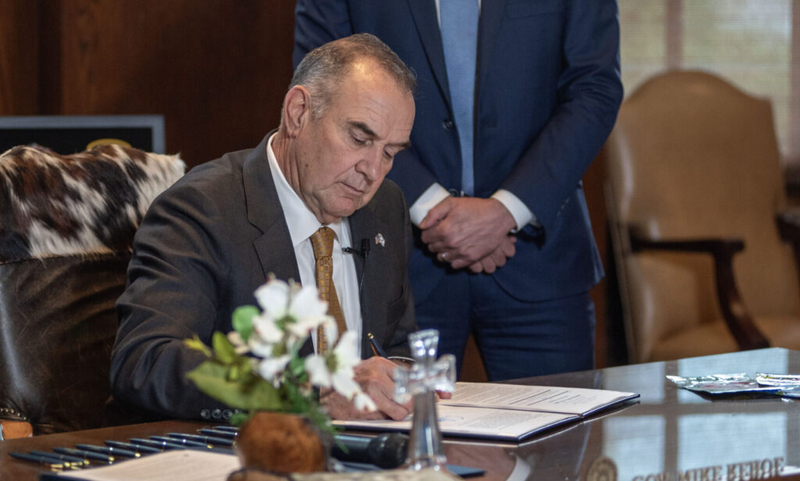
Gov. Mike Kehoe signs a bill on Thursday, April 23, 2026, in his office in Jefferson City (Annelise Hanshaw/Missouri Independent).
Pregnant women on Medicaid could see a doula more often and anyone using birth control could obtain a year’s supply of contraceptives under a bill that expands women’s and maternal health coverage signed into law Monday by Gov. Mike Kehoe.
The wide-ranging bill, which touches dozens of healthcare statutes and includes protections for nonprofit hospitals and children with severe allergies, was sponsored by Republican state Rep. Tara Peters of Rolla and state Sen. Mike Bernskoetter of Jefferson City.
The bill won final approval from a bipartisan group of lawmakers on the second-to-last day of the legislative session.
Kehoe hailed the legislation as a key to Missouri’s Rural Health Transformation Program, referring to the state’s part in the $50 billion federal program included in the One Big Beautiful Bill last summer.
In a press release, Kehoe said the measures would “protect our most vulnerable, hold insurance companies accountable and change the landscape of healthcare access and outcomes in communities across the state.”
Maternal and reproductive health
The new law includes a number of measures that a group of bipartisan lawmakers have been championing for the past few years.
This includes a provision that allows those with private insurance to pick up an annual supply of contraceptives rather than visiting a pharmacy every few months. Studies show this policy, which goes into effect Jan. 1, is already the law in a majority of states and leads to an increase in access and continuity of birth control use, which helps prevent unintended pregnancy.
Also beginning Jan. 1, insurance will be required to cover blood pressure monitoring equipment for those who are pregnant and up to 12 months postpartum as part of a widespread effort to address the state’s maternal mortality and morbidity rates. Cardiovascular disease, including hypertension, is among the leading causes of pregnancy-related underlying causes of deaths in Missouri, according to the Missouri Pregnancy-Associated Mortality Review Board.
Missouri governor signs bills creating armed school ‘rangers,’ high school sports appeals board
Doulas — professionals who advocate for the emotional and physical wellbeing of families during pregnancy and birth, but who do not deliver babies — are cited as part of the solution to Missouri’s poor maternal and infant birth outcomes. The new law expands doula services for low-income families enrolled in the state’s Medicaid program from six to 16 visits covering pregnancy, birth, postpartum and lactation support.
Also under the new law, those enrolled in Show-Me Healthy Babies, the state’s Medicaid program for pregnancy and postpartum, will now have access to free childbirth education classes.
The law broadens the scope of the state health department’s Pregnancy-Associated Mortality Review Board, which tracks maternal health outcomes. An amendment to the bill, filed by state Sen. Barbara Washington, a Kansas City Democrat, expands the board’s duties to include studying the state’s maternal healthcare deserts, tracking the level of prenatal and postnatal care given to women who die in childbirth or postpartum and making recommendations to combat racial inequities in maternal deaths.
On average, around 70 women die each year in Missouri during childbirth or in the first year postpartum. Of those deaths, 80% were deemed preventable by the state.
The new law also expands insurance coverage of contrast-enhanced mammograms for breast cancer screenings.
Healthcare access and affordability
Several provisions in the law aim to protect or increase healthcare access.
One provision bars insurance companies or their intermediaries from reimbursing hospitals at lower rates because they participate in the federal 340B program, which requires drug manufacturers to sell medications to nonprofit hospitals at a reduced rate.
Pharmacy benefit managers — middlemen that administer prescription drug plans for insurers — are among the entities prohibited from discriminating against 340 hospitals, including imposing extra fees or requiring them to undergo more extensive or frequent audits.
The Department of Commerce and Insurance can fine insurers or PBMs up to $5,000 per violation per day for breaking the law.
The bill also aims to increase access to telemedicine. Physicians will be able to use a patient questionnaire in place of an in-person evaluation to treat a patient, unless an in-person examination is necessary to meet the standard of care.
Another measure prohibits insurance companies from putting a time limit on their coverage of anesthesia during medical procedures, ensuring patients are covered for the full duration of surgeries.
Other measures ban hospitals from collecting on medical debts incurred while they were noncompliant with federal pricing transparency laws and require insurers to create web interfaces to streamline prior authorization of medications.
Tick-borne diseases
The Department of Health and Senior Services will be required to collect data on cases of Lyme disease and alpha-gal syndrome, a tick-borne allergy to mammal products, under the new law. Diagnostic testing labs and healthcare professionals will be required to report cases of the conditions to the department, which will submit annual reports to the U.S. Centers for Disease Control and Prevention.
The bill also establishes a fund to support research at public universities on diagnostics, therapies and treatments for Lyme disease, as well as preventative measures such as tick population control.
A 2023 CDC report placed Missouri in the center of the swath of the U.S. with the highest concentration of suspected cases of alpha-gal syndrome. There were more than 110,000 of those cases between 2010 and 2022, according to the report.
Children’s health
The bill aims to protect children with severe allergies by requiring licensed childcare providers to maintain allergy prevention and response policies.
And it allows schools to stock non-injectable “epinephrine delivery devices” like nasal sprays that school nurses can administer to students experiencing anaphylaxis. State law previously included only “auto-injector” syringes.
Another provision of the law aims to get timely medical examinations for children entering foster care. It requires an examination by a provider familiar with the effects of abuse and neglect on children within 72 hours and more thorough developmental, emotional and behavioral screenings within 30 days of entering care.

Jefferson City, MO