Childcare, education and children’s health are inseparable
Jul 10, 2026 | 5:55 am ET

Description
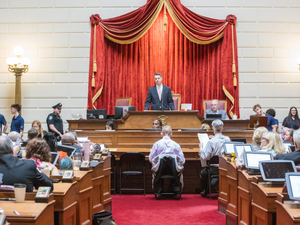
The state’s school clothing allowance application process did not open as expected on July 1, leaving families uncertain about basic school clothing. (Photo by Marcus Constantino for West Virginia Watch)
I write as one of West Virginia’s lost children: a child of poverty from North Central West Virginia who left my home among the hills to become a doctoral pediatric psychologist and graduate faculty member who supervised ten young doctors practicing in the United States and abroad.
After nearly 30 years of practice hundreds of miles from where I began, and as I move toward retirement, I believe I have earned the right to speak beyond the office, clinic, and examination room. I do not mean I have earned the right to speak carelessly. Decades of listening to children and families have made me more cautious about simple explanations.
I have never stopped carrying the children of West Virginia whose futures are narrowed by poverty, limited access, and public choices. Recent events should concern anyone who cares about children.
Childcare centers are closing. In Sissonville, one closure displaced 60 children and 12 staff. In Clay County, the only infant and toddler childcare center was reported to be closing.
The state’s school clothing allowance application process did not open as expected on July 1, leaving families uncertain about basic school clothing.
The House of Delegates spent $114,000 on a RAND study of West Virginia’s school-aid formula, a study that identified the need for more funding for highly qualified staff and children with special needs. Yet lawmakers did not implement its major recommendations. At the same time, the Hope Scholarship continues to expand, with more than 26,000 students applying for full funding and approximately $277 million appropriated for the program.
These are often discussed as separate policy issues. In the life of a child, they are not separate.
A child does not experience poverty, limited childcare, public-school strain, transportation barriers, Medicaid dependence, pediatric specialty scarcity, behavioral-health shortages, unstable housing, environmental exposure, clothing insecurity, and family stress as separate categories. They are the same crisis entering through different doors.
This is why education policy is pediatric policy. Healthcare access is pediatric policy. Childcare is pediatric policy. Public-school funding is pediatric policy. Behavioral-health access is pediatric policy.
The Hope Scholarship may benefit some children and families. That should be acknowledged. But statewide, many children live inside stacked barriers that make formal choice very different from usable opportunity. A family must be able to locate an appropriate school or provider, transport a child there, supplement services when needed, and navigate what happens when public-school protections and supports do not follow the child in the same way.
A voucher amount is not an individualized education program. A provider list is not access. A school-choice slogan is not a pediatric system of care.
This concern becomes more serious when school-choice politics are shaped by large outside spending. Recent reporting has described millions of dollars in outside political spending connected to West Virginia elections and school-choice advocacy. When child policy is heavily influenced by outside money, West Virginians should ask who benefits, who is accountable, and who manages the consequences.
This should not be reduced to a red-versus-blue argument. West Virginia’s children are not abstractions in a national political fight. They are children living in rural counties, families burdened by poverty and lack of childcare, underfunded classrooms, understaffed pediatric clinics, local churches, parents’ and grandparents’ homes, and family systems where policy decisions become developmental reality.
West Virginia has seen this pattern before: outside money arrives, value is extracted, and local communities are left to manage the consequences. Education, childcare, pediatric healthcare, and behavioral healthcare should not become another version of West Virginia’s long history of extraction.
When adults weaken the systems surrounding children and then blame children for the predictable developmental consequences, we mistake the symptom for the source.
To say this plainly is not to deny agency. Children are asked to learn, grow, try, repair, practice, and become. Families, educators, clinicians, and healthcare providers each carry real responsibility. But they should not be asked to compensate endlessly for social policy failures they did not create.
Public systems and political choices are responsible for building conditions adequate to children’s needs. Scores, diagnoses, enrollment counts, funding formulas, and school records can be useful, but they are not children. They must be interpreted within the developmental ecology that produced them.
It has been far more than coal, timber, gas, and income that have been extracted from West Virginia. Children’s futures have been, and continue to be, neglected and narrowed as well.
Our children and grandchildren should not be the place where social policy failures are deposited and named pathology.
Charleston, WV