Challenge unaccepted: The real reasons most state lawmakers are running unopposed
Jul 10, 2026 | 5:15 am ET
Description
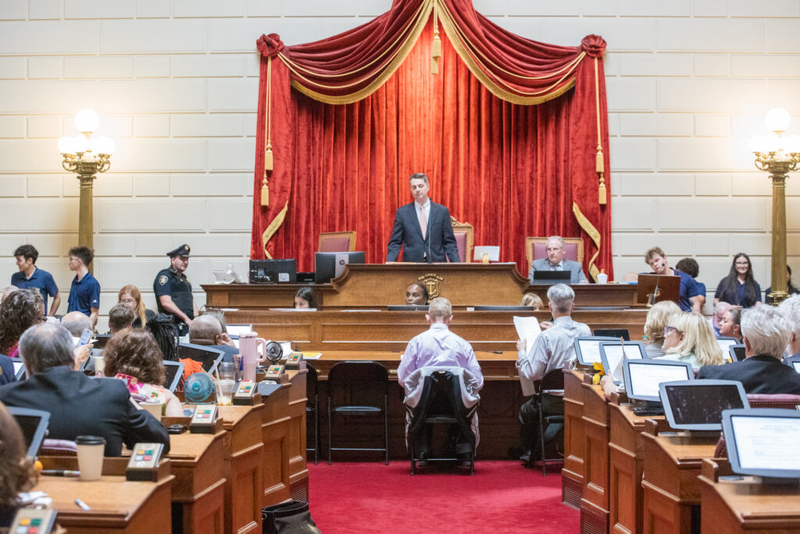
The Rhode Island House of Representatives debates the fiscal year 2027 state budget at the Rhode Island State House in Providence on Friday. June 5, 2026. (Photo by Alexander Castro/Rhode Island Current)
When Rhode Island’s candidate filing deadline passed last month, nearly two-thirds of incumbent state legislators had drawn no opponents. Of 75 House seats, only 32 face a contest; in the Senate, it’s just 13 of 38. This isn’t a fluke, and it isn’t just a Rhode Island story.
Ballotpedia’s national tracking found that 34.8% of state legislative incumbents nationally ran unopposed in the 2024 general election, in line with the 35% average since it began tracking in 2010. Rhode Island’s incumbent state lawmakers were unopposed at nearly double that rate — 64.1% in 2024 — a pattern that has held for most of the past decade, from a low of 20% in 2010 to 60% by 2014 and above 50% in most cycles since. Rhode Island isn’t experiencing a temporary lull in competition; it has among the least competitive state legislative elections in the country, year after year.
Declared safe: Most state lawmakers unopposed after filing deadline passes
Political scientists have studied the phenomenon of uncontested state legislative elections for decades, and their research points to a consistent culprit: the value of legislative seats. Peverill Squire’s landmark 2000 study of uncontested state legislative races found that legislative professionalism and compensation are the strongest predictors of competition nationwide — the more service in a state legislature resembles a real, well-compensated career, the more people fight for it. Rhode Island’s General Assembly sits near the bottom of the legislative professionalism scale. Lawmakers earn $20,922 a year for a demanding part-time job with minimal staff support. Anyone who wants to run for this job must first gather 50 to 100 signatures in about two weeks just to get on the ballot — never mind campaigning. Squire’s model would predict exactly what we see in Rhode Island.
Rhode Island’s one-party dominance compounds the problem. Democrats hold 98 of the General Assembly’s 113 seats to Republicans’ 14, and Ballotpedia’s 2024 data shows where this partisan imbalance matters: 69.2% of Rhode Island’s Democratic incumbents ran unopposed, versus 27.3% of Republicans. Squire’s research found that lopsided partisan environments discourage challengers from other parties. Rhode Island’s one-party dominance produces just that effect. Even our single-member districts and two-year terms — both linked to more competition in Squire’s data — aren’t enough to overcome it.
Uncontested seats don't just reflect weak electoral accountability — they may actively erode legislative effort.
Then, there’s redistricting. Common Cause Rhode Island’s John Marion points to gerrymandering as a driver of uncontested races, and he may well be right, but the research complicates an easy explanation. A 2009 study of state redistricting practices by Richard Forgette, Andrew Garner, and John Winkle found that independent redistricting commissions and requiring constituents to live as close to one another as possible, or “compactness,” had no significant effect on competition. What did work were rules requiring maps to respect existing jurisdictional subdivisions — i.e., city and town boundaries — and communities of interest. A 2012 study partly confirmed these findings. While dominant-party legislatures will gerrymander to preserve the dominant party’s electoral advantage, redistricting rules affirming jurisdictional boundaries can meaningfully mitigate that advantage.
Why should Rhode Island’s deviant rate of uncontested state legislative elections bother us beyond some abstract commitment to choice at the ballot box? Because uncontested state legislative elections appear to have consequences that outlast Election Day. A 2011 study found that legislators who win without serious opposition — especially those with a sustained history of it — miss more floor votes and introduce fewer bills than colleagues who had to fight for their seats. Uncontested seats don’t just reflect weak electoral accountability — they may actively erode legislative effort.
None of this means Rhode Island is doomed to a permanent uncontested-seat problem. Professionalizing the General Assembly would follow directly from Squire’s findings and make General Assembly seats worth contesting. Lowering the signature-gathering burden or extending the filing window would lower entry costs for candidates without existing political networks. On redistricting, the state constitution could be amended to add jurisdictional-subdivision and communities-of-interest requirements found to modestly increase competition, rather than relying on compactness alone. Given the impotence of Rhode Island’s Republican apparatus and how lopsidedly Democratic most General Assembly districts are, interest groups should focus their recruitment efforts on Democratic primary challengers, since Democratic primaries are where real electoral contests are still possible.
While uncontested state legislative elections might be dismissed as symptomatic of voter apathy, the data and the research suggest a more specific and more treatable diagnosis: seats that don’t pay enough, districts drawn to protect incumbents, and partisan imbalance. Rhode Island can’t legislate partisan balance in the General Assembly, but it can raise the value of serving in it, lower the costs of running for it, and rewrite its redistricting rules to foster party competitiveness. At the end of the day, the conditions underlying Rhode Island’s uncontested General Assembly races are choices, not laws of nature.
Providence, RI