How democratic socialist Melat Kiros stunned Colorado politics with congressional primary win
Jul 02, 2026 | 10:53 am ET
Description
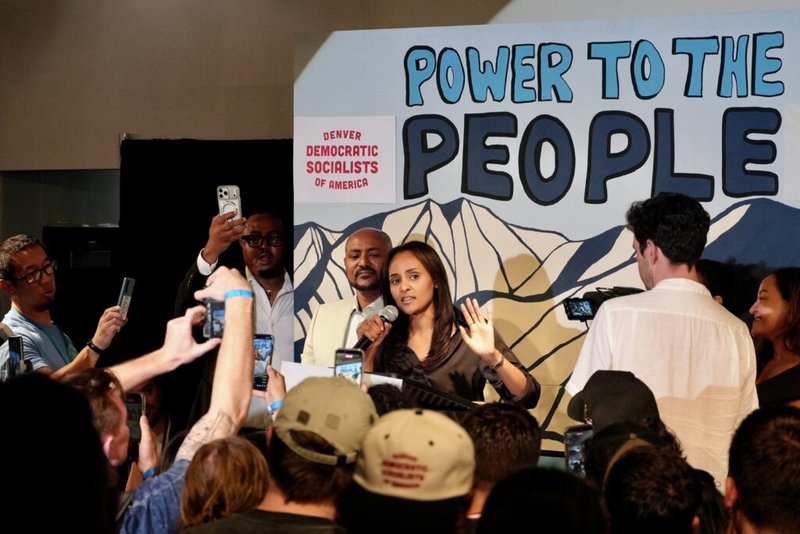
Melat Kiros, a democratic socialist and first-time candidate, speaks to supporters in Denver after unseating longtime Democratic Rep. Diana DeGette in Colorado's 1st Congressional District on June 30, 2026. (Photo by Chase Woodruff/Colorado Newsline)
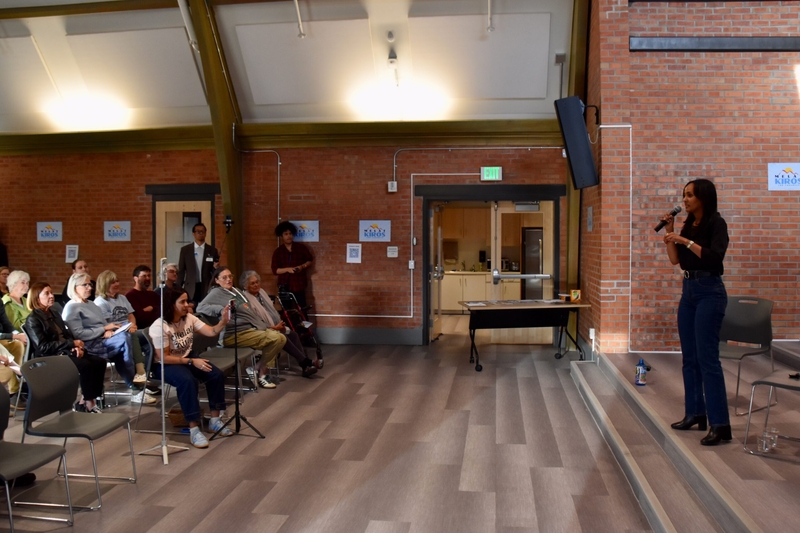
Only a few dozen people were on hand when Melat Kiros took the stage in a small auditorium in west Denver in mid-May to explain why she’d chosen to launch her long-shot campaign for Colorado’s 1st Congressional District.
After being fired from her job as a corporate attorney for writing an open letter supportive of student protests against Israel’s war in Gaza in late 2023, Kiros enrolled in a Ph.D. program in her hometown of Denver and tried to find a calling in public policy.
“I looked into healthcare, I looked into childcare, I looked into housing, I looked into social justice, I looked into climate,” she said. “Every single issue that I looked at, where we thought there was a problem that was persisting, we already figured out the solution a long time ago.”
“You solve homelessness by giving people housing, you solve hunger by giving people food, you solve healthcare by going to a single-payer system,” Kiros added. “We know these things already, and yet nothing changes, ever — and it’s because, despite the fact the vast majority of Americans agree on the solutions for all of these issues, there’s too much money in our politics.”
Six weeks later, a beaming Kiros celebrated a shock Democratic primary victory Tuesday over U.S. Rep. Diana DeGette, a 15-term incumbent who took office four months before Kiros was born, in front of hundreds of diehard supporters packed inside a disused Denver food hall. As the overwhelming favorite over Republican Christy Peterson in November’s general election, Kiros, 29, is set to be the first self-identified socialist and the first Black woman to be elected to Congress in Colorado history, and the second-youngest woman, after Rep. Alexandria Ocasio-Cortez in 2018, to be elected to Congress from any state.
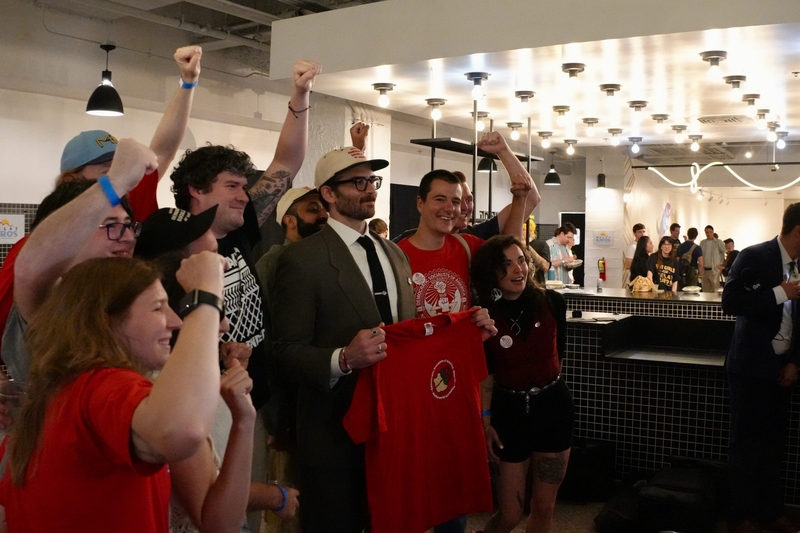
She spoke to an ecstatic crowd full of mostly younger Denverites with whom her strident critiques of the Democratic establishment had resonated, and who formed the highly motivated cadre of staff and volunteers that powered Kiros’ campaign, which said it knocked on over 115,000 doors in the frantic final weeks of the race.
“You are the proof,” Kiros said, “that the power of organized people beats the power of organized money.”
A political newcomer herself, Kiros drew in many young people into their first-ever campaign experience. When she took questions from the audience at her May town hall at Blossom House, an early childhood education center, two different attendees said they’d never attended a political event before.
A third was a high school student who asked a question about the Supreme Court’s decision in Citizens United v. FEC, which he’d learned about in AP U.S. History this year. At a different event, a Newsline reporter overheard a Kiros supporter tell a friend: “G-O-T-V. I now know what it means. Get out the vote.”
Along with many first-timers, Kiros’ extensive grassroots operation relied on local organizing networks established by groups like the Denver chapter of the Democratic Socialists of America, which has now notched by far its biggest electoral victory to date after years of downballot wins in state legislative and city council races. National support from Justice Democrats, a group that has backed left-wing primary challengers to several of the party’s incumbent members of Congress this year, also played a crucial role, as did a well-timed endorsement from U.S. Sen. Bernie Sanders.
“This took a village, it took a full team,” Rebecca Oliver, Kiros’ campaign manager, told the crowd from the stage on election night. “It took every single one of you in this room, and so far beyond it.”
Roddy Salimi, a 25-year-old Iranian-American who worked for Kiros’ campaign, was still in high school when he began volunteering for Democrats in Virginia, where he grew up, and later worked full-time to help elect Democrats in the 2020 election. But he grew disillusioned with the party as it failed to enact lasting, meaningful expansions to social programs under President Joe Biden’s administration, and as Biden and many congressional Democrats largely stood by Israel as it escalated a military operation in Gaza that U.N. bodies and human rights groups say amounts to a genocide.
“Last year, my home country of Iran was attacked by the very nation that funded that (2020) campaign, using weapons the representative I interned for voted to send,” Salimi said while introducing Kiros at her May town hall, referring to campaign contributions by the American Israel Public Affairs Committee. “I felt betrayed.”
As it has for similar insurgent Democratic campaigns across the country, the war in Gaza proved an important catalyst for Kiros’ early support, especially given the circumstances of her firing from the New York office of the law firm Sidley Austin. Her termination, which came after she published a letter defending campus protests against Israel, including those raising “the geopolitical question of Israel’s legitimacy,” from charges of antisemitism, was criticized by prominent free-speech advocates at the time.
In March of this year, video of a confrontation between DeGette and an activist from the Sunrise Movement, a left-wing youth group that endorsed Kiros, over the issue of legislation banning weapons sales to Israel, also helped raise the profile of her primary challenge.
“If the only issue that you care about is this issue,” DeGette told the activist, “then you should not vote for me.”

Kiros and her supporters, however, also framed the issue of the war in Gaza as one part of a broader critique of the pernicious influence of campaign spending by corporations and the rich.
“When you follow the money and influence in politics, you don’t end up on the doorsteps of working families, but the offices of lobbyists, with one goal in mind,” Salimi told the town hall crowd. “Ensuring their investment pays off on the House floor.”
PACs and attacks
As enthusiasm for her campaign grew, Kiros raised more from individual donors — about $641,000 as of June 10 — than the $593,558 DeGette had raised from individuals in the entire election cycle. But DeGette maintained a major financial edge over Kiros by collecting another $846,750 from a variety of political action committees associated with corporations, trade associations and liberal advocacy groups.
How mysterious super PACs and ‘redboxing’ are influencing Colorado’s Democratic primaries
DeGette, who has long been the most left-leaning member of Colorado’s congressional delegation, sought to blunt Kiros’ momentum by brandishing her own progressive bona fides, like support for a single-payer Medicare for All system.
But her continued acceptance of corporate PAC money — which set her apart from a growing number of Democrats of all ideological stripes, including most other members of Colorado’s Democratic congressional delegation, who have sworn off such contributions — handed Kiros a potent line of attack.
“We cannot trust members of Congress who are also taking money from Big Pharma or big health insurance to forcefully fight for things like Medicare for All,” Kiros said during a June 19 candidate forum alongside DeGette and a third 1st District candidate, University of Colorado Regent Wanda James.
“Nobody ever gave me a contribution and got anything in advance for that, and if people think that they can buy my vote by making a contribution, they are sorely, sorely mistaken,” DeGette said in reply. “I am not bought and I am not sold.”
DeGette also received millions of dollars in support from three super PACs: Pro-Choice Majority Action and Project 218, which have spent on behalf of other incumbent or moderate candidates in other Democratic House primaries across the country, and the Mile High Accountability Project, a newly registered group.
Many of those groups’ donors won’t be disclosed until the next Federal Election Commission reporting deadline in mid-July. Pro-Choice Majority Action is affiliated with the EDW Action Fund, another federal super PAC that has in turn received funding from United Democracy Project, a super PAC launched in 2022 by AIPAC.

DeGette and her allies faulted Kiros for her “extreme” views, criticizing her association with groups like the DSA and leftist figures like streamer Hasan Piker. After Kiros’ appearance on Piker’s stream in May, during which she called the Oct. 7 attacks by Hamas on Israel “an inevitable consequence of apartheid,” DeGette’s campaign ran ads featuring an unsigned blog post that described her comments as “rationaliz(ing) killing Jews.”
In an interview ahead of Election Day, Kiros said seeing that political attack “was the toughest day I’ve had on the campaign.” But she and her supporters believe that much of the negative advertising targeting her may have backfired.
“I’ve been really encouraged by the responses we’ve gotten from voters,” she added. “Even from people who are telling us they’re DeGette supporters, that are just like, ‘It’s a horrific ad, and it’s really gross and unfair.’ I think it says a lot more about her and her campaign than anything else.”
An anti-Kiros mailer featuring the candidate’s face crudely photoshopped onto a spacewalking astronaut — a reference to her “out there” views — was gleefully co-opted by her campaign, with a cardboard cutout of a space-suited Kiros making appearances alongside her as she marched in the Denver Pride Parade and at her election night watch party.
This is a young, progressive city, and unfortunately representation hasn’t caught up with that.
Kiros canvassers feared that the negative ads resonating the most with some 1st District voters were those that described her as having “moved to Denver last year” — a misleading claim, given that she was raised in Denver after immigrating to the U.S. from Ethiopia at 11 months old, and one her supporters said reeked of xenophobia. But for many other voters, especially the young, diverse renters and transplants who made up some of Kiros’ strongest bases of support, those attacks may have fallen flat.
“This is a young, progressive city, and unfortunately representation hasn’t caught up with that,” Salimi said in an interview. “There’s plenty of native Coloradans on this campaign, but I moved here two years ago. This whole city’s made up of people that weren’t originally from here.”
A generational rupture
The June 19 candidate forum held at the Denver Press Club was one of only two face-to-face meetings between the candidates during the primary campaign. About 45 minutes ahead of the event, an organizer politely held up a hand to several people walking towards the stairs up to the event space, telling them only candidates were allowed.
“I am a candidate,” replied DeGette, who has represented Denver in Congress for three decades.
DeGette’s relative anonymity in the Mile High City, especially among young people, and her perceived lack of effectiveness in Washington provided another major opening for an energized opposition campaign.
Under different circumstances, Kiros’ ascension to the 1st District seat might not have been felt as such a seismic development in Colorado politics. She is, after all, set to become the third consecutive left-leaning young woman with a law degree to win election to Congress from Denver, extending a 54-year streak that began with the 1972 election of DeGette’s predecessor, Pat Schroeder, at the age of 32.
But the Democratic Party finds itself in a much more unsettled state today than 30 years ago, when DeGette, then 38 and a two-term veteran of the state House of Representatives, won the primary for the seat Schroeder was vacating after 12 terms. It was an orderly transition from one generation to the next, and observers noted a sense of continuity: The Denver Post even wrote at the time that DeGette “sounds like the political reincarnation of Schroeder.”

Despite the overlap in their policy platforms and professional backgrounds, few such parallels are likely to be drawn between DeGette and Kiros today. DeGette’s career will end not with a retirement, offering Democratic insiders — among them the dozens of state and local politicians who may have eyed her seat in recent years — the chance to elevate a successor, but with a shocking loss to a political newcomer who worked most recently as a barista.
“If I just wanted to run for the sake of running,” Kiros said earlier in June, “I would not have made my first run against the 30-year incumbent who is backed by all of these massive industries that can just pour a million dollars into a race in a matter of two days.”
“Frankly, this was not the way I would have wanted to end my career in politics,” DeGette acknowledged in a statement conceding the race Wednesday. “I strive every day to be the quintessential legislator, passing bills of my own design and collaborating with colleagues on both sides of the aisle to make a better society for all Americans. Sadly, in our toxic political climate, there seems to be little room for that type of politician anymore.”
Though they wouldn’t describe themselves as “toxic,” Kiros and other left-wing Democratic challengers across the country don’t deny that they seek a radical break with the way the party has done business during DeGette’s career.
“We’re demanding a new kind of politics,” Kiros told Newsline. “Not just for the sake of it, but because that’s the only way you can actually have a functioning democracy.”
As the 2026 midterms approached, polls showed growing dissatisfaction among rank-and-file Colorado Democrats with the party’s direction and leadership. Two-thirds of Denver Democrats and two-thirds of all Denverites under age 35 hold a favorable view of socialism, as do half of the city’s unaffiliated voters, according to an August 2025 survey by the Colorado Polling Institute.
Sharp commentary during this primary season on the causes of this discontent came not only from Kiros and other progressive insurgents, but from no less an establishment figure than U.S. Sen. Michael Bennet, who sounded the alarm on a generation-defining affordability crisis unfolding in Colorado even as he failed to convince Democratic voters to nominate him for governor to fix it.
“People my kids’ age hate the parties,” Bennet said during a June 4 debate. “They don’t believe that they’re standing for them.”
During an earlier forum on housing policy alongside Attorney General Phil Weiser, Bennet inveighed against state and federal policy interventions that have enriched some people but “made it impossible for young people and working people” to buy homes over the last 10 to 15 years.
“The reality is that people of my generation, and Phil’s generation, have benefited from a ridiculous increase in our asset prices, and we have rolled up the carpet on everybody else,” Bennet said. “You see the massive intervention … to inflate the stock market, to inflate the assets of people living in the wealthiest neighborhoods, in the largest houses in Colorado — very clearly to the detriment of the people who work in our restaurants, who work in our schools, who serve in our police department and our firefighters.”
Building a coalition
Months before they canvassed Denver neighborhoods in the run-up to Election Day, the first task many Kiros volunteers were given was to collect petition signatures to secure her spot on the June primary ballot.
They ended up not needing them. Nine days before the start of Democrats’ caucus and assembly process in March, the Kiros team switched gears and sought to qualify for the ballot through that route instead.
“It was a last-minute decision, but we managed to organize because we cared,” Kiros said. “We had all these volunteers that were invested, and we were invested, and we wanted to make our case.”
“We're demanding a new kind of politics ... because that's the only way you can actually have a functioning democracy.
Kiros dominated the assembly process and took the top spot on the ballot with 67% of the party delegate vote, while DeGette earned 32.8%, only a few points clear of missing the ballot completely. The unexpected result — DeGette’s first-ever defeat at a party assembly — drove another major surge in interest to Kiros’ campaign. After the race was called in her favor on election night, Kiros told Newsline that the assembly result was the moment she began to believe a historic primary upset was possible.
“It just became very clear that she wasn’t taking it seriously,” Kiros said. “(With) somebody who’s asleep at the wheel at a moment like this, when the frustration for voters of this party is so palpable, it felt like we might be able to pull it off.”
Still, a poll in March by Justice Democrats had found Kiros starting at just 7% support among likely primary voters. In the campaign’s tense final weeks, DeGette continued to project confidence as millions of dollars in outside spending arrived to help her. Sanders’ endorsement, along with major upset victories for DSA-aligned candidates in New York on June 23, added to Kiros’ momentum, but she also faced criticism for an interview in which she declined to call the June 2025 firebombing attack in Boulder an act of antisemitism.
A rally Kiros had planned with Piker on June 14 was called off after several Denver-area venues refused to host the event. He returned to Denver on election night and spent the evening greeting fans at the Kiros watch party, livestreaming the event to tens of thousands of viewers.
Many observers expected the race to be decided by slim margins. Some Kiros supporters were more confident than others. Late on election night, after her victory speech, Salimi called the campaign a “slow burn” and admitted he’d struggled to believe that a win was really possible.
“Honestly, going into tonight, when the 7 p.m. ballots dropped, I thought we were going to be down by like 8 or 9 (percentage points),” he said.

In fact, shortly after polls closed, the race was all but over: Kiros held a 2-point lead over DeGette in the first batch of just under 97,000 ballots, and Denver election results almost invariably shift towards more progressive candidates as later-arriving ballots from younger voters are added to the count.
Though it took several more hours for most media outlets to officially project Kiros as the race winner, the mood at her watch party turned jubilant after the first ballot drop and stayed that way until she addressed the crowd shortly after 10 p.m. As of Wednesday evening, more than 153,000 votes had been counted, and Kiros’ lead had increased to over 13 points.
For all the focus on the youth vote, the early results suggested a relatively strong performance by Kiros among the older and less ideologically aligned voters who might otherwise have come to DeGette’s rescue.
“Some of our most enthusiastic supporters are older voters who’ve been protesting since, like, Vietnam,” Kiros said. “They have been calling out these problems for a really long time, and are begging the party to pass the torch.”
Riding high from the convincing win, talk among Kiros’ inner circle of supporters turned to other races up and down the ballot that their insurgent left-wing movement could target next. Chris Rabb, a Pennsylvania state lawmaker and democratic socialist poised to become the next member of Congress from his state’s Philadelphia-centered 3rd District, joined the party and introduced Kiros’ victory speech.
“I came out here because I believe in this sister, because I know that you believe in her too,” Rabb said. “This is all of our success. This is our collective victory.”
In the wake of other wins for DSA-endorsed congressional candidates in New York a week earlier, spurred on by endorsements from socialist Mayor Zohran Mamdani, Colorado’s left will aim to build on the momentum of Kiros’ victory with a political machine of its own. The midterm elections loom in November, to be followed by a Denver municipal election in 2027 and the high-stakes battle over the Democrats’ 2028 presidential nominee.
“At the end of the day, this was never about just one campaign,” Kiros told Newsline. “This is about building a coalition in Congress and all different levels of office here in Colorado, making sure that we are combating the dark money and the corporate money that’s been pouring into our races.”
“We just proved that if you organize the people, you can beat the organized money,” she added. “And we’re going to replicate it in races all across the state.”
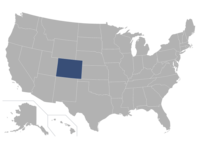
Denver, CO