As America marks 250 years, Iowans highlight an inclusive view of history
Jul 02, 2026 | 3:18 pm ET
Description
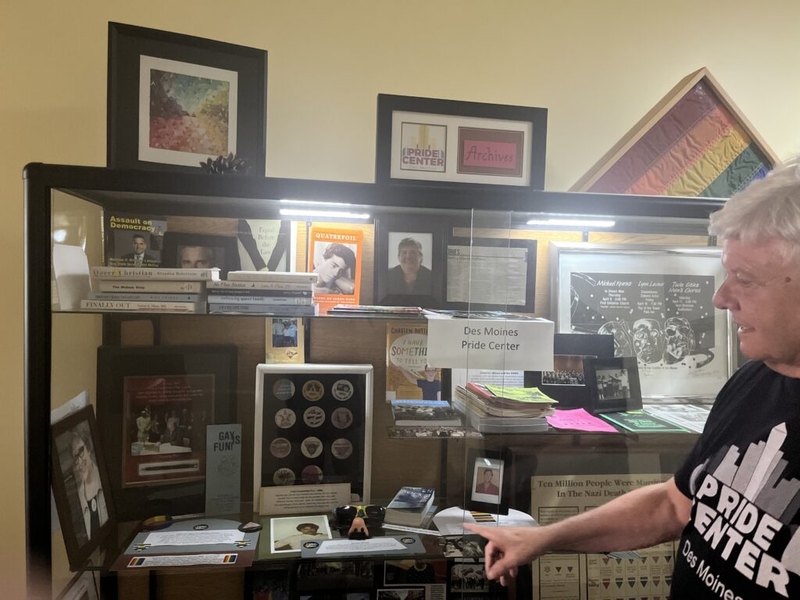
Rick Miller, a Pride Center board member and in-house archivist, shows off display of LGBTQIA+ artifacts, including various books, activist memorabilia and posters from past AIDS benefits at the Pride Center in Des Moines on June 29, 2026. (Photo by Kadin Luhmann/Iowa Capital Dispatch)
As Americans celebrate U.S.’s 250th anniversary, Iowa museums, archives and community organizations are working to ensure that the stories of historically underrepresented communities are being remembered.
The Pride Center in Des Moines, the Meskwaki Nation in Tama and the African American Museum of Iowa in Cedar Rapids are among organizations highlighting their communities’ contributions to history in Iowa and the country.
Des Moines Pride Center
Tucked away in the Mickle Center in Des Moines, the Pride Center includes a library and exhibits regarding LGBTQIA+ history in Iowa and across the U.S.
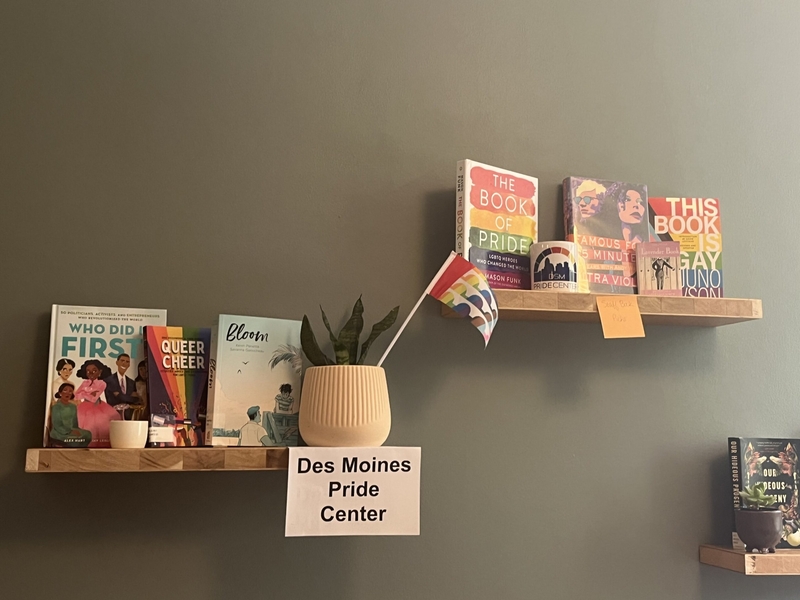
At the Pride Center, the Rick Miller LGBTQIA+ Library is filled with shelves of nonfiction, fiction, children’s and “banned” books, free for people to check out.
The facility also features an exhibit, preserving activist memorabilia, banners from the first LGBTQIA+ march in 1978 and posters from past AIDS benefits.
“We really wanted to encapsulate the broadness of what LGBTQ archives and library spaces mean, and a lot of that was inclusivity and also the ability to recognize that we don’t really have any spaces that are centered around something like this,” Sarah High, board president at the Pride Center, said. “We want the ability to have space, hold space and get more people in our space.”
Rick Miller, Pride Center board member and archivist, said preserving LGBTQIA+ history ensures that future generations understand not only the community’s accomplishments, but their current and past struggles.
“Any kind of group or minority that doesn’t have a history really doesn’t exist,” Miller said. “If we can’t preserve it now, future LGBTQIA+ people won’t know what they can be proud of.”
LGBTQIA+ history is especially significant in Iowa, as it was the third state to legalize same-sex marriage in 2009 after the state Supreme Court unanimously ruled that denying marriage licenses to same-sex couples was unconstitutional. The decision set the precedent for other states to follow in subsequent years.
“We were the third state in the nation to get marriage equality, and what people don’t really know is because of the way it was handled at the Iowa Supreme Court,” Miller said. “It became the template for other district courts. Suddenly, there were 35 states following Iowa.”
Miller pointed to singer and anti-gay activist Anita Bryant’s 1977 visit to Des Moines as a monumental moment in LGBTQIA+ history. She drew protesters, with one demonstrator from Minnesota threw a pie in her face.
“She comes to Des Moines and she’s going to have a big news thing, in which she doesn’t ‘hate the homosexual, she just wants them to be quiet,’” Miller said. “A guy from St. Paul threw a pie in her face. Des Moines was on the international (news). That caused all these organizations to start forming all over the state of Iowa.”
We exist and we are Americans. There have been a lot of horrific things that have gotten us here, but also beautiful things.
Although Iowa was one of the first states to legalize same-sex marriage, Gov. Kim Reynolds signed a bill in 2025 that removed gender identity as a protected class in Iowa’s Civil Rights code and banned local governments from enacting civil rights protections that differ from state law.
Miller said the bill resulted in the rights of transgender Iowans being “erased,” describing the measure as an act of political extremism.
“Iowa was the first state in the union to strip all transgender rights,” Miller said. “They have no rights whatsoever. They have been erased. We’re not just conservative, we’re clear to the right of conservatives, so we’re really close to fascism.”
High added that freedom only exists if it can be sustained, saying “Even if you have freedom, it doesn’t mean you’re going to keep it.”
As stories are set to be retold during America 250 celebrations this weekend, High hopes more people can come to recognize LGBTQIA+ people as Americans with American history.
“We exist and we are Americans. There have been a lot of horrific things that have gotten us here, but also beautiful things,” High said. “That is the luxury and the privilege that we have in terms of preserving history and being able to have a space that recognizes those two things can exist at one time.”
Miller expressed optimism for the future preservation of LGBTQIA+ culture and history, saying that a lot of young people are taking interest in past events.
“The young people are really stepping up,” Miller said. They want to know about this stuff as part of that whole generation of people that are going to say, ‘Yeah, those old folks did some stuff that we want to know about.’”
Meskwaki Nation
The Meskwaki Nation, also known as the Sac and Fox Tribe of the Mississippi in Iowa, has lived in North America for thousands of years, with roots in Iowa dating back centuries, predating European colonization.
“We have been citizens of North America for thousands of years,” Jonathan Buffalo, the historic preservation director of the Meskwaki Nation, said.
Despite their roots, Native Americans have only been recognized as U.S. citizens since 1924.
As Iowa marks 250 years of the U.S., the Meskwaki Nation’s history stretches far beyond the milestone, and the anniversary is not considered a central reference point for the tribe.
Buffalo said Meskwaki citizens do celebrate the Fourth of July, but not in a unified way, and individual Meskwaki people make their own choices regarding the celebration, much like any other Americans.
When visitors come into the Meskwaki Nation museum, Buffalo said many people are surprised and “saddened” by some of the darker history regarding Native Americans in the U.S, with some visitors even apologizing for the past events.
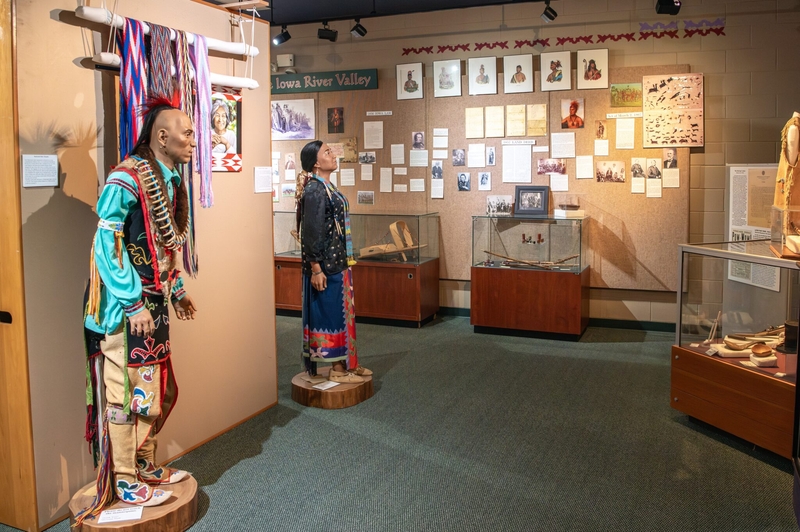
“Many Iowans are surprised to learn there is an Indian tribe in Iowa at all,” Buffalo said. “They don’t need to apologize because it wasn’t you, it’s just history. History is hard and not all nice, but people still need to learn it.”
Buffalo said in 1858, Iowa made a choice that strongly differed from other states by passing legislation that allowed the Meskwaki tribe to stay in Iowa at a time when “other states were trying to kill off their Indians” by forcing them to migrate to the Western U.S.
He stressed that Iowa is “unique” and Iowans are “strong, independent minded people,” and fears that history could be forgotten and the state will lose its identity.
African American Museum of Iowa
Anne Carter, executive director of the African American Museum of Iowa, said its mission is to “preserve, exhibit and teach the African-American heritage of Iowans.”
Carter added that people in “power” are the ones who decide how history is told, but at its core, history is something that is passed down from generation to generation. The question, she said, is who gets to tell it and whose voices are missing.
“In any society, whoever holds the power tends to decide which stories become part of the official record,” Carter said. “The museum exists to counter that imbalance in Iowa, to make sure Black Iowans are not a footnote, but part of the main narrative as the state looks toward America’s 250th birthday.”
Carter said an interesting Iowa story involves the town of Buxton, a rare racially integrated community during the early 20th century.
Founded as a coal-mining town, Buxton became nationally known for its racially integrated workforce, businesses and schools during the early 1900s.
As the U.S. prepares to celebrate its 250th anniversary, Carter wants Iowans to remember that many Black Americans were still enslaved when the nation was founded, and it took nearly a century for slavery to be abolished afterward.
“250 years is significant for our country and for democracy,” Carter said. “But, in 1776, there were still people of African descent enslaved.”

Des Moines, IA