Many California fishermen are nearing retirement. Can the industry save its graying fleet?
Jun 30, 2026 | 8:05 am ET

Description
In choppy surf off of La Jolla, fisherman Shane Volberding fought to land a yellowtail, a silver and gold fish prized in the sushi seafood trade.
Gulls wheeled above the water as the fish dove and darted against him, dragging the line. One crank at a time, Volberding reeled it in, jabbed it with a gaffe and then hoisted it on deck. As he grappled with the thrashing fish, his deckhand Destiny Louise Silva hauled in another yellowtail and dunked it in a bucket, tail up.
The swift, back-to-back catch was the highlight of an unusually productive day on the water that yielded seven yellowtail and other fish, not counting the ones snatched by thieving sea lions.
“That’s a really good day for yellowtails,” Volberding said. “They’re usually very hard to catch.”
That lucky happenstance belies the unpredictability of California’s commercial fishing sector, where the speculative nature of the catch collides with complex regulations, economic hurdles and a graying fleet.
Volberding, 27, is one of the younger captains in a fleet in which the average age is 48 and many captains are looking toward retirement. And he’s one of relatively few who didn’t enter the trade through family connections.
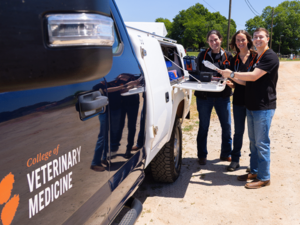
To address those shortfalls and protect the supply of locally caught seafood, UC San Diego Scripps Institution of Oceanography launched a fishing apprenticeship, designed to train new commercial fishermen on fishing techniques, rules and safety protocols.
The program has propelled careers for a few, including Volberding. But it has also exposed gaps in the industry that prevent fishermen from making a living and discourage newcomers to the trade.
Pay for commercial fishermen across the West Coast has plummeted over the last decade, according to data from the National Oceanic and Atmospheric Administration. Median annual crew pay dropped by about a third, from $90,468 in 2014 to $61,592 in 2024. Captains’ earnings plunged from $173,271 to $108,972 over that period. In San Diego, pay rates are even lower.
“It’s revealing a lot about what needs addressing within the industry, if we really want a resilient, sustainable food system with seafood as a part of it,” said Theresa Talley, a coastal specialist with California Sea Grant, who coordinates the apprenticeship.
Training the next generation of fishers
Despite its coastal locale, San Diego’s fishing industry and seafood supply are more tenuous than you might imagine.
At least two-thirds of the seafood that Americans eat is imported, and some estimates paint an even bleaker picture. In a 2016 report, Talley estimated that just 10% of seafood consumed in the city of San Diego comes from local fishermen, and only 8% of San Diego’s 86 seafood markets consistently carried San Diego-sourced seafood.
“Once dubbed the ‘Tuna Capital of the World,’ employing more than 40,000 people directly or indirectly in the tuna industry… the county is now home to just 130 local commercial fishermen,” Talley wrote.
These days, the tuna on your plate might come from Mexico, while your salmon fillet was likely farmed in Chile, Norway or Canada. Imported seafood is often cheaper than U.S. caught fish, which is subject to strict environmental rules and catch limits. Competing with less regulated fisheries puts additional strain on American fishing fleets.
To sustain locally caught seafood and backfill the declining ranks of California’s fishing fleet, Scripps introduced its apprenticeship in 2020.

The program provides instruction in key aspects of the fishing trade, including Coast Guard safety protocols and emergency drill conductor training, fishing regulations, methods and conservation. It guides fledgling fishermen on how to market and sell their seafood.
“Fishing isn’t just dropping your line in the water,” Talley said. “You need to know navigation and safety and fishing and engine repair and business”
This was never going to produce large numbers of new deckhands for the fishing fleet. Classes are small, with just a handful of students per session. The program took a hiatus during the pandemic and then came back on line in 2024.
So far, 11 people have graduated and six are still fishing, Talley said. Four more students are in training now.
Apprentices participate in what Talley calls a “boot camp style” course over the course of two or three months.
It started in 2020 with 130 hours of shore-based training, then added hands-on sessions on diesel engine repair and marine mechanics in partnership with the San Diego-based Maritime Institute. Then apprentices spend 1,000 hours on-the-job with local fishermen.
“They’re training across these topical areas that the fishing communities and the fishing industry helped us identify,” Talley said. “And then we help connect the apprentices with commercial fishing vessels.”
That’s where things get tricky. Although commercial fishing captains urged Scripps to create the apprenticeship, few ultimately stepped up to mentor graduates, Talley said. Some captains worried about losing time showing beginners the ropes. And the insurance cost of taking on a new crew member can be prohibitive.

For apprentices, it’s unsteady gig work. Deckhands get a percentage of the catch, so their pay depends on the size of the haul. They’re also expected to help ready the boat for fishing trips, scrub barnacles from the hull and prepare gear. Those tasks are typically unpaid.
Without another job, pension, or family support, it’s tough to earn enough to live on, fishermen acknowledged.
A deckhand in San Diego earns about $15,000 to $50,000 net per year, said Peter Halmay, 85, a founder of the San Diego Fishermen’s Working Group, and an urchin diver for more than half a century. That’s below the per capita income of $57,083, and insufficient for housing and other expenses in one of the country’s costliest cities.
“It goes to show you that a deckhand in the fishing business can’t afford to live in San Diego,” Halmay said. “And that’s the problem we’re getting at.”
A fishing captain can make $100,000 to $200,000 annually he said, but that’s gross income, and permits, gear and other expenses take a big chunk out of that.
“If you’re entirely reliant on commercial fishing for all your economic needs, that’s a hard puzzle to put all the pieces together to make that work consistently year after year,” said Peter Brownell, 53, an earlier Scripps apprentice who left a career as a PhD sociologist at a San Diego nonprofit to become a fisherman.
Halmay said fishermen need to support each other, build their ranks and engage the public. He helped develop the apprenticeship program with that goal in mind.
“You’ve got to change the fishing culture and you have got to make the fishermen and the public appreciate this culture,” he said. “These are professionals that take pride in bringing in their catch, and they bring in the best catch and they harvest sustainably because it’s in their best interest to do so.”
A day at sea
Volberding got hooked on the ocean early. Born in San Diego, he lived in Idaho for a few years as a child before returning to his hometown, where he “fell in love with surfing.”
He stayed near the water, working at a fish market cutting and selling fish, in seafood restaurants and on sport-fishing boats. In 2020 he joined the Scripps apprenticeship program, which covered the basics of commercial fishing. But he really cut his teeth with his mentors, who set him to work pulling spot prawn traps, taught him fishing techniques and instilled the “work ethic thing.”
“I owe them huge, dramatic credit for my success,” he said. “They work harder than anyone I know.”


He fished from a jet ski for a while then got his own boat, a 25-foot Imemsa panga. Last month he sailed out in mid-morning fog to fish off La Jolla. As rough waves rocked the narrow boat, Volberding and Silva pulled in a small mako shark and dozens of mackerels while hunting for yellowtail to a party music soundtrack of The Commodores’ “Brick House” and Taio Cruz’ “Dynamite.”
Fishing has always come naturally to him: “When I was in Boy Scouts I was the kid catching all the fish and the other kids were wondering, how I was catching all the fish? I had a knack for it.”
Near La Jolla, Volberding moved frequently across the water, reading ocean color and temperature, monitoring atmospheric pressure and watching for birds gathering and fish flopping. Small splashes were mackerel. Bigger splashes meant yellowtail.
As soon as he hooked one, he reeled hard as the powerful fish fought against the line. Several times sea lions beat him to it.
“We got more bites – a big, big yellowtail, like a 30-pounder – and they got stuck in the kelp and a sea lion stole the yellowtail,” Volberding. “And then it broke the line and then ate it with all his friends.”


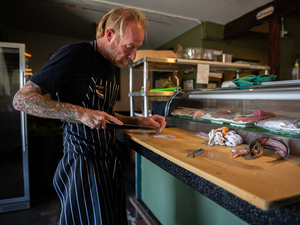
As soon as they got fish on deck, Volberding and Silva euthanized them using a Japanese technique called shinkei-jime. Inserting a wire into the spinal cord they killed the fish instantly to prevent the meat from spoiling and preserve its buttery texture and flavor.
That’s just part of the job. Volberding markets his fish to high-end restaurants and sells them at the Tuna Harbor Dockside Market at the Port of San Diego on Saturdays.
He offers what he calls “value-added” products, including the shinkei-jime killed yellowtail and filleted mackerel, which command a higher price. Sometimes he crews on friends’ boats, buys tuna from them and sells those fish.
“You gotta be good at fishing,” he said. “Be smart. Yeah, being good at sales”

Not everyone can make it work
For Brownell, fishing was a mid-career switch from his previous job as research director for the Center on Policy Initiatives, an economic justice nonprofit based in San Diego.
“I definitely was interested in being in the water and operating boats, in my efforts to not be operating a desk,” he said.
He worked on habitat restoration in San Diego and got a seasonal job with the U.S. Forest Service in Alaska, before turning his attention to fishing. Brownell went through the Scripps apprenticeship, where he was introduced to Dan Major, a fisherman with Plan B Sustainable Fisheries in San Diego.
Brownell crewed for Major, fishing for crab, rockfish, sanddabs and lobster.
The two eventually partnered on an experimental fishery for brown box crab, a chunky crustacean known for its sweet, delicate meat. In return for the opportunity to catch the spiky crabs, they gathered data for fisheries scientists.
“He was a good mentor, and I think we were a good team,” Brownell said.
Eventually Brownell bought his own fishing boat and marketed his fish at Tuna Harbor Dockside Market. Then the bottom dropped out of his business.
“Most of what I was making on my own was fishing sanddabs, but then that fishery closed,” he said. “That’s part of the vagaries of commercial fishing, is that you work on something that may not continue to be available to you.”


That’s a common problem. While a boat’s catch varies from day to day, the mere opportunity to fish is also speculative.
In addition to a commercial fishing license, fishermen need specific permits for most species. The permits are competitive and boat captains tend to hold them as investments, which means newer fishermen may be cut out of the fishery. Halmay said only a fraction of the captains who hold urchin diving permits actually use them each year.
Even holding a permit for a species doesn’t mean they’ll get to fish for it. State and federal regulators manage fisheries to maintain healthy populations, and shut them down once the annual quota is met, or if environmental conditions threaten the species.
After winding down his fishing operation, Brownell moved to the Bay Area to run a debris removal boat for the Army Corps of Engineers, deploying navigation and mechanical skills he acquired in San Diego.
Brownell still keeps his own boat docked at Fisherman’s Wharf in San Francisco and maintains his commercial license in hopes of fishing the coveted salmon season. That fishery was closed for three years, but partially reopened this year. He plans to try his luck with salmon this summer when weather conditions permit.
“I do love both the fishing and the bounty of the sea and providing for people from the sea,” he said. “I’m hoping the fisheries continue to rebound and we’re allowed more generous use in the years to come, fingers crossed.”

Janelle Louie, another Scripps apprentice who fished for several years with the late San Diego Captain Doug Dirkse, started selling t-shirts on a GoFundMe page to support their business after salmon fishery closures decimated the industry.
“I wasn’t aware of this issue when I started, but now understand how difficult it can be to stay afloat as a full-time small boat commercial fisherman,” Louie wrote on the GoFundMe drive.
Other apprentices have tried their hand at fishing before moving onto more stable employment. Darian Schramm, owner of Paramount Fish Co, mentored one of the Scripps apprentices, but found he couldn’t offer steady enough work to keep him on.
A few years back Schramm, 48, made a similar career u-turn as Brownell, turning in his laptop after 15 years in computer programming. The remote tech job allowed him to combine work, travel and hobbies, but he wanted to do “something potentially more useful.”
“I could surf and fish and travel,” as a programmer, he said. “Then the computer thing just kind of soured for me. Now I’m part of the food system here in San Diego, and I can give back to the community through fresh, local food.”
He was happy to take on an apprentice, Sebastian Torreblanca, and thought they worked well together. But he understood when Torreblanca took a full-time job with a local city instead.
“For Sebastian, he was into it, he loved it,” Schramm said. “But at the end of the day he had a mortgage, he had to support his family.”
It would help if Scripps could subsidize apprentices while they get started, Schramm said. And he warned that new crew members should view the job as a starting point that requires investment of time before it pays dividends.
“This is getting your feet wet,” he said. “You can’t halfway do it, you have to fully believe in it.”

Part of the reason fishermen face tough odds is because they seldom join forces. Working on the water or the wharf, out of wifi and cellphone range, they have little opportunity to organize, attend meetings or lobby lawmakers.
“A lot of fishermen are kind of solitary, so it’s not easy to get them together,” Schramm said.
They guard their best spots and fishing methods, wary of giving away secrets to competitors.
Volberding declined to reveal certain techniques for landing and handling fish. But as he hauled in yellowtail throughout the recent fishing trip, he alerted friends by radio to let them know where fish were biting.
It didn’t compromise his own catch. Around sundown it began to sprinkle and Volberding headed for shore. At dock he laid out a mako shark, two barracudas, a bucket of mackerel and seven yellowtail with gleaming, gold fins and tails, valued at roughly $250 each, or around $13 per pound.
The apprenticeship aims to foster that kind of knowledge sharing by pairing novice fishermen with experts who can guide the next generation.
“We’ll get together, and we’ll talk about it,” Halmay said. “We’ll share our experiences, and we’ll all rise together. And that’s how you’re gonna succeed is by working together.”

Sacramento