Utah just saw energy shutoffs to prevent wildfires — are more coming this season?
Jun 30, 2026 | 7:06 am ET
Description
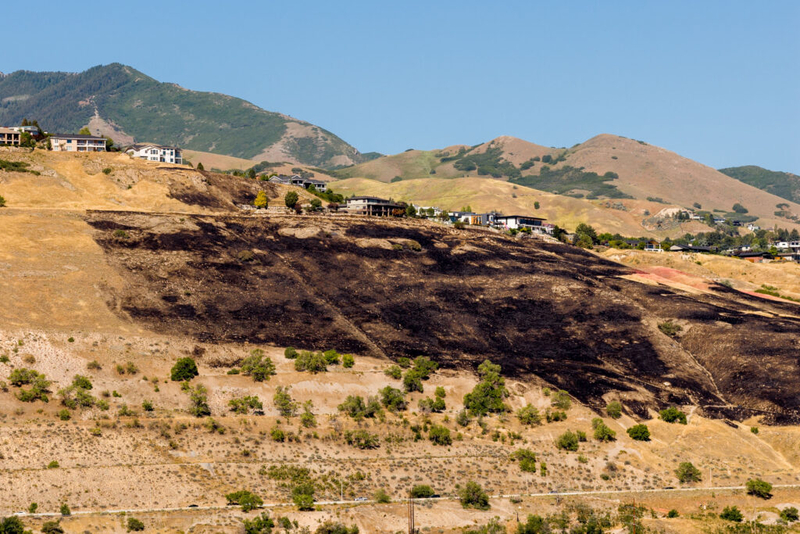
A burn scar from the Sandhurst 2 wildfire is pictured on the hillside near Ensign Peak in Salt Lake City on Thursday, June 11, 2026. (Photo by Spenser Heaps for Utah News Dispatch)
The largest electricity provider in the state activated a relatively rare power shutoff protocol last week, temporarily cutting energy service for over 7,700 customers. Should Utahns expect more of them as one of the most wildfire-prone seasons continues in Utah?
It depends.
Rocky Mountain Power activated a public safety power shutoff warning for 48 hours in about a dozen cities in Southern Utah, including Cedar City, Milford, Moab, Price and Vernal, while the utility monitored environmental conditions in which fire ignition is possible.
This was the third watch the utility has done in the last four years, said Jona Whitesides, a spokesperson for Rocky Mountain Power.
“Last year we did this (public safety power shutoff) event around the same time last year, and we expected that we would have more, but it really just depends on the weather patterns,” Whitesides said. “If we move into more of like a monsoon season, where we’re getting a lot of rainfall, and we’re not seeing as many of these wind-driven events that come in on already really dry vegetation, then we may not see any.”
Rocky Mountain Power has in-house meteorologists who track hundreds of weather stations the company has installed in its poles throughout its service area and builds a five-day weather forecast every weekday, Whitesides said. Predictions get more accurate as projected red flag days get closer.
A 48-hour watch status for Rocky Mountain Power customers means a shutoff is possible, but conditions are still being monitored. Users who receive a 24-hour notice are more likely to require a shutoff.
This week, Whitesides said on Monday, the meteorology team hasn’t flagged any weather issues that would meet the criteria for a public safety power shutoff watch. But that’s different every week.
“This (last) one ended up being a pretty big weather system that was coming in and kind of hitting that central southern part of Utah on the west side with the winds moving from west to east,” he said. “And then as they made their way through there, they kind of split off, and some were headed up towards Uinta Basin, and some down to southeastern Utah, which is why you kind of have just a sparse effect of so many different places.”
While the low-snowpack year and dry soil are making up an especially dangerous wildfire season in Utah, Whitesides said preventive power shutoffs are always based upon forecasts of a combination of conditions including wind patterns, hot temperatures and dry vegetation.
Cox says ‘there’s no end in sight’ to wildfire that could be Utah’s most destructive ever
“You technically could see a public safety power shut off in the middle of winter as well, because even though you’re maybe not getting those high, hot temperatures, if you’ve had no snow through the wintertime and you’re getting really windy conditions come in, you still could have that wind affect the power lines, create a spark and start a wildfire,” he said.
The protocol is different for other emergency de-energization practices, such as what’s in place amid the Cottonwood Fire near Beaver, which public officials have labeled one of the most destructive wildfires in the state’s history.
Unlike public safety power shutoffs, when a wildfire starts, the utility usually doesn’t have time to notify customers ahead of time when it needs to de-energize lines for the safety of first-responders.
“We did have to de-energize a couple thousand customers at the start of the Cottonwood Fire, and then we were able to get permission from the fire officials to go in there and place a couple of mobile generators,” Whitesides said. That’s a temporary fix until the fire is contained.
Salt Lake City, UT