Changes to immigration program for domestic violence victims impede safety, advocates say
Jun 29, 2026 | 5:00 am ET
Description
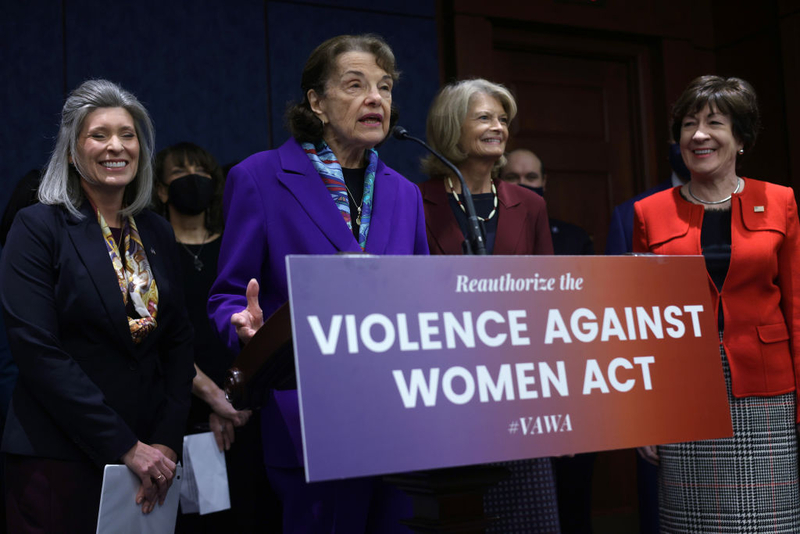
Democratic U.S. Sen. Dianne Feinstein of California, speaking alongside other senators and an advocate in the U.S. Capitol in 2022, announces bipartisan legislation to update the Violence Against Women Act. Despite protections in the law, immigrant survivors may have a harder time applying for a legal status under new guidance introduced by the Trump administration. (Photo by Alex Wong/Getty Images)
In March, Michigan attorney Ruby Robinson received a denial notice for legal status for his client — an immigrant woman suffering physical abuse from her husband.
Her husband had choked her, Robinson said. Shoved her. Forced unwanted touch. Controlled the finances.
The woman and the man married in the United States after being in a relationship for many years. Robinson’s client submitted the marriage certificate and letters from a long-time friend and the man’s daughter, vouching that the marriage had been in good faith, meaning they genuinely wanted to be together.
As a domestic violence survivor, she’d applied for legal status. But federal officials announced policy changes late last year.
Footage, documents at odds with DHS accounts of immigration enforcement incidents
Under the federal Violence Against Women Act, known as VAWA, abused foreign national spouses of United States citizens or green card holders, or abused foreign national parents, can file a self-petition for a lawful immigration status if they are experiencing abuse. The 1994 law, was sponsored by then-U.S. Sen. Joe Biden and enacted during the Clinton administration. It has been renewed several times, most recently in 2022 during Biden’s presidency.
But the Trump administration announced new narrowed guidelines in December, and the U.S. Citizenship and Immigration Services has been increasingly scrutinizing domestic violence survivors’ applications for legal status, making more stringent asks of attorneys and their clients, such as more concrete proof of cohabitation during a “good faith” marriage.
Despite photos and declarations, including four single-spaced pages of testimony from a witness who had known Robinson’s client and the alleged abuser for three decades, the woman’s application to live in the United States with legal documentation was denied. Immigration officials said the evidence wasn’t enough to prove the marriage was in “good faith,” said Robinson, senior managing attorney at the Michigan Immigrant Rights Center, a legal resource center for immigrants.
The agency says the new requirements aim to prevent fraud, saying that misuse of the system can cause significant delays in processing self-petition requests.
But the changes, which include narrowing the definitions of “battery” and “cruelty” and requiring that petitioners prove they resided with their abusers, are adding barriers for survivors who often are in tenuous situations, advocates say. Amid President Donald Trump’s immigration crackdown, many immigrants experiencing abuse may be in fear of filing paperwork, especially if perpetrators use deportation as a means of threatening their victims.
Police officers can help prevent domestic violence killings by asking the right questions
“VAWA was designed to create protections for survivors of intimate partner violence and domestic violence,” Robinson said. “These protections are essentially falling apart.”
The U.S. Citizenship and Immigration Services says the revisions aim to prevent fraud, saying that misuse of the system can cause significant delays in processing self-petition requests. There have been recent cases of attorneys whose clients have accused them of filing fraudulent claims.
The immigration agency also cited a significant increase in filings by men and parents between 2020 and 2024. Over the years, Congress broadened the language of the law to explicitly allow protection for male victims such as those in same-sex couples.
“By clarifying the policies and requirements for aliens filing VAWA self-petitions, we are better equipped to protect program integrity, combat fraud, and manage the VAWA program as intended by Congress,” the agency wrote in its December announcement, calling the increases in male and parental applications “alarming.”
Cristina Velez, legal and policy director at ASISTA, which provides consultation and training for immigration attorneys across the country, said preserving the integrity of the program to make sure it helps legitimate survivors is critical. But she said an increase in male applications doesn’t necessarily indicate fraud. She had male clients in her private practice who had been abused by U.S. citizen sponsors, including same-sex spouses, she said.
“The government has the capability of identifying fraud through means other than narrowing the definition of battery and extreme cruelty,” she said. “I would encourage them to take those other kinds of steps.”
Velez added that any change in application patterns should prompt the government to learn more by asking questions such as, “What is this change based on? Is it that more people are learning about this avenue of relief, or is it something else?”
Officials should focus their accountability on lawyers and abusers who take advantage of immigrants, said Cecelia Friedman Levin, director of the Alliance for Immigrant Survivors.
“Many of these cases are now adjudicated with a fraud-focused lens, which to my mind can create a chilling effect of survivors coming forward to access these protections,” she said. “A few bad actors are not an excuse to punish survivors for whom the program was designed to rely on.”
Domestic violence in Native communities is focus of new survey
The updates to the Violence Against Women Act’s policy manual requires that those seeking self-petitions prove that they resided with the abuser — who has to be a U.S. citizen or a permanent legal resident — while they were married, and that the abuse occurred during that period. This means if a person experienced abuse before marriage, and fled during marriage if their spouse showed signs of abusing them again, the prior abuse wouldn’t qualify under the policy update. They also should provide proof of their abuser’s citizenship or permanent legal status. USCIS says it will “attempt” to verify that status or, if it can’t, may consider information offered by petitioners.
In addition, they must provide proof that an abuser’s prior marriage had been legally terminated.
“The intent behind it is to prove the validity of the marriage. But that should not be a burden on the applicant to prove that the person terminated their marriages before they married them,” said Malou Chávez, executive director of the Northwest Immigrant Rights Project.
Chavez said while it may not be common, there have been situations where a survivor believed the person she married had gotten a divorce, and actually hadn’t.
“Our clients have had to leave in the middle of the night, barefoot with three things that they were able to grab, as a result of the abuse,” said Laura dePaz Cabrera, an immigration lawyer in Gainesville, Florida.
It can take domestic violence victims several attempts to leave the relationship, and abusers may be controlling a person’s finances or have bills only under their own name, making proof of residence harder. Research shows victims are at their most vulnerable to violence when trying to leave.
“Survivors of abuse, they don’t typically have a spouse who’s going to join them on a credit card or add them to their cell phone bill or take a lot of pictures or have traditional evidence,” said Cabrera. “It puts this specific population at an almost insurmountable disadvantage, in many cases, of having to prove cohabitation within documents that are completely unable to exist — and that maybe intentionally don’t exist due to the abuse.”
In the case of Robinson’s client, “Her spouse never put her name on the lease. Almost nothing was in her name,” he said.
Survivors of domestic and sexual violence can break their leases early in some states
The guidelines also narrow the definition of “battery or extreme cruelty,” bypassing the legal definition of battery, which refers to non-consensual touch. Instead, it adheres to a dictionary definition: “to strike with repeated blows of an instrument or weapon, or with frequent missiles; to beat continuously and violently so as to bruise or shatter.”
Its definition of “extreme cruelty” is clarified to denote an act “to the utmost possible degree” that “endangers the life or health of the other.”
“To say that in order to qualify for this immigration benefit, the abuse needs to have been unusual in some way — it really flies in the face of what is known about domestic violence, and what VAWA was meant to address,” Velez said.
Evidence guidelines are also more stringent under the changes. For example, for photographs of physical abuse, the self-petitioner now needs to identify who took the photographs, when and where.
Last month, a U.S. court ruled in favor of a class action lawsuit that challenged the Trump administration’s attempt to rescind existing protections against deportation for survivors of abuse and sex and labor trafficking.
“So many of my clients have been told, by their abusive partners, ‘If you call the police, you’ll be deported, and the children will stay with me,’” said Jane Stoever, director of the University of California, Irvine School of Law’s Domestic Violence Clinic.
Stoever said she’d been able to get a deportation case dismissed for one survivor client, but the client still has to meet with deportation officers every six months. She had been stabbed and had broken bones at the hands of her child’s father. She still fears deportation, as it was a tactic he would use to threaten her.
This month, members of Congress in the Democratic Women’s Caucus wrote a letter to Department of Homeland Security Secretary Markwayne Mullin, saying the policy manual’s changes have “weakened longstanding protections” for immigrant survivors.
“Without protections in place for survivors to report violence coupled with stories about enforcement actions at courthouses and other sensitive locations,” the members wrote, “immigrant survivors are left with no safe avenues to report their abuse.”
Stateline reporter Nada Hassanein can be reached at [email protected].