Can AI help Oregon prepare for wildfires?
Jun 25, 2026 | 5:06 pm ET
Description
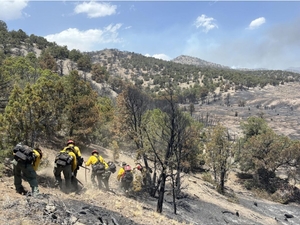
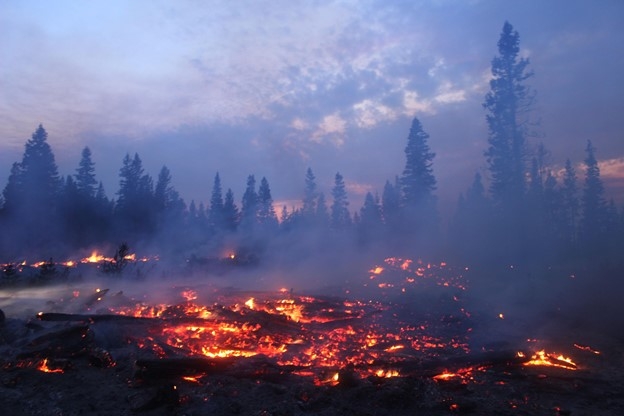
The Bootleg Fire in southern Oregon in 2021 burned more than 435,000 acres, including a quarter of the Klamath East forest carbon project. (Photo by U.S. Forest Service/Flickr)
Oregon and the Northwest generally have gotten off light so far this year when it comes to wildfires. That can change and probably will, because wildfires tend to take a worsening turn in the month or so ahead.
But starting this year, we may have some new tools for planning for their arrival.
As of June 25, the National Interagency Fire Center has reported a total 35,118 fires nationwide burning 2.9 million acres — both numbers considerably higher for this point in the year than any year in the last decade and well above the average this century. The northwest, with its fire-friendly weather and other conditions this year, is unlikely to escape for much longer.
In fact, the Oregon Department of Forestry said June 15 that all of its forestry districts are now considered to be in fire season. Fire Protection Division Chief Michael Curran said that “Looking at the current conditions and projections for the summer, ODF is prepared to have another busy fire season.”
Apart from the usual preparation efforts of assembling firefighters, equipment and supplies, is there anything Oregon can do to get ready?
Might this, in part, be a job for artificial intelligence?
An April 10 report from Oregon State University and the Nature Conservancy offers what amount to predictive tools about wildfire probabilities, including some factors wildfire analysts may have missed in the past.
Their model breaks wildfire risk into three groups of factors. One of them, wildfire hazard, includes the probability and intensity of burns, and researchers over the years ordinarily have considered them. Relative dryness, availability of burnable material, climate changes and other environmental considerations are all readily reduced to numbers.
But the new study also includes two more major areas: Infrastructure vulnerability (structural and neighborhood characteristics and defensible space) and social vulnerability (demographics, socioeconomics and types of housing and transportation), both of which seem a little less obvious.
The ability of an area to resist major fires can be broken down into specific physical factors (access to water, materials to block fire, easily burnable buildings or other materials). And detailed information about those factors can be developed at a hyperlocal level using Census and other other data.
In other words, the relative fire risk of the places we live based on elements ranging from building materials to how development is concentrated or scattered can be reduced to a specific number — and implicitly, more factors besides those. The study found large degrees of social vulnerability around the Cascade and Coastal ranges and across much of eastern Oregon, though the most vulnerable tracts were widely scattered.
The writers made the point that they weren’t trying to establish specific cause-and-effect relationships between fires and community statistics, but simply that certain of these things tended to go together. From that, over time, researchers could start to focus in on risk factors.
In the new study, all these things were developed for about 400 communities in Oregon and Washington.
For example, co-author Chris Dunn from the OSU College of Forestry said, “Warm Springs and Goldendale have slightly lower wildfire exposure than some nearby, better-resourced communities like Bend and Leavenworth, but they experience greater social vulnerability and therefore are likely to experience greater impacts if a fire occurred. By blending a mix of factors, our assessment method is a path toward more equitable investments in community wildfire risk reduction.”
The manipulation of vast amounts of information and assessment of new patterns and sets of probabilities is very much in the wheelhouse of AI, artificial intelligence. Its use in wildfire analysis has not been central yet, but could become more so.
For example: An extensive September 2025 academic study based in Switzerland titled AI for Wildfire Management: From Prediction to Detection, Simulation, and Impact Analysis looked into the uses even at that point, and existing limits, for AI in fire prediction and planning for containment.
It said “the main domains of wildfire management where AI has been applied — susceptibility mapping, prediction, detection, simulation, and impact assessment — and highlight critical limitations that hinder practical adoption. These include challenges with dataset imbalance and accessibility, the inadequacy of commonly used metrics, the choice of prediction formats, and the computational costs of large-scale models, all of which reduce model trustworthiness and applicability.”
Some of these constraints could be eased as the technology progresses.
Whether the OSU and Nature Conservancy used AI in developing their reports didn’t seem entirely clear, but going forward AI looks like exactly the sort of tool that might be useful in working our areas of risk from wildfire.
Oregon may need all the help it can get.
Salem, OR