US House passes bill to combat ‘ghost’ federal student aid applicants
Jun 10, 2026 | 4:11 pm ET
Description
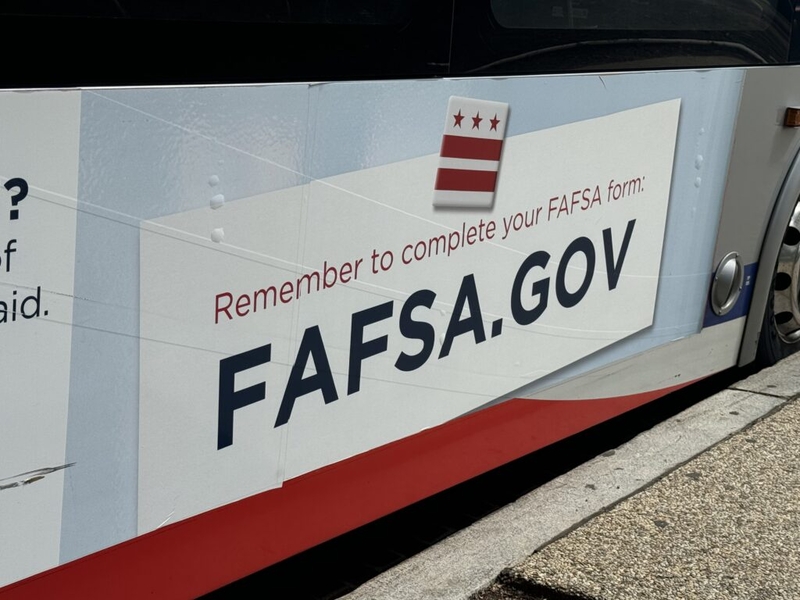
A sign reminding people to complete the Free Application for Federal Student Aid — better known as FAFSA — appears on a bus near Union Station in Washington, D.C. (Shauneen Miranda/States Newsroom)
WASHINGTON — A bill to crack down on financial aid fraud passed the U.S. House on Wednesday.
The measure, which passed 249-172, would require the U.S. Department of Education to set up an identity fraud detection system for the Free Application for Federal Student Aid, better known as FAFSA.
Nearly 40 Democrats voted for the GOP-led bill.
The bill safeguards against fraudulent “ghost students,” which lawmakers say have cost taxpayers millions of dollars by applying for federal student aid and college under stolen identities and enrolling in classes, only to later disappear with such funds.
The measure would codify a FAFSA fraud detection tool already underway at the Education Department and comes as President Donald Trump’s administration pursues a sweeping anti-fraud effort across the federal government.
Rep. Burgess Owens, who sponsored the measure, said during floor debate Tuesday that his bill “builds on the good work already done by the Trump administration to protect taxpayer dollars and help safeguard the integrity of the student aid system by ensuring federal aid goes to real students.”
The Utah Republican added that his legislation “takes a straightforward approach, identifies suspicious student aid applications and ensures these applications are for who they say they are before dollars go out the door.”
A similar, bipartisan effort was introduced in the U.S. Senate earlier this year.
Education Secretary Linda McMahon said her department was “proud” to see the House pass the bill, which she said “will cement our ongoing efforts to eliminate fraud, waste, and abuse by requiring screening for suspicious federal student aid applications,” in a Wednesday statement.
“Since Day One, the Trump Administration has been committed to restoring existing fraud detection capabilities while building the most comprehensive fraud-detection system in the Department’s history,” she said.
Fraud detection system
Under the bill, the Education secretary would be required to use the identity fraud detection system to assess each FAFSA submitted on or after Oct. 1.
If a “reasonable suspicion of identity fraud” on the FAFSA is presented, the secretary must notify the applicant and the schools designated on the application that they are subject to “additional identity verification requirements” before they can receive federal financial aid.
The bill also requires both an annual audit of the system and a report to Congress on its effectiveness.
The measure loops in provisions from a separate bill from Pennsylvania GOP Rep. Glenn “GT” Thompson that also aims to combat student aid fraud.
That includes a requirement that the Education secretary prioritize program reviews of institutions that have “demonstrated a pattern” of providing federal financial aid to students whose FAFSA “presented a reasonable suspicion of identity fraud.”
‘Vague enforcement standards’
Rep. Bobby Scott, ranking member of the House Committee on Education and Workforce, voiced his opposition to the measure during floor debate Tuesday, saying the bill “could reasonably be viewed as part of a broader strategy to weaponize student aid.”
The Virginia Democrat noted that while preventing federal student aid fraud and protecting taxpayer dollars “is always a good idea,” the bill’s “creation of vague enforcement standards and punitive mandates without clear guidance” for schools and students could make it more difficult for legitimate students to access aid in order to attend college.
Scott also pointed to the Education Department’s April launch of an identity fraud detection system, saying Congress should allow the tool to operate and wait for the agency to evaluate the results.
“Codifying this new system without assessing its effectiveness just doesn’t make any sense,” he said.
All States Newsroom content is free to republish. Read our republishing policy for more information.