Advocates end Nebraska property tax, winner-take-all, hand-count ballots petition effort
Jun 10, 2026 | 6:19 pm ET
Description
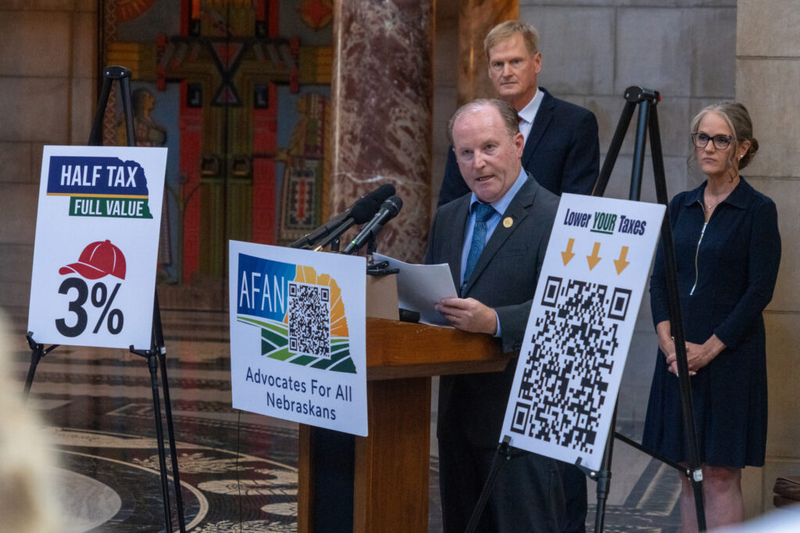
Eric Underwood, former chair of the Nebraska Republican Party, center, leads a news conference with his new nonprofit Advocates For All Nebraskans to announce two ballot measures intended to lower property taxes and cap annual increases to property valuations. Aug. 25, 2025. (Photo by Zach Wendling/Nebraska Examiner)
LINCOLN — Nebraskans will not vote this November on any parts of a multi-pronged petition drive seeking to address property taxes and change key parts of state elections.
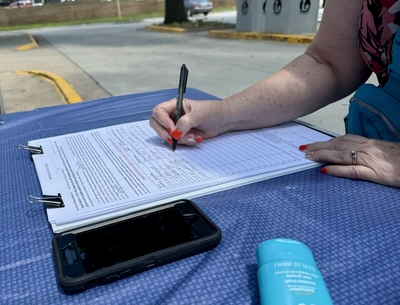
Eric Underwood, the former chair of the Nebraska Republican Party and spokesperson for the Advocates For All Nebraskans campaign, confirmed to the Nebraska Examiner that the 200 volunteers across the group’s five petitions have been pulled back. Campaigns for statewide ballot measures must submit signatures to the Nebraska Secretary of State’s Office by July 2.
“I’m not going away, we’re not going away,” Underwood said of the group’s future. “We will continue to go to the people until lawmakers represent them.”
While Underwood’s team looks to regroup, including through the launch of a new local petition drive in Lincoln in the coming days, Underwood said the grassroots, volunteer-only effort achieved “exceptional” success in going door-to-door.
But Underwood said a top issue was that at local supermarkets, health clubs and Department of Motor Vehicles offices, volunteers faced a “disconnect” between separate paid petitioners and the “authenticity” of his volunteer group and their “genuine attempt to try and move something with purpose.” Many statewide petition campaigns have employed at least some paid circulators in their quest to qualify for the ballot, including most current ballot measure campaigns.
Underwood said Advocates For All Nebraskans fielded emails and texts from voters who said they had been “accosted” by some circulators, which he said wasn’t the case with his team.
“We did not want to put our volunteers into the environment that the paid circulators were now, in essence, creating,” Underwood said. “Not saying it hasn’t been there before, but the fatigue was starting to kick in.”
Petition specifics
The Advocates For All Nebraskans campaign had five petitions:
- Amend state law to halve the percentage of a property’s valuation subject to property tax rates — for homes, from 100% to 50%, and for agricultural or horticultural land, from 75% to 37.5%.
- Amend the Nebraska Constitution to cap property valuation increases at the growth rate of Nebraska’s general fund tax receipts or 3%, whichever is less.
- Amend state law to establish a baseline pay of $50,000 for all Nebraska public school teachers, and require the state to retool its school funding model to pick up the tab.
- Amend the Nebraska Constitution to require that all Nebraska elections utilize paper ballots and that ballots be hand-counted to tally results.
- Amend the Nebraska Constitution to mandate that a presidential candidate who wins Nebraska’s popular vote wins all five of Nebraska’s Electoral College votes. Currently, the statewide winner wins two votes, and candidates pick up more votes if they win Nebraska’s congressional districts. The Omaha-based 2nd Congressional District has split blue three times, in 2008, 2020 and 2024, while the rest of the state has voted red.
Voter-led changes to state law require verified signatures from at least 7% of registered voters (nearly 90,000) to appear on the November general election ballot. Constitutional changes need valid signatures from at least 10% of voters (nearly 126,000) to qualify.
Campaigns must simultaneously qualify signatures from at least 5% of registered voters in at least 38 of the state’s 93 counties to appear on the November general election ballot.
Underwood did not say how many signatures his team had collected, as some finished petition pagers are still in the process of being returned.
‘Extreme disconnect’
Millions of dollars have already poured in this cycle for other 2026 petitions hoping to legalize online sports betting, constitutionally restrict school sports participation to a student’s sex and make it harder for lawmakers to change what the people have passed through future legislation.
However, Underwood’s campaign reported no campaign finances, a requirement once a petition campaign reaches or exceeds $5,000 in funds raised or in funds spent.
Underwood said not one of his group’s five petitions exceeded $5,000 on its own because some expenses, such as printing or buying clipboards, could be divided five ways, so his team did not file a campaign committee with the Nebraska Accountability and Disclosure Commission.
This petition cycle follows past ones where lawmakers later tweaked or tried to change voter-approved language, on minimum wage, paid sick leave, medical cannabis or tax dollars for private school attendance, which Underwood said permeated some of his volunteers’ work.
Underwood said some voters asked campaign volunteers last year: “So what if we sign?”
“They’re going to change it, not do it, something,” Underwood said of some voters’ complaints, adding some signers would still sign but express concern that while they didn’t support previous minimum wage or medical marijuana petitions, they didn’t like that the Legislature could change it.
Said Underwood: “There is an extreme disconnect between lawmakers and the voters right now, and it was even at the very beginning, at the infancy of just going out there.”
Underwood’s group differed from the campaigns of Tax Relief Nebraska (sports gambling), Fairness For Girls (school sports) and Respect Nebraska Voters (related to legislative authority to change voter-approved laws), for instance, in not hiring paid signature gatherers, many of whom come from out of state.
Local petition could target Lincoln
While suspending the 2026 statewide effort, Underwood said he and other supporters plan to announce a local petition in Lincoln in the coming days. The deadline to coordinate and submit a smaller, more localized batch of signatures is slightly longer, into late summer.
State law allows such local petition efforts in Lincoln or Omaha. Underwood said he wants to focus on one city first in the hopes of making inroads now.
As for what the local effort will focus on, Underwood did not give specifics other than to say it would be a continuation of his group’s goal of “being an advocate for all Nebraskans.”
“It’s not going to be dealing with property taxes per se, it’s going to just be in supporting the City of Lincoln,” Underwood said. “I can guarantee you it will be a nonpartisan mindset.”
The other property tax petition
For years, state lawmakers have stalled or been slow at enacting significant property tax changes that leave voters satisfied. Nebraska Gov. Jim Pillen has made property tax reform a priority since taking office in 2023. He’s often suggested cutting state spending and increasing or expanding sales taxes to do so, sometimes to the chagrin of a bipartisan group of lawmakers.
‘EPIC Option 2.0’ effort regroups, aims for 2028 to end Nebraska property and income taxes
Underwood’s group was the latest to get involved with petitions. Another petition effort, EPIC Option — an acronym to eliminate property, income, inheritance and corporate taxes — also stopped its 2026 petition campaign early, citing a lack of funding as a key hurdle.
Successful citizen-led efforts often have had to raise more than $1 million to reach the ballot, and many campaigns have gone on to spend millions more before the general election.
EPIC Option 2.0 supporters hope to return for 2028 with a “3.0” approach, and many supporters, too, have blamed the Legislature for not working fast enough. A lead supporter, former state Sen. Steve Erdman of Bayard, has often said the Legislature provides a “decrease in the increase” of property taxation, not real relief.
Some lawmakers proposed identical legislation to both EPIC and Underwood’s campaigns in 2025 and 2026. But Underwood said of his group’s proposals: “I don’t think the appetite is going to change much for passing legislation that would be this bold.”

That could change with at least a dozen new lawmakers joining the Legislature next year, and Underwood hopes lawmakers act. In the case of winner-take-all, which legislatively stalled in 2025, he said asking voters would be better because it “ends a lot of things.”
“It ends debate. It ends time. It ends frustration,” Underwood said. “People get to make the choice. I think that is a better message to the people instead of, ‘OK, you guys [voters] go draft laws, and then we’re just going to not enact them, or we’re going to change them.’”
‘Not about reform anymore’
As for property tax “actual cuts,” Underwood said there can’t be any more “word play” using assessments, valuations, tax levies, spending caps and more. He said the focus needs to be on passing cuts, eliminating unfunded mandates and rebalancing maximum tax-asking rates for local entities.
On why property tax legislation is so important, Underwood said “subjective math” and “objective reality” show the same: Nebraskans are being taxed out of their homes.
“I get really frustrated, and so do the people, that the fuzzy math comes out,” Underwood said of property tax rates. “There’s only two multipliers here — a levy and a valuation — and the people have no control over either one of them.”
Property taxes have continued to rise, and property taxes totaled nearly $5.59 billion last year, an increase of $286 million from the year before. Voters banned the state from assessing property taxes in the 1960s, but state lawmakers have sought to provide relief through credits that effectively return money to taxpayers and pay a portion of the local tax-asking request.
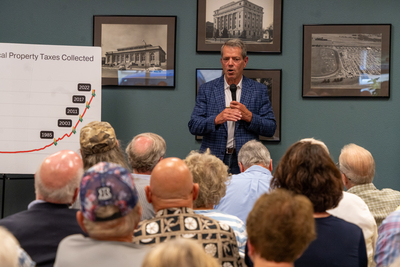
Underwood said voters can’t afford property taxes, are frustrated at how dollars are being spent and feel helpless to make any dents statewide.
“This methodology of valuations and levies and who’s to blame, it’s almost like a circular firing squad that nobody’s shooting bullets at,” Underwood said. “They’re pointing at each other, but they’re not actually solving the problem.”
He continued: “It’s not about reform anymore. That’s just a game. Cut it, or don’t even talk about it.”
This spring, no major property tax bill came to the legislative floor for a vote, Underwood lamented. And for the one bill that did come up for brief debate — a measure to place hard spending caps on local governments — some lawmakers at the time said they wanted to at least push the conversation for the optics to voters, without necessarily needing a vote.
Underwood said he hoped to put pressure on state officials, and he saw angst because of his group’s existence with a hope they would “just go away.” Underwood said that’s not happening.
“I’m not defeated,” Underwood said. “I just look at it [as] I’ve got to figure out a different avenue to get it done, or repeat the avenue, just start it faster and sooner.”
Lincoln, NE