Investing in people is clear path forward for Oregon Gov. Kotek’s ‘Prosperity Council’
Jun 05, 2026 | 12:05 pm ET
Description
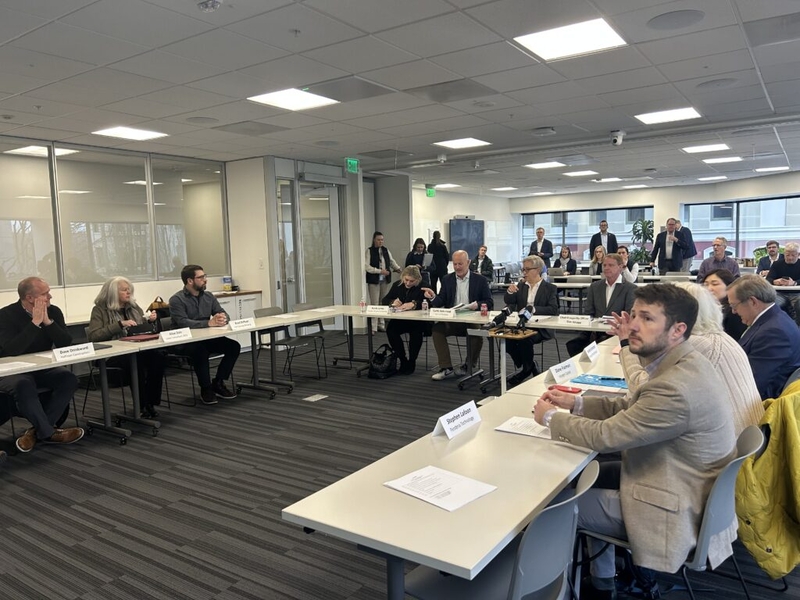
Oregon Gov. Tina Kotek greets business leaders on Jan. 22, 2026 during a kickoff event for her "Prosperity Council". (Photo by Shaanth Nanguneri/Oregon Capital Chronicle)
Rather than recycle the big business lobby’s permanent agenda to beef up its bottom line, Oregon Gov. Tina Kotek’s Prosperity Council recommendations should follow the evidence. Prosperity comes from public investments in people and their capacities, especially in education from early childhood through apprenticeships and higher education.
A highly skilled, adaptable labor force attracts and grows businesses, supports innovation and raises incomes for everyone. Investing in people is much more effective than even the best targeted business subsidies or tax breaks – and most aren’t well targeted. Although Oregon faces challenges beyond our control, we have a lot going for us. Now we need to pull together to invest in ourselves and our children.
Prosperity — economic development — is best measured by income per person and child poverty. More income per person, especially in the middle and bottom of the income distribution, means higher standards of living, better support for local businesses, more tax revenue and less need for social services. Low child poverty is the strongest predictor of low future poverty rates.
States with the most educated populations posted the highest per person income growth over the last 50 years. Businesses look for a skilled, productive labor force. Asked about a possible California tax on billionaires, Nvidia CEO Jensen Huang said ‘“We work in Silicon Valley because that’s where the talent pool is”… The company’s ability to hire qualified employees is typically the biggest factor in deciding where the company establishes a presence.’
Our educational system needs strengthening, from early childhood through higher education. Oregon’s serious underfunding of schools and local governments stems from property tax limits in the 90s. Oregon ranks 40th in the World Population Review’s assessment of public school quality. We’re 41st in U.S. News and World Report’s ranking. That perception matters, for families and businesses.
The biggest bang for the education buck is early childhood. Economic returns to state-level universal Pre-K are three times as high as the best targeted business subsidies, according to economic development expert Timothy Bartik. Parents’ incomes rise from working more or gaining more education or training. Teachers paid living wages are more stable, building expertise and raising preschool quality while spending more locally. Kids do better in school and earn more as adults.
By contrast, Bartik shows that at least three-quarters of firms given financial incentives by state or local governments would have located where they did without them. Study after study by economists shows that state and local taxes have little impact on business location.
Nor do affluent households move for lower taxes. The number of high-income households in Multnomah County has grown steadily over the past decade, especially at the top. Census data show three times as many households with incomes over $500,000 in 2024 as in 2019!
Researcher Cristobal Young analyzed decades of IRS data on everyone with incomes of $1 million or more. Only in the early COVID years did millionaires move to lower tax areas. In-person business networks weren’t functioning, and they could work from home in places with low infection rates. Starting in 2023, they began to move back, closer to their colleagues and contacts.
We should focus on attracting young professionals, the high-income households of the future. They’re far more mobile than older and wealthier households, open to attractive communities in which to settle. As well as good job opportunities, they want strong schools, affordable housing, outdoor recreation and cultural offerings. Portland and Oregon have a lot to offer, and can work to improve our schools and housing affordability
We’re struggling with forces beyond our control. Federal headwinds include extreme, erratic tariff policies, big cuts in agencies and scientific grants, harsh immigration tactics, and war on Iran. Nike and Intel both made strategic stumbles. COVID sped up the switch from downtown to working and shopping from home — and studying from home, in the case of Portland State.
On the plus side, we have gorgeous geography and fantastic outdoor recreation. Our food, music and cultural scenes have rapidly become more interesting, varied and sophisticated. Our economy is more broadly based, with solid roots in growing sectors.
Where we lag is in public investment, especially in education from early childhood through apprenticeships and universities, but also in the full range of housing needs and health care. The federal government is failing us as an economic partner. We’ll have to depend on ourselves for the foreseeable future. Fortunately, we have abundant local resources that most states lack.
Salem, OR