Federal appeals court denies youth climate lawsuit against Trump executive orders
Jun 05, 2026 | 3:28 pm ET
Description
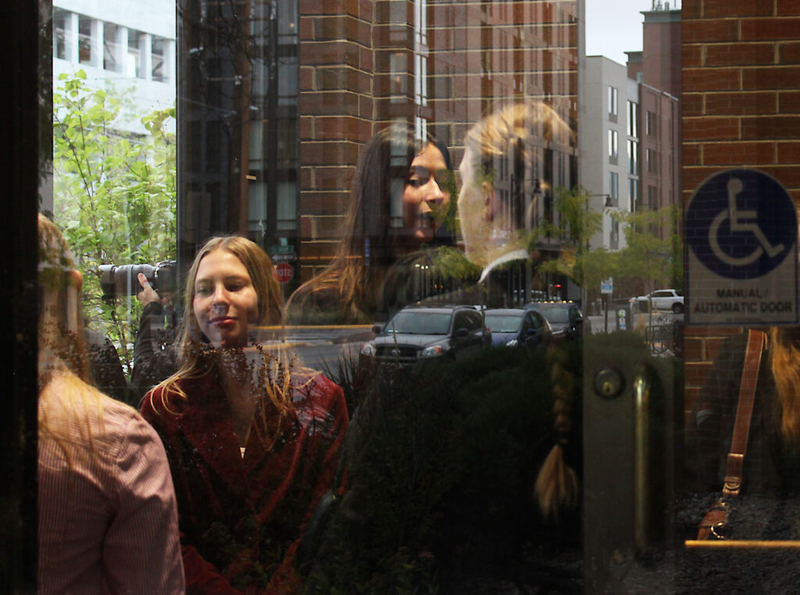
Eva Lighthiser, left, and other plaintiffs wait to enter Missoula's federal courthouse on Sept. 16, 2025. (Micah Drew/Daily Montanan)
The U.S. Ninth Circuit Court of Appeals in a June 2 ruling rejected a youth-led constitutional climate lawsuit seeking to overturn three of President Donald Trump’s executive orders aimed at supporting the fossil fuel industry, curbing renewable energy and suppressing climate science.
A three-judge panel agreed with a Montana District Court judge who dismissed the lawsuit last fall, saying the plaintiffs did not create a plausible link between alleged injuries and the three Executive Orders. They also said the requested injunction was unlikely to address their concerns, and was overly broad and complicated.
“By effectively challenging hundreds of current and anticipated agency actions in one lawsuit, Plaintiffs seek to circumvent the jurisdictional and procedural rules Congress has established for challenges to agency actions,” the court wrote in an unpublished memorandum. “Such a sweeping injunction against hundreds of agency actions in one lawsuit is unprecedented.”
Lighthiser v. Trump is one of a series of youth-led climate change lawsuits brought by Our Children’s Trust, an Oregon-based advocacy law firm, which also successfully litigated Held v. Montana in 2023.
Lighthiser, first argued before a federal judge in Missoula, alleged three executive orders Trump signed early in his second term will accelerate human-caused climate change and cause further harm throughout their lives.
The challenged orders included Trump Executive Orders 14154, “Unleashing American Energy,” 14156, “Declaring a National Energy Emergency,” and 14261, “Reinvigorating America’s Beautiful Clean Coal Industry.”
Federal District Court Judge Dana Christensen said he had dismissed the case “reluctantly,” but the scope of the request from the 22 young people was “an unworkable request.”
The circuit court agreed, saying granting an injunction rolling back three Executive Orders would require “extensive judicial supervision of executive branch actions related to energy policy.”
“Plaintiffs explicitly seek to undo everything from staffing reductions, to the revocation of research grants, to anticipated rule changes, to the type of language the current administration has used on government websites,” the memorandum states. “…The district court correctly recognized that disputes over such questions would inevitably result in the court ‘spending a lot of time together’ with the parties and holding hearings ‘until the expiration of [their] collective lifetimes.’”
In a statement, Chief Legal Counsel of Our Children’s Trust Julia Olson panned the circuit court decision, saying it allows the President to direct a fossil fuel agenda with no Congressional approval and no judicial review.
“This decision … tells the children harmed by that agenda that they cannot challenge it until it is unconstitutionally implemented piece by piece. That is not how the Constitution works,” Olson said. “The court did not decide whether these Executive Orders are constitutional. It did not decide whether the federal government may knowingly endanger children. Instead, it slammed the courthouse doors on children fighting for their lives and told them to file hundreds of cases against every agency action carrying out the President’s unconstitutional Executive Orders.”
The circuit court panel heard arguments in Lighthiser v. Trump in April.
Several states, including Montana, joined the Justice Department in arguing for the case’s dismissal, saying the plaintiffs lacked the standing to argue issuing executive orders exceeded a president’s constitutional powers, and that the orders’ scope did not contain specific policies for the courts to review.
Federal attorney John Adams argued that unlike other federal cases challenging executive orders — such as those imposing tariffs — the Lighthiser case was challenging orders far removed from a specific action that could be deemed illegal or harmful.
In the dismissal memorandum, the court stated “Plaintiffs can only speculate that the Executive Orders are the cause of the many agency actions they allege will exacerbate climate change,” and said the link was “too speculative.”
Montana Attorney General Austin Knudsen, in a statement from his office, praised the court’s decision.
“We couldn’t have asked for a better outcome, as now two courts have proven that we were right all along — this case was nothing more than an attempt to stop President Trump’s pro-energy policies and push a bad-for-Montana liberal climate agenda,” Knudsen said.
Our Children’s Trust said in a press release they will assess “all legal options available to these young people, whose lives, health, safety and futures are on the line.”
“The court never said we were wrong. They never said the harm isn’t real. They just said they wouldn’t stop the harm,” lead plaintiff Eva Lighthiser of Livingston said. “They had the power to act and they chose not to. By the time we are harmed enough to satisfy them, it will be too late.”
The three-judge panel included one notable name: Lawrence VanDyke, a Trump appointee to the court who previously ran for the Montana Supreme Court and spent time as the Solicitor General of Montana, the Solicitor General of Nevada and an assistant solicitor general of Texas. The other two judges sitting on the case were John Owens, a Barack Obama appointee and Jennifer Sung, who was appointed by Joe Biden.
Helena, MT