Wisconsin Supreme Court to have committee study recusal rules
Jun 05, 2026 | 4:00 am ET
Description
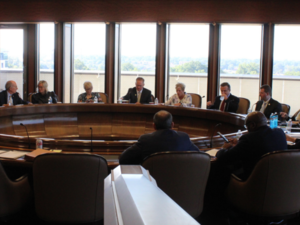
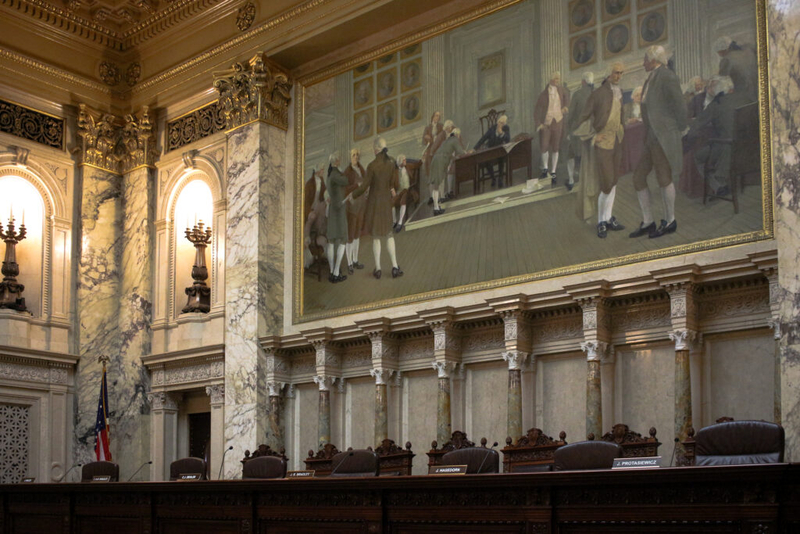
The Wisconsin Supreme Court chambers. (Henry Redman/Wisconsin Examiner)
The Wisconsin Supreme Court voted Thursday to create a committee that will study and assess the state’s recusal rules for judges and justices — delaying immediate action on an issue that has gained public prominence as the cost of the state’s Supreme Court elections has risen.
The Court voted after holding a public hearing and open conference on a petition from a group of retired judges to update the state’s recusal rules, which currently put the decision of recusal in the hands of each individual judge or justice.
The existing rules were adopted in 2010 and largely written by two powerful lobbying groups, Wisconsin Manufacturers and Commerce and the Wisconsin Realtors Association. In 2017, the Court’s then-conservative majority voted 5-2 to reject a petition to enact stricter recusal rules.
In recent years, as the Court’s liberals worked year by year to gain a majority, the conservative justices and many Republican officials in the state have complained that they were in league with the state Democratic party and called for the recusal of justices on high profile issues. Those accusations continued Thursday.
“I oppose the creation of this committee, because I think it will ultimately waste the time of all of the members,” Justice Rebecca Bradley said. “Because if the committee proposes anything that represents true reform in the recusal arena, the court, as currently constituted, will never adopt anything that will interfere with the successful formula for electoral success in recent elections, which is to telegraph how you will rule on cases and receive up to $10 million from a party, and then sit on that party’s cases. So I ultimately think it’s going to waste a lot of people’s time.”
During the public hearing, the petition authors were among the speakers pushing for a committee to study the issue rather than adopt the suggested new rules because of the complexity involved. Speakers questioned how recusal rules might conflict with the First Amendment, whether they would adhere to existing state law, the state of Wisconsin’s legal culture and Supreme Court campaigns were questioned.
“We want to have the correct rule, the best rule,” said retired Dane County Judge Richard Niess, one of the petitioners. “There is no one single rule that is demanded by the circumstances. There are a number of options, but they all need to be vetted within the context of Wisconsin and within the context of the constitutions, both state and federal.”
Throughout the day, Justice Brian Hagedorn was especially vocal, pushing speakers to say what they hoped to accomplish with a new rule. He noted that every member of the Supreme Court has decided cases in which one of the parties spent money campaigning for or against them.
“A lot of this feels like PR cover to me that doesn’t really do anything, and so I’m trying to figure out what problem you’re trying to solve,” Hagedorn said. “Who should have recused that’s not recusing, that you think this rule is meant to resolve. Like your petition is described as something ‘toughening recusal.’”
He added that it “goes both ways. From my perspective, I don’t know whether it matters whether somebody campaigned for or against somebody, so for example, SEIU [the Service Employees International Union], they spent, according to public records, under $40,000 campaigning against me. I sat on the case. They gave $400,000 plus to the Chief Justice [Jill Karofsky]. She sat on the case. Is that problematic? None of us, neither of us seem to think it was under those circumstances.”
The justices also debated how modern campaigns have affected the issue of recusal — with political parties and their allies spending millions of dollars to elect their preferred candidate while the candidates themselves more directly reference their personal views on important issues.
“There’s this question about what kind of legal culture we want in the state of Wisconsin,” Hagedorn said. “What kind of judicial elections we want in the state of Wisconsin. When I travel around the country, frankly, judges of all stripes kind of aghast at what has become of Wisconsin’s elections. We’re kind of considered a bit of a national disgrace about how elections are run nowadays, and part of that’s the resources that flow into these races. Part of it’s the nature of how campaigns have played out, because they’re no longer about often the legal questions.”
Karofsky said that those frustrations about Wisconsin’s system also go the other way, noting that observers are just as annoyed by nominees to the U.S. Supreme Court telling senators they’ll just “call balls and strikes” when clearly they will bring a political frame to the Court.
“The utter frustration of members of the Senate, members of the public, members of the legal community who know that’s probably — and as it turns out, in many cases — just not the truth, and that there’s this veneer that they hide behind and say that they are just going to be fair and impartial,” she said.
During the hearing, Ann Jacobs, a former president of the Wisconsin Association of Justice and chair of the Wisconsin Elections Commission, said that whatever the rule is, the Court needs to be careful that it doesn’t punish attorneys for being politically involved.
“It appears that in considering recusal, a judge has to consider a lawyer’s or a litigant’s prior political activities, and what does that mean? Door knocking, signature gathering, fundraiser holding, social media posts, hours spent on behalf of a campaign, meetings attended,” she said, referring to the draft rule written by the petitioners.
“How does a judge ascertain this?” she asked. “Does a lawyer have to divulge this as a matter of course, does the judge have to question lawyers about their political activities? Is a judge required to search the internet looking for political activity?”
Jacobs warned against the prospect of “a system where parties, litigants, their lawyers, etc. are cross examined” about their political activity and possibly excessive partisanship.
She said she has a “selfish interest in this” because she’s a co-chair of a Democratic party caucus, a partisan appointee to a state commission and sits on the board of a political organization.
“I’m sort of the definition of politically active, and what I can’t tell from this proposed rule is whether and when and how my political activity that I am proud of, within the party of my choosing could cause the recusal of a judge,” she said. “We must be extraordinarily careful not to penalize lawyers and litigants for being politically active. That’s the heart of our democracy. It’s what we want people to do.”
Madison, WI