With closure of key Lexington kinship care program, what will families do?
Jun 05, 2026 | 5:30 am ET
Description
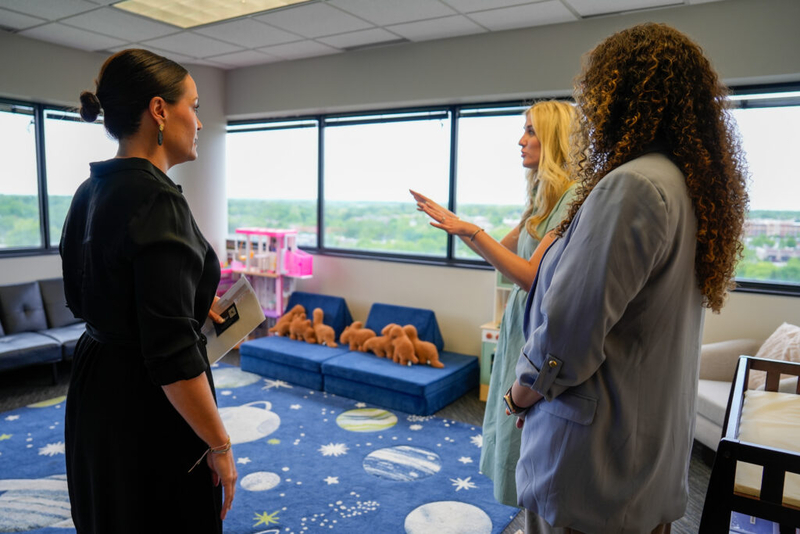
During a Back to School event in August 2025, Lt. Gov. Jacqueline Coleman (left) visited Kindred Roots. With her is program director Samantha Sheets (center) and program supervisor Noelle Thomas, (right). (Photo provided)
After four years of reuniting children being raised by non-parent relatives with their parents, Kindred Roots will close at the end of June after the Kentucky Cabinet for Health and Family Services canceled its contract.
The Lexington-based program, which works exclusively with children in kinship care placements, launched in 2022 and has served more than 1,000 children since then through supervised visitation, court advocacy, parenting education and more.
Kinship care is when the state removes a child from a home and grandparents or other family members choose to take temporary custody of the child rather than have the child go into state custody.
Kindred Roots had already signed a contract with the state for 2027 and 2028, said program director Samantha Sheets: “We thought that everything was going to be okay.”
Cabinet officials met with them in late May and told them their contract would be canceled, she said. The Bair Foundation, a Christian nonprofit over Kindred Roots, said in a press release that the news came “without advance notice and leaving no opportunity for transition planning.”
The program primarily — but not exclusively — works with families in Clark, Fayette, Madison, and Scott Counties. It’s the only known program of its kind in Kentucky.
KY gov announces foster care, Medicaid reimbursement, other program cuts
According to its state contract, available online through Kentucky Transparency, the program utilized Temporary Assistance for Needy Families (TANF) funds. Last October, the Beshear administration reduced cash payments that low income Kentuckians can get through the Kentucky Transitional Assistance Program (KTAP), which come from TANF.
In January the Trump administration froze access to TANF and other welfare funds to investigate “serious concerns about widespread fraud and misuse of taxpayer dollars.” Sheets said her understanding is the federal action “just trickled down to the state level and prohibited the state from continuing our contract.”
Cabinet spokeswoman Beth Fisher said the decision to terminate the contract was because the next state budget, passed by the General Assembly this year, didn’t sufficiently cover all its programs and because of “chronic defunding from the federal government.” On Thursday, the Beshear administration announced a series of social service cuts and reductions for the same reason.
“Unfortunately, due to the budget cuts by the Kentucky General Assembly, the Cabinet for Health and Family Services was forced to terminate its contract with Kindred Roots, a valued partner in providing services and care for family caregivers and children,” Fisher said. “Some of the services provided by Kindred Roots will now fall to the local Department for Community Based Services office in Fayette County as well as other vendors. DCBS will work with impacted families through this transition.”
Without an unforeseen intervention — the organization is actively looking into emergency funding options — it will shutter at the end of the month, on June 30.
“This clearly has far-reaching impacts, not just on, most importantly, our families, but also our very overburdened child welfare system that is already about to burst,” Sheets told the Lantern. “This program has greatly assisted our DCBS workers in those four counties, and I have talked to many of them since receiving this news, and they do not know how they’re going to do their jobs. They can’t absorb the amount of work that we were doing.”
Kentucky statute says social workers with the Cabinet for Health and Family Services and DCBS should not exceed caseloads of 25. The average caseload in June 2026 is 30, an improvement over recent years but still higher than the statute’s threshold.
Kindred Roots is currently working with 128 children, Sheets said. Each of those children has at least one parent and one kinship caregiver also being served — nearly 400 people in total.
The program had a 87% success rate in closing cases, Sheets said, which meant permanent custody with a relative or a successful reunification with the parent.
“This is a devastating loss for the families we served, for the dedicated Kindred Roots staff who showed up every day, and for the communities who counted on this work,” Renay Crouse, chief executive officer at The Bair Foundation, said in a statement. “The Kindred Roots team were exceptional stewards of every dollar entrusted to them and exceptional servants to every family who walked through their doors. The decision to eliminate this funding was made by the state and not a reflection of the program’s outcomes, the quality of its work or the commitment of its people. We grieve this alongside them.”
A population oft ignored
The kinship care population has often fallen below the radar. Without the grandparents and other relatives who step up to raise minor relatives, Kentucky’s already strained foster care system would be stretched further. There are nearly 9,000 children in out-of-home placements in Kentucky, which includes foster care homes, residential facilities, hospitals and detention.
Research shows that staying with family means better outcomes for children, but much needed financial support for kinship care is lacking.
In 2024, the legislature passed — and Gov. Andy Beshear signed — Senate Bill 151 into law, which was meant to provide financial relief to grandparents and others who are raising children who otherwise would be in state care by making it easier for the family members to qualify for foster care payments.
The measure was not funded at the time of passage. The legislature, auditor’s office and Beshear’s administration have, ever since, debated the funding issue — including in court — over who is responsible for it and where the money should come from.
In 2026, the General Assembly allocated $12 million over the next two years to implement the law. The Beshear administration had asked for $30 million.
In addition to supervising visits between children and parents and other educational services, Kindred Roots has historically offered tangible support for families, Sheets said.
“Anything that could be considered aiding reunification or placement stability in the kinship caregiver home, we can purchase. We frequently purchase beds for kids that have recently been placed with a relative who wasn’t expecting this kind of move,” Sheets said. “Maybe we buy a pair of work boots for a parent who just got hired on at a factory or Toyota, and then things for the children: Clothing; we pay for extracurricular activities. We can assist whoever has the child with a utility bill payment here and there.”
This support is key for families who are often facing unexpected — and extreme — expenses associated with raising a child.
“You cannot financially plan for taking in your grandchild,” Sheets said. “A lot of our caregivers are already living at or below the poverty line, and they get that call at midnight: ‘Your grandchild needs somewhere to go. Can we bring them to you?’ And they have to urgently make that decision. There’s no time to financially plan for that — and even if they could have financially planned, many of them just simply don’t have the resources to begin with.”
‘Uncertainty’ ahead
Kindred Roots is balancing looking for emergency funding that can allow them to continue their work and informing the families in their roster of the closure.
“It’s really difficult to try to explain to them what’s happening, (how) short of notice they have, and that we do not know how they’re going to transition, and we do not know what to tell the children, and so that’s a really difficult part of this too,” Sheets said.
She added: “How do you explain to a young child who’s been coming here for a year or eight months now that ‘you don’t get to come here and see your mom anymore, and we’re not sure when you’re going to be able to see her and where you’re going to go next’ in a child’s life that’s already had so much uncertainty? It’s heartbreaking.”
Frankfort