MSU trustees continue to push back against board policy tamping down on dissent
Jun 03, 2026 | 5:24 pm ET
Description
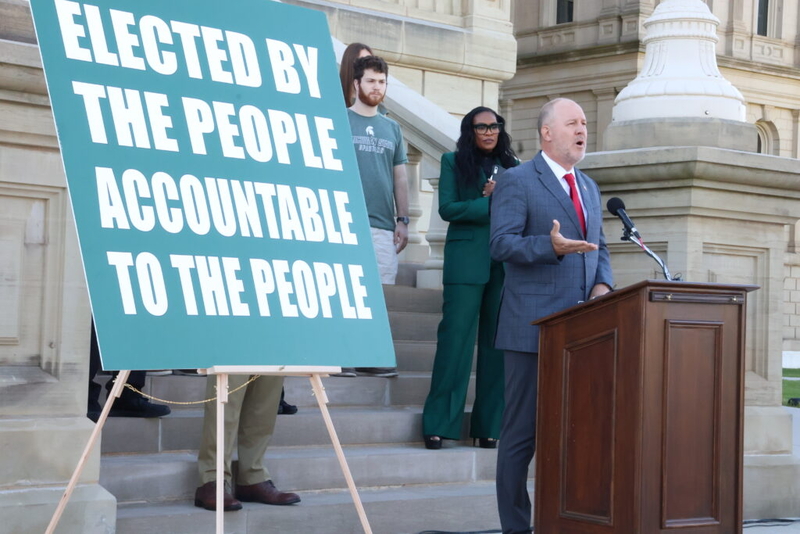
Michigan State University Trustee Mike Balow speaks out against recently approved changes to the Board of Trustees Code of Ethics and Conduct. June 3, 2026 | Photo by Kyle Davidson/Michigan Advance
Standing on the west steps of the Capitol building on Wednesday morning, two members of the Michigan State University Board of Trustees continued to disavow changes to the board’s Code of Ethics and Conduct, arguing that the new provisions present serious questions on their rights to free speech.
MSU Trustees Rema Vassar and Mike Balow, a Democrat and Republican, respectively, declined to sign a required statement agreeing to follow an updated Code of Ethics. The update bars trustees from speaking out against decisions made by the majority of the board, among other provisions.
Trustees who did not sign the statement were warned that they could face sanctions including public censure, removal from leadership positions and the loss of privileges like complimentary access to university sporting events.
After Balow and Vassar refused to sign, the university made good on its warning and revoked their credentials to attend the Detroit Regional Chamber’s annual Mackinac Policy Conference.
“What Michigan State University has done sets a dangerous precedent, not only for its own board, but for every elected governing board in this state,” Vassar told reporters on Wednesday. “If a public university where rigorous debate and academic freedom is actually championed, if a public university can sanction an elected official for refusing to sign a loyalty pledge, the principle of free democratic representation is at risk.”
While Vassar has requested Michigan Attorney General Dana Nessel’s opinion on the changes, the Foundation for Individual Rights and Expression, an organization focused on free speech issues, sent a letter to the board on Friday, arguing that the updated Code of Ethics and Conduct violates the First Amendment. The organization requested a response by June 12.
Nessel spokesperson Danny Wimmer told Michigan Advance on Wednesday that the Michigan Department of Attorney General does not legally advise or represent the university, their boards or the trustees.
“Trustees and the university have their own legal counsel, and any advice provided by our office would not be legally binding on the university,” Wimmer said in a statement.

MSU spokesperson Amber McCann previously told the Advance that the Board of Trustees did its due diligence in seeking a legal review before making the changes.
“The Board of Governors at Wayne State University also has a Code of Conduct that includes similar standards, and the State of Michigan’s ‘State Ethics Act’ provides standards of conduct for public officers and employees,” McCann added.
Balow disputed McCann’s statement, telling reporters the trustees never received a written opinion on the matter, and that the updated policy did not go through the board’s committee process.
“If what MSU Comms — which speaks for someone, let’s just say the administration and the bare majority of the trustees here — claims that a legal review of that policy is the fact that it was drafted by our chair and our general counsel, then I reject that as a legal review,” Balow said. “When I say legal review, it should be a rigorous constitutional expert, someone that is independent of the board, which the general counsel surely is not, and neither is the chair.”
The new code of conduct and the State Ethics Act share provisions barring officials from representing their opinion as that of their institution and blocking officials from sharing confidential information with unauthorized people before that information is officially released to the public.
MSU’s code of ethics goes further, however, both in its restriction on dissent and its requirement that trustees “act ethically and not provide inaccurate, misleading, or false information concerning the university.”
“Who gets to decide what would be considered inaccurate?” Balow said.
Alongside a request for Nessel to review the matter, Vassar called on the Michigan Legislature to look into oversight mechanisms and potential new measures “to protect elected officials from institutional retaliation for the exercise of their constitutional rights.”
It appears that a few leaders in the Legislature have already heard that call.
Joining Vassar and Balow at the press conference on Wednesday were state Sens. Joe Bellino (R-Monroe) and Jim Runestad (R-White Lake).
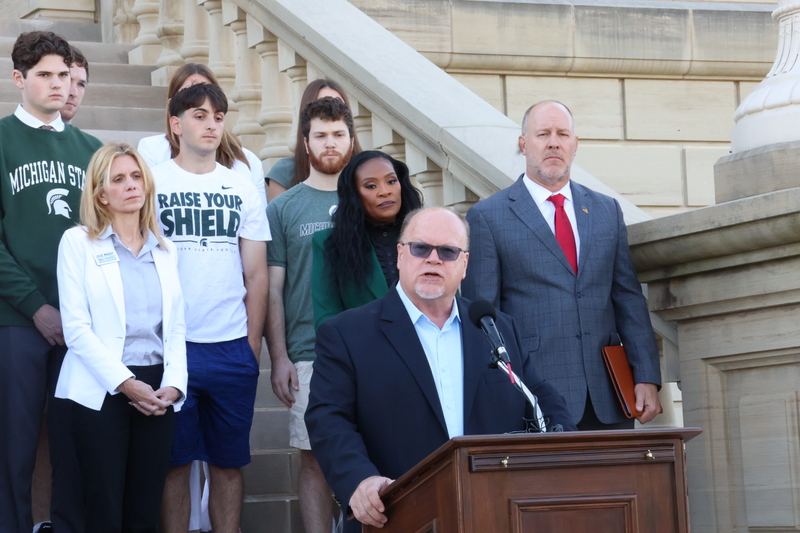
Runestad, who also serves as chairman of the Michigan Republican Party, emphasized that the university’s eight trustees are not employees, but individuals elected by the people to exercise independent judgment.
“When you ask elected officials to sign away their voice, you are asking them to betray the very people who put them there,” Runestad said.
In recent years, the MSU Board of Trustees has been a frequent source of scandal and public frustration due to infighting within its ranks, with former Michigan State University President Kevin Guskiewicz citing friction within the board as the reason for his recent resignation.
While Michigan Gov. Gretchen Whitmer previously denied a request from the board to remove Vassar and Trustee Dennis Denno for allegedly violating its policies around ethics and conduct, the governor has endorsed a bipartisan proposal giving the governor control over university board appointments. It would also allow primary voters to determine nominees for Michigan secretary of state and attorney general — all of which are currently determined by the major parties at their election-year spring and fall conventions. The nominees are later elected during the November general election.
That vote failed, however, on Wednesday when HJR U — which would have created a constitutional amendment to change how the governing board members are chosen — received only 52 votes during the House’s regular session. It needed a two-thirds majority vote to advance to the Senate.
If the proposal had been approved by the House, and later by the Senate, it would have gone before voters on the Aug. 4 primary ballot, according to Gongwer News Service.
Lansing, MI