Things are looking up for the Crook Point Bridge
Jun 03, 2026 | 6:39 pm ET
Description
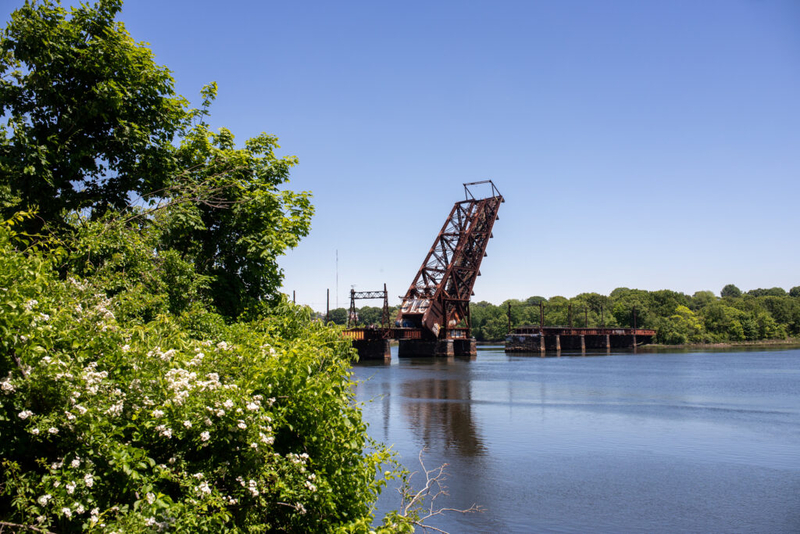
The Crook Point Bascule Bridge in Providence, seen here on June 3, 2026, has been locked in an upright position over the Seekonk River since 1976. (Photo by Alexander Castro/Rhode Island Current)
Fifty years since the rusty and iconic railway bridge connecting Providence and East Providence became a bridge to nowhere, legislation that would bring new life to it moved toward a more concrete destination Wednesday.
A pair of concurrence votes in both chambers of the Rhode Island General Assembly sends legislation to create the Crook Point Bridge Authority to Gov. Dan McKee’s desk.
Providence Democrats Rep. Rebecca Kislak and Sen. Sam Zurier sponsored the legislation in their respective chambers that would create the quasi-public body to take over the defunct railroad bridge with half its span locked in a skyward pose since 1976. The Crook Point Bascule Bridge is owned by the Rhode Island Department of Transportation (RIDOT).
“The Crook Point Bridge is our version of the Leaning Tower of Pisa,” Zurier said via email after the floor vote Wednesday. “I look forward to following the work of the new Authority to find the best new incarnation of this local landmark.”
This new agency would oversee the maintenance, preservation and possible redevelopment of the bridge and its surrounding area near a paved bike path and baseball diamond off Gano Street in Providence.
Back in April, both the House and Senate initially approved their own versions of the legislation. Wednesday’s votes, which approved each chamber’s companion bill and were packaged as part of the day’s consent calendars, concluded the General Assembly’s input on the matter.
Kislak said via text message Wednesday that the bridge is “a very popular monument and the decision about what happens next will be Providence’s.”
“I hope that it will become more open space for the community to enjoy,” she added, citing a 2021 contest which prompted imaginative designs for the bridge’s future and the winning design as “so beautiful.”
Olivia DaRocha, a spokesperson for McKee’s office, said Wednesday that the governor will review the bills when they reach his desk.
RIDOT is “ready, willing and able to transfer ownership to the city through a bill of sale for a nominal amount ($1),” department spokesperson Charles St. Martin III wrote in an email Wednesday.
That may prove a relief for the state, which has tried to demolish the bridge several times — an outcome St. Martin reiterated Wednesday.
“The structure as it stands today is badly deteriorated and RIDOT has determined that it serves no useful transportation purpose and therefore we would remove it,” St. Martin wrote.
Upon transfer to the city, St. Martin added, the bridge would become the onus of the new authority, who would have “to insure, maintain and inspect the bridge at its own expense,” leaving the state without “any further responsibility regarding the bridge.”
Providence mayor unveils New Year’s resolutions in legislative package
Providence Mayor Brett Smiley highlighted the Crook Point Bridge bills as one of his legislative priorities for his administration in 2026.
“Mayor Smiley has long supported and urged for the creation of a Crook Point Bridge Authority as it provides clarity and a path towards ownership, preservation and maintenance for a beloved city landmark,” Carl Austin Miller Grondin, a spokesperson for the Providence Mayor, said via email Wednesday.
The Providence City Council supported the bridge authority’s creation via a resolution approved in February.
The resolution was sponsored by Providence City Councilor John Goncalves, who represents Ward 1, where the bridge is located. Goncalves said via text message Wednesday, that he “used to always relish it as a kid growing up in the neighborhood!”
The Providence Preservation Society also urged preservation of the bridge, and placed it on its 2026 list of most endangered places.
Marisa Angell Brown, the society’s executive director, said via email Wednesday that the group is “excited to see this move a big step closer to reality.” The bridge “has tremendous potential to become a dynamic recreational space that reconnects people with our riverways,” Brown said.
“I know some people view it as a hulking industrial relic, but the fact remains that it has tons and tons of usable steel that can be used as the foundation for something new,” she added. “And demolition costs money! Why not put that money into rehabilitation and reuse?”
Saving the bridge from demolition
Per the bill text, the quasi-public authority would be governed by a three-member board of directors, who would be appointed by the city’s mayor and approved by its City Council. The board would be able to enter contracts, hire consultants and borrow funds in its oversight of preservation or redevelopment efforts.
The bill does not, however, specify any designs or plans. The Scherzer rolling lift railway bridge was abandoned in 1976 amid declining railroad usage and left up to permit the smooth flow of river traffic underneath.
“It’s an iconic part of the skyline,” Zurier said when introducing the bill to the Senate Committee on Special Legislation and Veterans Affairs in April. “Everybody who rides on the Route 195 bridge, you have extra time these days to admire the Crook Point Railroad Bridge.”
When introducing the bill before the House Committee on Municipal Government and Housing on March 31, Kislak called the Crook Point span “the iconic bridge that is stuck in the up position, and on many a T-shirt.” An initial plan for demolition of the legendary structure in 2016, she said, saddened “many, many, many of my constituents.”
The legislation passed Wednesday essentially safeguards the bridge from demolition while the city susses out what to do with it next.
Whatever ends up happening, the bridge will likely need some rehabilitation to achieve the level of splendor associated with the popular Pedestrian Bridge that crosses the Providence River. This walkway, completed in 2019, was part of the old Interstate 195 and had no apparent use at first either, Smiley noted when testifying on the Crook Point bill in the March 31 House committee hearing.
The Crook Point Bridge is our version of the Leaning Tower of Pisa.
“We have a long track record in Providence of taking underutilized and overlooked spaces and turning it into great public places,” Smiley told House lawmakers.
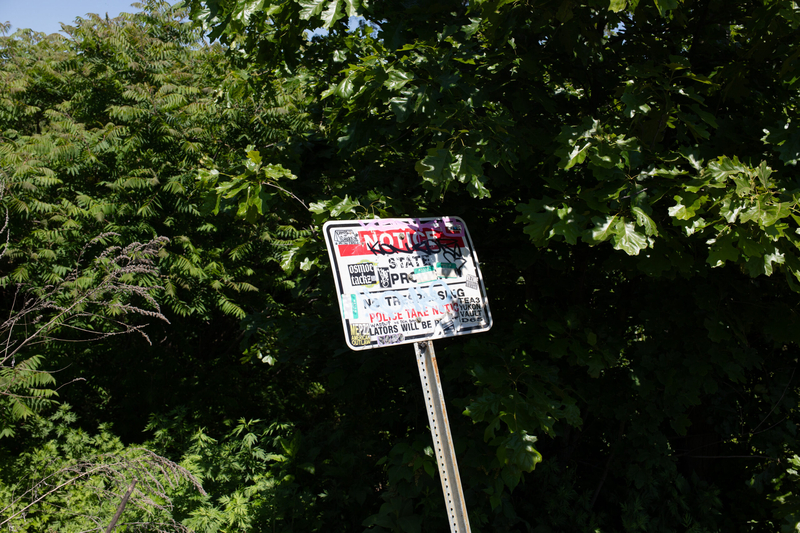
In contrast, the Crook Point Bridge remains a generally guarded, albeit minimally barriered, landmark. On Wednesday afternoon, the bridge remained inaccessible, its storied steel kept behind not just one, but two, layers of black chain link fencing. A sign on a bent post, its text barely visible through a layer of graffiti and stickers, declared the area state property and warned against trespassing.
The 850-foot bridge has lived many lives since being built in 1908 as part of the East Side Railroad Tunnel project, which connected Providence Union Station to the New York, New Haven and Hartford Railroad lines. At one point, it was even electrified and carried passengers to Bristol, and Fall River, Massachusetts. In more recent history, the bridge is a popular site for photography, illicit climbing and industrial sightseeing.
The bridge authority proposal passed the Senate without a hitch on April 16, but it encountered two votes of resistance during its initial floor appearance in the House that same day. Rep. Charlene Lima, a Cranston Democrat, voted against the bill. So did Rep. Ramon Perez, a Providence Democrat, who did not respond to a request for comment Wednesday.
Lima, however, explained her rationale from the floor. She found it quizzical to create another public body charged with upkeeping the bridge. While she reiterated her feelings that RIDOT is “overbloated,” leaving the bridge to a new entity struck her as odd.
“I don’t know, this bridge thing seems very fishy to me,” Lima said.
“I can assure you, there’s nothing fishy about it,” Kislak responded. “It’s that the people of Providence did not want DOT to knock down the bridge.”
Kislak also tried to assuage Lima’s worries about leaving the land’s development and use to a quasi-public entity, saying there was minimal land to actually develop.
“There isn’t enough room to develop anything there,” Kislak said. “It will be open to public purposes.”
Lima said she appreciated that information, but clung to a sliver of superstition. The bridge authority bill mandates that the new quasi-public entity shall comply with the state’s access to public records law, which falls under Title 38 in state statute.
“This is in section 38 which reminds me of 38 Studios,” Lima said, and cast her no vote out of an “abundance of caution.”
- June 4, 202612:40 pmUpdated with a comment from Providence City Councilor John Goncalves.
Providence, RI