Lamont orders $300 grocery gift cards for residents losing SNAP
Jun 03, 2026 | 4:45 pm ET
Description
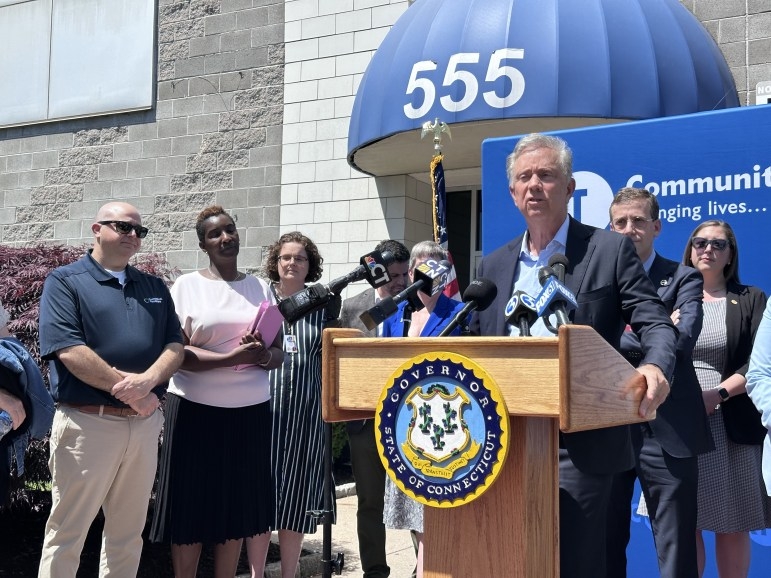
Photo courtesy of CT Mirror
Connecticut will provide $300 grocery store gift cards to an estimated 25,000 residents who’ve lost federal nutrition assistance, Gov. Ned Lamont announced Wednesday.
The program, expected to cost $8.5 million and paid for with state surplus funds, will use the state’s nonprofit community action agencies to distribute cards to eligible residents, likely by August, according to Department of Social Services Commissioner Andrea Barton Reeves.
“Most other states are saying ‘Tough luck, blame it on [President] Trump, nothing, we can do,’” Lamont said during a late morning press conference outside the offices of Community Renewal Team in Hartford, the nonprofit community action agency for Hartford and Middlesex counties. “Here in Connecticut, we’re stepping up and looking out for you.”
Anti-hunger advocates estimate more than 30,000 Connecticut recipients of federal Supplemental Nutrition Assistance Program, or SNAP, have been removed from the rolls since November because of rule changes ordered last summer by Trump and the Republican-led Congress.
Veterans, unhoused people, young adults transitioning out of foster care and parents of minor children age 14 and older no longer are exempt from work requirements, even though many struggle with mental illness. Federal officials also cut SNAP benefits for certain categories of legal immigrants.
State social services officials project about 25,000 members of that group may not be able to find or maintain employment.
Reeves noted Connecticut will become just the second state to commit state dollars this year to replace vanishing federal SNAP support. The Illinois legislature and Gov. J.B. Pritzker this week ordered a one-time benefit of $400 to assist people losing federal nutrition aid.
Lamont’s proposal must be reviewed by Connecticut legislative leaders, who are expected to approve it but cannot modify it based on the terms of a special reserve they created last November to mitigate deep federal cuts to human service programs.
House Speaker Matt Ritter, D-Hartford, quickly endorsed the governor’s plan.
“This is exactly why we pushed for the creation of this fund in the 2025 budget process,” he said. “It is also a reminder that federal cuts are causing serious problems for Connecticut families. “
Lamont’s announcement came just two days after some of his fellow Democrats in the General Assembly criticized his administration for doing too little to assist this population.
The governor earlier this year sent nearly $25 million from state surplus to food banks and pantries. Another $4.7 million went to the United Way of Connecticut’s 2-1-1 information line and to nonprofit community action agencies, which help SNAP recipients navigate new eligibility rules and find additional forms of aid.
The Lamont administration also added 50 new positions to an understaffed social services department to help residents with SNAP and other assistance programs.
But food bank officials have said they can offset only a fraction of the need created when so many lose SNAP benefits.
Sen. Cathy Osten, D-Sprague, who has criticized the governor over the issue in the past, praised him Wednesday for taking another step. “It’s about feeding people, feeding families, feeding children, feeding elders,” she said. “That’s what it’s about.”
Another critic, Sen. Matt Lesser, D-Middletown, co-chair of the legislature’s Human Services Committee, called the gift card plan a “bridge” program to help keep households fed until a larger political debate is held.
Connecticut Democrats are hopeful that if their party regains control of the U.S. House following the November elections, some of the federal human service cuts will be reversed.
But if they’re not, some lawmakers here say they expect a state legislative debate, when the 2027 regular session launches in January, about whether Connecticut should create its own ongoing nutrition benefit.
“Our governor is there on the right side, standing with the people, and we are so grateful for it,” Lesser added.
Lesser’s co-chair on the Human Services Committee, Rep. Jillian Gilchrest, D-West Hartford, said she’d hoped Lamont would have gone further.
A $300 gift card, distributed in August, would provide an average of $60 per person per month until the next General Assembly session convenes in January. That’s a little less than one-third of the $191-per-person average monthly SNAP benefit.
Anti-hunger advocates have suggested Connecticut replace at least half or all that gap.
“I’m appreciative that something is being done to add the food needs of Connecticut citizens,” Gilchrest said. “I’m frustrated that this proposal doesn’t go far enough and that once again the governor has responded to recommendations from those in the field — who know best — by doing less than what was asked.”
Gilchrest said Connecticut has the resources to afford a stronger response.
The special fund created with state budget surpluses to temper federal cutbacks in human service programs held about $380 million before Lamont committed the $8.5 million for grocery store gift cards.
And the state expects to end the fiscal year on June 30 with roughly $1.6 billion unspent.
Lamont said Wednesday he would consider further action next year after the $300 gift cards are exhausted.
“If we find that’s not good enough,” he said, “we’ll be sitting back together with the legislature to see what we can do on a more permanent basis.”
At a New Haven food pantry on Wednesday, several people said they had lost SNAP since Trump returned to office.
“It’s affected me a lot,” said one woman, who declined to give her name due to concerns about her immigration status. Without SNAP, most of her family’s food comes from visits to food pantries.
She is prediabetic and her husband has high cholesterol, so she tries to cook a healthy diet. “We can visit food pantries, but it’s not enough. Rent is really high and the price of gas has gone up a lot.”
Jose Santini, who had a liver transplant a year ago, said that his daughter lost SNAP and he visits food pantries frequently to help her and his grandchild.
“I’ve got to eat healthy because of the liver transplant, and everyone else in the house, we try to eat healthy,” Santini said.
Hartford, CT