Rhode Island backed a pro-slavery amendment 165 years ago. Now lawmakers look to repeal it.
Jun 03, 2026 | 2:44 pm ET
Description
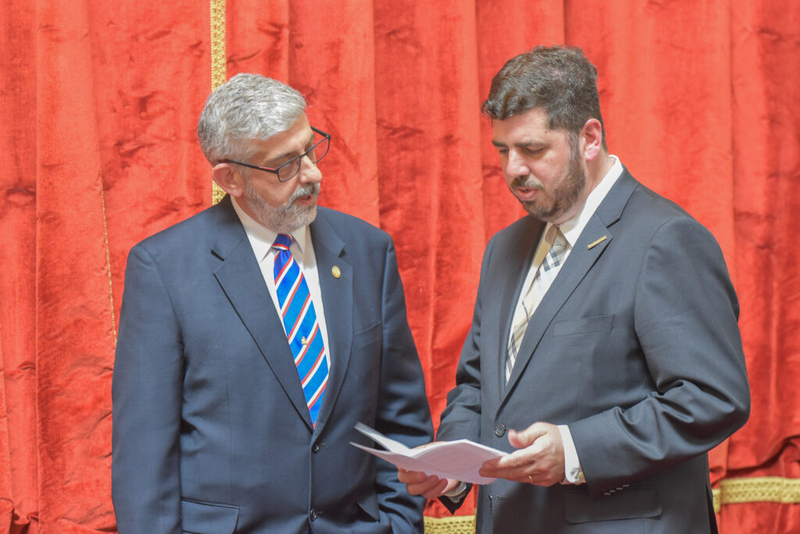
Daniel Trafford (left), a State House publicist, speaks with Rep. Joseph Solomon on the House floor on Wednesday, June 3, 2026. (Photo by Christopher Shea/Rhode Island Current)
Daniel Trafford can rattle off dates of Civil War battles and publications down to the month and day without hesitation.
But the State House publicist and history buff had no idea Rhode Island lawmakers attempted to prevent the Civil War by ratifying a constitutional amendment that would have protected slavery as a states’ rights issue.
“I had never heard of it before,” Trafford said in an interview. “I was shocked.”
The Corwin Amendment, named after the Ohio Republican congressman who drafted it, never became law. Only five state legislatures (out of 26 needed) ratified what would have been the 13th Amendment following its March 1861 passage in Congress. The attempt to appease southern states by preventing federal interference in slavery became moot; the Civil War broke out in April 1861. Four years later, in 1865, the 13th Amendment abolished slavery, relegating the Corwin Amendment to a quickly forgotten relic.

Trafford uncovered the unflattering detail from Rhode Island’s past during an unrelated archives search in February, prompting present day legislators to reverse the decision made by their predecessors 165 years earlier.
A joint resolution repealing the May 31, 1861 state ratification of the Corwin Amendment was unanimously approved by the House of Representatives Wednesday afternoon. A Senate companion received unanimous approval on May 28.
“It’s never too late to right a wrong,” Rep. Joe Solomon, a Warwick Democrat and sponsor of the House resolution, said in an interview Monday.
Three other states that ratified the amendment, Ohio (1864), Maryland (2014) and Illinois (2022), have already repealed their legislatures past decisions. Only Kentucky has yet to rescind its prior approval, according to research from Kate Wells, state librarian.
Wells declined to be interviewed, though Secretary of State Gregg Amore, a former high school history teacher, wrote in support of the repeal.
“It is important that we acknowledge the mistakes of the past and rectify them when we are able,” Amore wrote to lawmakers in a May 21 letter to lawmakers.
Amore touted Rhode Island’s contributions to the Union Army during the Civil War, alongside the “great distinction” of becoming the second state to ratify the actual 13th Amendment outlawing slavery.
Uncovering the truth
The 1861 state legislature’s approval of the Corwin Amendment, passed unanimously in the Senate and by a 43-18 vote in the House, suggests a different take. A June 3, 1861, article published in the Providence Evening News appears to be the only documented account on the decision.
“The debate was earnest and animated, and it were to be wished that the whole people of the State could have heard for themselves the illustration which it furnished of the truth, that while there is union among us in supporting the government against rebellion, there is a very decided antagonism in reference to questions nearly connected with the preservation of the government ordained by our fathers,” the article states.
Put another way: Lawmakers wanted to avoid civil war, and preserving the right to own slaves seemed a viable way to keep the peace.
“I think the prevailing thinking was that slavery would die out of natural causes anyway,” Trafford said as explanation for the legislature’s approval of the Corwin Amendment.
Keith Stokes, Rhode Island’s historian laureate and consulting historian for the Rhode Island Black Heritage Society, offered a less flattering explanation.
“Even though Rhode Island and other New England states abolished slavery, they remained complicit for a long time,” Stokes said in an interview Wednesday.
Fresh off an industrial revolution marked by massive population growth and a booming textile industry, state leaders were reluctant to sacrifice newly acquired economic gains and interests at risk by supporting war, Stokes said.
Nearly 100 manufacturing mills extending from Westerly to Exeter and Providence depended on slave-picked cotton, which was turned into a type of durable, denim material referred to as “Negro cloth” sold back to Southern states to clothe their enslaved laborers.
An 1835 article in the Providence Daily Journal documents a “very numerous and respectable meeting” of anti-abolition leaders in Providence. Nicholas Brown Jr., Brown University’s namesake, was appointed one of its officers.
Meanwhile, a growing number of Southern plantation owners were flocking to Newport to build summer homes, simultaneously flexing their political and economic interests in the state.
“For Rhode Island to take this pragmatic political approach, or self-interested economic decision, would have made perfect sense for people at the time,” Stokes said.
Bringing past to present
Drawing attention to the unsavory side of Rhode Island’s slave-rooted history has gained traction among lawmakers and advocates in the wake of the May 2020 murder of George Floyd, a Black man killed by police in Minneapolis.
That same year, Rhode Island voters approved a constitutional amendment dropping “Providence Plantations” from the state’s official name. Also in 2020, the city of Providence began a multi-phase racial reparations program that included a detailed report and interactive exhibits on the 400-year history of city and state racial inequities.
This February, the grassroots-funded African American Museum of Rhode Island opened in South Providence as the first statewide space dedicated to preserving and celebrating Black history. The Newport Historical Society is set to open its own educational and engagement space, the Edward W. Kane and Martha K. Wallace Center for Black History, on June 19.
But reshaping long-held perceptions, however misguided, remains challenging.
Sen. Tiara Mack, a Providence Democrat and co-chair of the Rhode Island Black, Latino, Indigenous, Asian-American and Pacific Islander Caucus, still walks by seals within the State House that bear the “Providence Plantations” clause now erased from the state’s official name. She and other lawmakers have spent much of the 2026 legislative session advocating for a state Voting Rights Act to enshrine racial voting access and equality as longstanding federal protections are dismantled.
“I am still having to explain to people what the Voting Rights Act is and why it matters,” Mack said in an interview.
Repealing the Corwin Amendment is a good thing, she acknowledged.
“But the real work is ensuring that we as Rhode Islanders learn from our history and are compelled to make sure we are amending some of the work that has happened and is still taking place to disenfranchise people,” Mack said.
Trafford, who planned to watch the House floor vote alongside fellow members of the Sons of Union Veterans of the Civil War, still sees value in the gesture of repeal. Especially because the Corwin Amendment has no expiration date, allowing for a slim but possible chance at revival.
“To have a legal document like that with Rhode Island’s name on it just rubs me the wrong way,” he said.
The resolution does not require Gov. Dan McKee’s signature. Once each chamber approves the other’s duplicate resolution, it will be forwarded to the president, federal archivist, U.S. House speaker and clerk, U.S. Senate president and secretary, and Rhode Island’s congressional delegation, and printed in the congressional record.
- 4:27 pmUpdated to include the House of Representatives vote repealing the Corwin Amendment ratification on Wednesday.
Providence, RI