New Orleans, state leaders continue fight over court consolidation
May 11, 2026 | 5:41 pm ET
Description
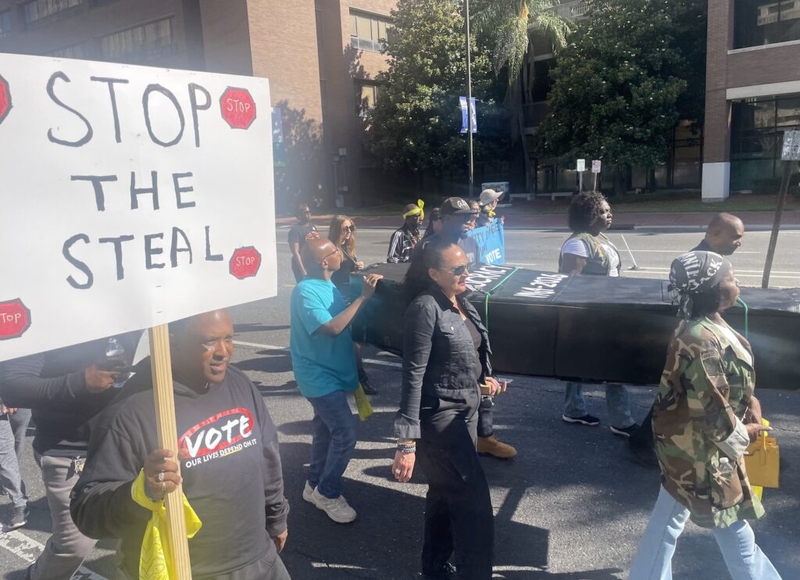
Protesters hold a coffin for "Democracy" as they march down Tulane Avenue in New Orleans on Monday, May, 4, 2026, in opposition to Gov. Jeff Landry's order to suspend U.S. House elections in Louisiana and eliminate the clerk of criminal court's position. (Photo by Greg LaRose/Louisiana Illuminator)
The New Orleans City Council met Monday for a special meeting to place an interim clerk in charge of its recently consolidated court system and set a special election in November to fill the job permanently.
Louisiana Attorney General Liz Murrill said she intends to block both moves, elevating the intensity in a continuing battle between city leaders and the Landry administration over who’s in charge of the local judiciary — a fight with racial and political subtext.
Council members voted 5-2 to name retired Judge Calvin Johnson to the interim post, despite a new state law that put Orleans Civil Court Clerk Chelsea Richard Napoleon in charge of the combined offices. The statute, Act 15, also prevented Calvin Duncan from taking office as criminal court clerk a week ago, despite his resounding victory in the November election.
In a separate resolution, the council called for a special election to be placed on the Nov. 3 ballot to decide who gets the unified clerk’s job for the long haul.
There are ongoing lawsuits in state and federal court that challenge whether the state can displace Duncan from the job he was elected to hold, but supporters of the council measures approved Monday are leaning on a separate statute to support their actions.
“We would love to wait to see how the cases play out, but the law in question has a time limit,” City Council President JP Morrell said before both items were approved.
The law Morrell referenced details how local governments handle vacancies in elected offices when the remaining term is more than a year. The statute requires a special election be called to fill the post within 20 days of it being vacated, which is how Morrell and others behind the resolution interpret the consequences of Act 15.
Ahead of Monday’s special council meeting, Orleans District Attorney Jason Williams provided its members with written guidance Thursday on the two laws, indicating they would be within their rights to name an interim clerk and call for an election. Mayor Helena Moreno supported that stance in her own message to the council.
Murrill countered with her own letter Friday, in which she told the council Williams’ analysis of the two state laws was “plainly wrong.”
“It is not only legally misguided but irresponsible …” Murrill wrote. “Acting upon this advice
will create the very uncertainty he incorrectly claims now exists.”
Act 15 did not create a new office but rather eliminated one, consolidated its duties under the civil court clerk and then renamed that office, the attorney general wrote.
Napoleon, who has not come out publicly against Duncan taking office, took part in a public comment period before Monday’s council votes and called the special election proposal an “illegal proposition.” If the courts allow the election to take place Nov. 3, it would mean she would have to run for the post, most likely against Duncan and possibly other candidates, after being unopposed last November for a second term in the civil clerk’s post.
“Is the goal to create chaos where there is none?” Napoleon told the council. “Are we called here today to talk about the law or politics?
The two votes against the propositions came from council members Eugene Green Jr. and Lesli Harris, who both said a special election would give validity to the new state law that eliminated the criminal court clerk’s role.
“We’re playing into the hands of Baton Rouge. We’re pitting two Black elected officials against each other,” Harris said.
The maneuvers from Landry, Murrill and the legislature for control of the Orleans court system reached their apex just as the U.S. Supreme Court ruled Louisiana’s map of congressional districts was an unconstitutional racial gerrymander. The governor issued an emergency order to suspend the U.S. House party primaries based on that map, and the legislature has started the process to update the map’s boundaries. The GOP-favored options could eliminate one or both of the districts that have elected Black Democrats to Congress.
Critics of the effort to condense the Orleans court system consider the policy changes are less about striving for efficiency and more of an attempt from the state’s Republican leaders to bring elected officials in the state’s predominantly Black, Democratic stronghold to heel.
Duncan’s election win drew national attention last year, following his vow to seek the clerk’s office after he was wrongfully imprisoned for nearly three decades. He pleaded guilty to a lesser charge in 2011 before evidence was brought forward to clear his name in 2021.
After earning the moniker “jailhouse lawyer” during his time at Louisiana State Penitentiary, Duncan earned his law degree and has continued to represent incarcerated clients.
Landry signed the measure to abolish the criminal court clerk’s position just before Duncan could officially take office May 4.

Baton Rouge, LA