6 years after COVID-19, Arkansas leaders need to do more to battle vaccine skepticism
Mar 22, 2026 | 6:00 am ET
Description
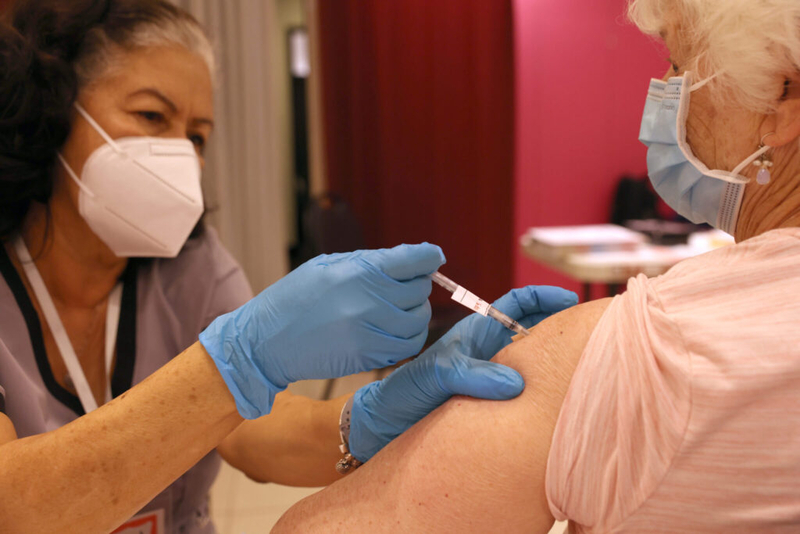
Registered nurse Orlyn Grace, left, administers a COVID-19 booster vaccination to Jeanie Merriman, right, at a COVID-19 vaccination clinic on April 6, 2022 in San Rafael, California. (Justin Sullivan/Getty Images)
Like most people in Arkansas, my daily routine changed completely six years ago this month when the state announced its first case of COVID-19. My beat as an AP statehouse reporter shifted almost entirely to covering the pandemic’s impact on nearly every aspect of Arkansans’ lives.
A key part of that work included covering the daily news conferences then-Gov. Asa Hutchinson led about the growing number of cases and the steps being taken throughout Arkansas to battle the coronavirus.
Hutchinson was a different kind of Republican, more comfortable with charts and graphs than with waging fights on social media. He deferred to the state’s top medical officials when facing questions about the coronavirus, vaccines and other health issues.
To avoid crowding into a conference room at a time when we were all supposed to be distancing ourselves, reporters were thankfully allowed to call in remotely with questions.
Along with learning how to cram two or three questions into one in case I didn’t get a followup, I discovered something very important. People around Arkansas who had been sent home from work or school were closely watching these news conferences. On a regular basis, I’d get emails or Facebook messages from the public requesting specific questions to be asked at the next day’s news conference.
The experience underscored just how much people rely on policymakers to provide accurate information in moments of crisis, and how much they rely on factual reporting to help them make sense of confusing times.
It also highlights what’s so worrisome about the consequences of misinformation and skepticism about vaccines will have the next time Arkansas and other states face another serious health emergency. COVID-19 may seem like a distant memory for some, but its lessons shouldn’t be forgotten.
That’s why the doubts and skepticism that U.S. Health and Human Services Secretary Robert F. Kennedy has sown about vaccines are so troubling. The dangers in Arkansas are exacerbated by the gaps in health care that remain, especially for the state’s lower-income residents.
A federal judge’s ruling last week blocking Kennedy’s efforts to change immunization policies offered some hope, but state leaders need to take a more prominent role in battling misinformation.
Kennedy, who has long pushed debunked theories linking childhood vaccines to autism, overhauled a Centers for Disease Control and Prevention Committee dedicated to issuing immunization recommendations. Kennedy last year replaced the committee’s members with a slate that included some vaccine skeptics.
Giving vaccine skeptics not just a platform for sharing misinformation but a role in the nation’s immunization policies is an especially significant threat for a state like Arkansas.
There may not be another pandemic on the horizon, but the dangers of vaccine misinformation are clear as states like South Carolina and Texas have seen an outbreak of measles cases.
Combatting parents’ hesitations about vaccines was already a challenge even before Kennedy took on his role. Researchers last year found that parental hesitancy about vaccines in Arkansas increased by 15 percentage points between 2019 and 2023. The World Health Organization and other health advocates say advances in vaccines are being undermined by the spread of misinformation and disinformation about them.
Policymakers can distance themselves from Kennedy’s moves to weaken the public’s trust in vaccines.
Hutchinson provided a model for how to do this when he embarked on a series of town halls as governor to talk about vaccinations. His message to constituents, including some who were downright hostile about vaccines, was to listen to medical professionals instead of conspiracy theorists.
That approach is in line with findings from researchers at the University of Arkansas for Medical Sciences, who say health care providers along with family and friends play a large part in parents’ decisions on whether to vaccinate their children.
Gov. Sarah Huckabee Sanders also tried an approach aimed at vaccine-skeptical conservatives, writing an op-ed during her successful 2022 campaign sharing her reasons for getting the COVID vaccine. But Sanders’ message was also tinged with partisan digs at top Democrats and Dr. Anthony Fauci.
The two Republican governors’ approaches may have been different, but they displayed that the state’s top elected officials have a role to play in cutting through misinformation about vaccines.
Arkansas’ leaders don’t need to wait until the next crisis to begin pushing back on that misinformation now.
Little Rock