‘A real trust problem’: Senators question SC superintendent’s judgment giving homeschoolers vouchers
Feb 19, 2026 | 5:59 pm ET
Description
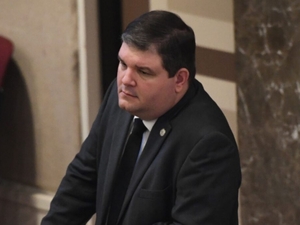
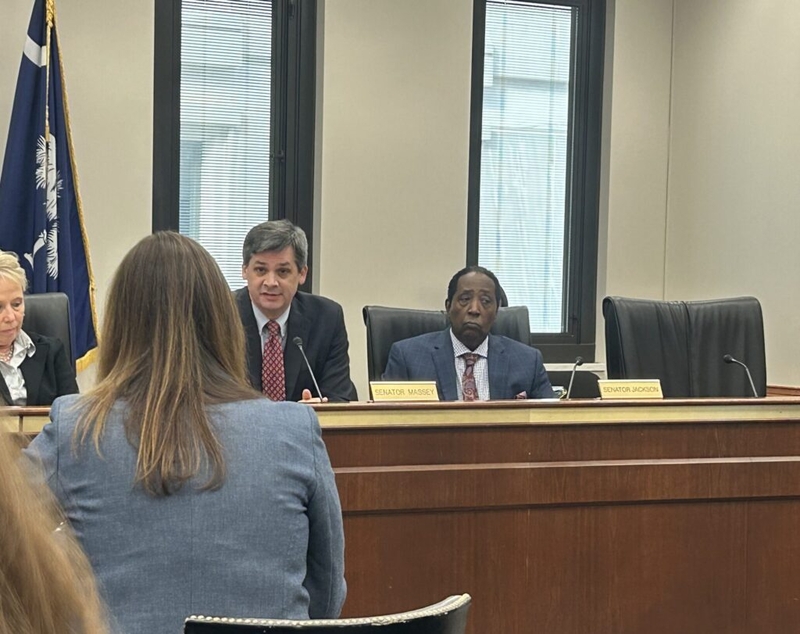
Senate Majority Leader Shane Massey, R-Edgefield, question state Superintendent Ellen Weaver over how the agency spent voucher funds at the Gressette Building in Columbia, S.C., on Thursday, Feb. 19, 2026. (Photo by Skylar Laird/SC Daily Gazette)
COLUMBIA — Senators grilled the state superintendent Thursday over her department’s decision to give taxpayer-funded education scholarships to homeschooled students despite legislators explicitly saying that’s not an option.
The money was intended to cover private school tuition and other costs associated with attending a school outside a student’s zoned public school. Qualifying expenses specified in the law include transportation, tutoring and electronics.
The way the education department read the law, it also allowed students to collect funds for at-home education, Superintendent Ellen Weaver told legislators.
At the beginning of this school year, 1,182 students of the 10,000 total receiving $7,500 stipends used the money for at-home education, Weaver said. Some of those students have since switched to a private school, and Weaver did not have an updated count of students homeschooling with the funds, a process the department calls “unbundling.”
Senators intended for the number to be zero. Even if the law they passed technically allowed the program to exist, they questioned why Weaver allowed such a program to move forward without their knowledge or consent.
“This is not a legal problem,” said Senate Majority Leader Shane Massey. Speaking directly to Weaver, he added, “There is a real trust problem right now.”
Unintended
Legislators have passed two separate laws about the program, one in 2023 to establish it and one last year to reinstate funds for private school tuition following a state Supreme Court ruling that those payments were unconstitutional under the way it was originally set up.
Both explicitly prohibited the money from going toward homeschooling under the three options laid out in longstanding state law. Homeschooling parents asked for that piece, fearing inclusion in the program could invite more government oversight.
A bill proposed in the Senate would abolish vouchers for homeschooling once and for all by deleting the lines the education department pointed to as creating the program. The panel of senators took no vote Thursday, instead spending just over an hour questioning Weaver over why the program exists at all.
Weaver defended her decision, saying she thought the agency would violate the law if it didn’t accept students planning to use the funds for homeschooling.
Parents fear losing vouchers for homeschooling. GOP senators say K-12 agency misled them.
Weaver and her legal team, in a follow-up letter to senators, pointed to parts of the law allowing the program to satisfy attendance requirements and money to go toward “any other educational expense approved by the department to enable personalized learning” as supporting the use of funds for students learning at home.
“Our role is not to reshape policy,” said Weaver, who before becoming superintendent led a group that was the chief proponent of K-12 school choice scholarships.
“Our role is to execute the law faithfully, and that is what we have done today to the very best of our ability,” she told senators.
The panel’s senators didn’t buy that argument.
Anyone who watched the Senate debate on the floor last year would have known senators didn’t read the law they passed that way, said Senate Education Chairman Greg Hembree. When Hembree’s colleagues asked whether homeschooled students could get the money, the bill’s author repeatedly and explicitly said no.
“Now, I have been made a liar,” said the Little River Republican.
Though they made their frustration over her decision clear, senators stopped short of threatening funding or programs under Weaver’s agency.
Weaver is a superintendent with big ideas, which is a good thing for the state’s education system, Massey said. But in the future, senators will likely think twice before passing bills supporting those ideas, whether through policy or funding, after seeing how she handled the voucher program and how she doubled down when questioned over it, he said.
“If this is the position that the department is going to take, I don’t think we can change it,” the Edgefield Republican told Weaver. “But I don’t think it’s a faithful implementation of the law, and I think this is going to affect everything else that happens from here forward.”
Up to 1,000 ineligible SC students booted from voucher program, report finds
Massey said he wasn’t threatening any piece of the department’s funding. Money that flows through the agency to K-12 schools takes up a huge portion of the state budget.
Nor was he necessarily threatening to block legislation the agency supports in coming years. But the issue and Weaver’s response to it frayed the trust between legislators and superintendent, making even those who typically support her more likely to question any grand new projects she brings forward, he said.
Weaver is up for reelection this year for a second term. So far, she has no Republican challengers. Two Democrats have announced runs against her, but Republicans have held the office for the past two decades. Weaver is almost certain to spend another four years working with legislators, Massey said.
“How we deal with this situation right now is going to affect the entire relationship going forward,” Massey told reporters after the meeting. “Trust is a big issue around here, and if you lose that, it makes it very difficult to govern.”
Weaver repeatedly asked legislators to consider the parents already using the money for at-home education, especially those who struggled to succeed in traditional classroom settings.
The program had 1,006 children self-identified as having special needs. Parents didn’t need to submit proof of medical conditions, so the department could not verify that number, and she did not know how many were homeschooling, she said.
Hembree asked point-blank if Weaver supported the bill getting rid of homeschooling of any kind as one use for the funds. She declined to answer.
The agency enforced the law as attorneys understood it, Weaver said repeatedly.
The department told legislators about the use of funds for at-home education in a handout answering questions about the program last year, distributed in March, after both chambers advanced the bill. Senators said they didn’t learn about the practice until after the legislative session ended.
“I understand that progress moves at the speed of trust,” Weaver said. “I deeply at a personal level regret that this is a trust issue.”
“I regret it, too,” Massey replied.
‘Homeschool option four’
Under the department’s interpretation of the law, a student’s parent could sign off on a form at the beginning of the year, then not educate their child at all, Hembree said.
Maybe the parent would use the money, which comes from taxpayers, to buy a laptop for their child. Maybe the parent would buy some curriculum or textbooks, but no one would check that they actually used them, he said.
At the end of the year, the student would have to take a test, as the law requires. But there are no consequences for failing that test, so a student who learned nothing during the year could flunk it, then continue on until they aged out of high school, Hembree said.
“If that’s what you believe, this means that you no longer have to go to school,” he said.
All three of the options for homeschooling in state law require some sort of oversight to make sure students are actually learning. A local school district or homeschooling association, with oversight from the state, must set minimum standards for students to meet. Although the voucher program sets no test-taking standards for private or public school students using the money, those schools likely have their own consequences for failed tests, such as putting children in remedial courses or holding them back a grade, said Senate Minority Leader Brad Hutto, D-Orangeburg.
SC students booted from K-12 voucher program spent $64K. The problem didn’t repeat, report says
If senators had intended for the law to create what they called “homeschool option four,” they would have added guardrails the way they did with the three options for homeschooling written into state law, which legislators vetted and debated before passing, Hembree said.
“In ‘homeschool four,’ there are no such clear definitions, are there?” Hembree said.
Agency officials are monitoring student success through test scores and how students spend their money, Weaver said.
The agency has removed 78 students from the program for failing to submit testing data to the state, she said, and final testing scores, held up because of delays in collecting scores from parents, are headed to the Education Oversight Committee within the next week, she said.
But the department has given legislators little reason to believe they are truly supervising the program, Hembree said. The department has repeatedly demurred when asked for specific data on how children are spending their money and how well students performed on the tests they were required to take.
Legally, the agency must submit testing data to the Education Oversight Commission and legislators. Neither has yet to see the results from the 2024-2025 school year, despite repeated requests.
“You can’t even tell me your numbers from a year ago from the test,” Hembree said. “I mean, I’m a little nervous, OK? I’m uncomfortable that we ask about data and you can’t give us data.”
“But you’re on top of it. You’re really zeroed in on this thing,” he added, sarcastically. “I, quite frankly, am not convinced. I’m just not convinced that you had (the system) built. I’ll tell you why you don’t have it built: because it’s not in the statute.”
SLED arrest
As senators questioned Weaver, the State Law Enforcement Division announced the arrest of 33-year-old Courtney Alissa Gibson on charges of using money from the program to buy electronics to sell at a profit.
Between Sept. 16 and Sept. 19, 2025, Gibson is accused of buying $6,547 worth of Apple products, computer monitors and graphing calculators to sell for a profit, according to warrants for her arrest. The Calhoun County resident faces two breach of trust charges, which could carry up to five years in prison or a fine.
Gibson was arrested last Friday. She has since posted bond, according to court records.
Reached by the SC Daily Gazette on Thursday, she declined to comment.
SC House passes bill to revive K-12 vouchers. The bulk of this year’s money will go unused.
The Department of Education caught the fishy spending through monitoring tools that flag unusual activity in the program, said spokeswoman Christy Cox. She declined to give more information because the investigation is still ongoing.
The education agency referred another case of potentially fraudulent spending to SLED, Weaver told legislators Thursday.
The cases point to a need for more oversight in the program to prevent such problems from happening in the first place, said Rep. Neal Collins, an Easley Republican who has long criticized the spending program.
He questioned whether that was happening as legislators debated the bill last year, when the agency said most of the money spent the year prior went toward computers and other electronics.
“When taxpayer dollars are handed out with minimal oversight, abuse is not a possibility — it’s a predictable outcome,” Collins said in a text message. “We need a serious reassessment of whether this voucher program is fiscally responsible and defensible to the taxpayers funding it.”
Columbia