Iowa agriculture experts release report on state ag economy amid downturn
Jul 17, 2026 | 7:20 pm ET
Description
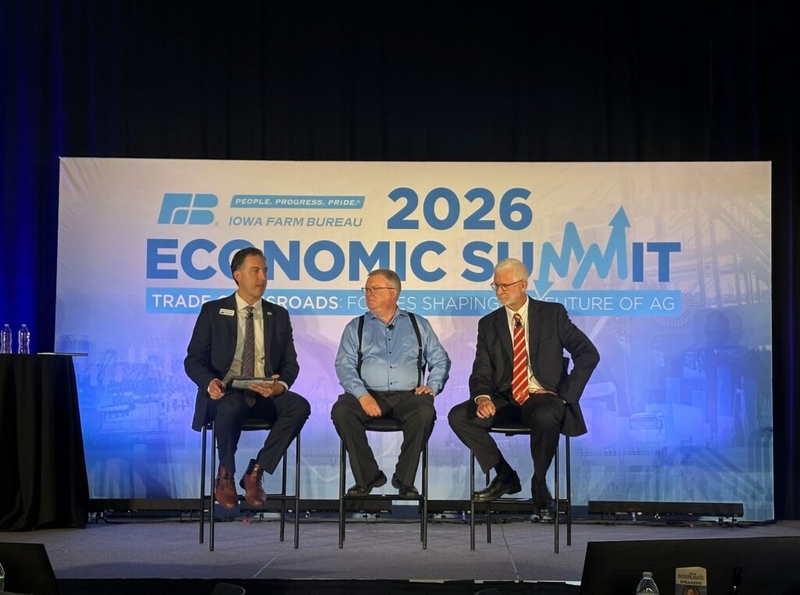
(Left) Christopher Pudenz, an economist with the Iowa Farm Bureau, moderated a presentation of an agriculture economy report with ISU economics professor Chad Hart and Center for Agricultural and Rural Development Director John Crespi. (Photo by Brooklyn Draisey/Iowa Capital Dispatch)
A new report suggests Iowa’s agricultural industry is in a multi-year downturn that might not let up for a few more years, and experts are advising farmers to look back to the practices that got them through tough financial times a decade ago to weather the current storm.
The Iowa Farm Bureau Federation, Iowa State University’s Center for Agricultural and Rural Development and the Iowa Bankers Association released the executive summary of the report Friday at the Iowa Farm Bureau Economic Summit in Ankeny, detailing Iowa’s current agriculture economy from different perspectives, how it came to reach this point and what the future holds.
Christopher Pudenz, an economist with the Iowa Farm Bureau, moderated a presentation of the report as well as a discussion by ISU economics professor Chad Hart and Center for Agricultural and Rural Development Director John Crespi. Hart wore suspenders to the panel discussion, a fashion choice he said was to help people recall the past and how they’ve made it through times like this.
Pudenz laid out the main facts for the audience: Iowa’s agriculture industry is in its third year of a downturn, with a third year of crop costs outpacing crop revenues and net farm income falling 53% between 2022 and 2024.
Record and near-record crop production in recent years has caused prices to trend downward, Hart said during the panel discussion, creating a tighter squeeze on farmers dealing with higher costs. Rising costs of fertilizer, seed, and other necessities have combined with conflicts outside of the U.S. and other trade and economic uncertainties, but Hart and Crespi said that doesn’t mean people should do nothing.
“It comes back to managing what we can, and sort of letting the uncertainty sort of wash over you. If we’re just going to sit on our hands, we may find ourselves in an even worse situation than that has happened before,” Hart said during a media availability after the panel. “So that’s why I dress like this, to get people to think, ‘Old-timey, yeah,’ because some of those old ideas of working through this, and like I say, sort of pinching that penny, even though we don’t have pennies anymore, still matter today.”
The report, titled “2026 Iowa Agricultural Outlook: The Pressure is Rising,” also went over agriculture’s impact on Iowa’s economy. Iowa’s average GDP is around $272 billion, Crespi said, and the 60 industries involved with agriculture in the state make up about 20% of it. For every dollar made in those industries, he said $1.50 goes back to the state.
What goes up must also go down, however, Crespi said, and every dollar less earned in agricultural industries means $1.50 not going to the state.
“It’s in everybody’s interest that this turns around, that those become profitable dollars and not losses each year,” Crespi said.
One “silver lining” in Iowa’s agricultural economy right now is livestock, Pudenz said, with the executive summary stating that livestock sectors are “generally performing well despite ongoing issues” like the avian influenza, as well as smaller stocks of cattle and softer consumer demand for hogs. Livestock also provides avenues for young people to break into the industry.
Analyses of farm finances and lending are also included in the report, and Hart said there is strong demand for agricultural land, with the report stating average farmland values have decreased slightly since 2023. Farmers use their land as an asset in their borrowing and balance sheets, and further decreases in value could hurt farms with debt or relying on land equity for credit.
According to the report, the number of financially vulnerable farms has more than doubled since 2022, with 19% of mid- and large-size farms falling under the category in December 2025. Chapter 12 bankruptcy filings are also rising, as well as increased credit demand and less repayment of loans.
Likening it to bank accounts, Hart said the current issues in agriculture are like when someone has a lot of money in their retirement account but not much in their checking account: “I’ve got a lot of value, but I can’t really access it to pay the bills.”
Hart said the situation Iowa’s agricultural sector currently finds itself in “tends to show up in agriculture about every decade,” the last downturn having taken place in the mid-2010s. And just like back then, he said people are asking the same question: is this going to be like the farm crisis in the 1980s?
Unlike the 1980s, where Iowa’s agriculture sector had a “solvency problem” where land values departed from farm incomes, leading to greater borrowing and more bankruptcies, Hart said today’s debt-to-asset ratio is relatively low and land values are holding generally steady.
Farmers also have more tools in their pocket to deal with problems, set in place by government actions after the 1980s crisis.
With forecasts in the report showing that the economic downturn could last at least six years, Hart said the approaches farmers need to take to keep themselves above water haven’t changed in the past decade, even if circumstances — and costs — have.
Crespi said one of his biggest fears is that people will begin pulling back too much out of uncertainty, leading them to not purchase things or not plant crops because they don’t know what will be financially viable in the future.
Pudenz and Hart agreed that while injections of funding from the federal government, like the $11 billion proposed by President Donald Trump, can make a difference in farm financials, it’s not going to actually fix the problems causing these symptoms. Farmers need to work on controlling what they can control, Hart said.
“What farmers tend to do, and I would argue what most folks tend to do, is that when we get money, we tend to get a little loose with spending that money, and then when you take that money away, we have a hard time adjusting back down,” Hart said. “And that’s what farming is having to do right now, is adjust back down and tighten on those crop budgets, as we’re looking forward and making sure that we, like I say, maximize the return we get for the investment we put into those inputs.”
Des Moines, IA