Arizona voters may decide future of universal school voucher system
Feb 11, 2026 | 6:07 pm ET
Description
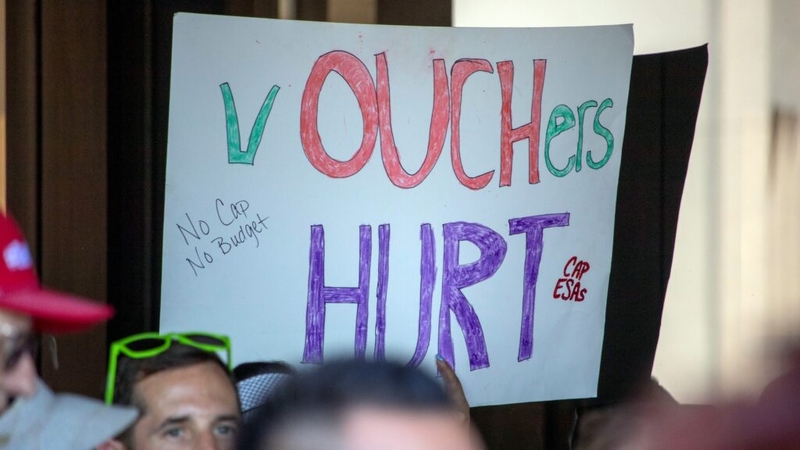
A sign held by a teacher at a rally at the Arizona Capitol on June 5, 2024, to advocate for restrictions on the state's school voucher system, known as Empowerment Scholarship Accounts. (Photo by Jerod MacDonald-Evoy/Arizona Mirror)
Arizona voters this year may get to decide which students can pay private school tuition or be homeschooled with taxpayer money.
Last week, the Arizona Education Association, the state’s largest teacher’s union and Save Our Schools Arizona, a public education advocacy group, filed language with the Arizona Secretary of State’s Office for a ballot measure that would completely overhaul the state’s school voucher system.
AEA President Marisol Garcia said that intent is to rein in the program’s exploding costs — the Empowerment Scholarship Accounts, as they’re formally known, will cost more than $1 billion this year — which inevitably detracts from the state funding that is available for public schools. She pointed out that teachers are already shouldering the burden of an underfunded public education system.
Arizona has an ongoing teacher retention crisis. During the 2024-2025 academic year, nearly 20% of public school teachers left or switched schools. Dismal teacher pay is a large part of why the Grand Canyon State continues to see teachers leave. The average teacher salary in Arizona last year was $62,714 — far less than the national average of $72,030.
“We have to be very honest about the crisis that is facing public education right now,” Garcia said. “This system is unsustainable.”
The vouchers were initially designed by Arizona Republicans as a way to help students with special needs or attending struggling schools pay for the education that best fit them, including through homeschooling or at private schools.
They weren’t the first time GOP lawmakers had crafted a system to divert funding from public to private schools, but ESAs were the first to pass constitutional muster. When the Arizona Supreme Court in 2014 refused to take up an appellate court ruling upholding the constitutionality of the voucher program, school choice advocates set about expanding who could receive vouchers, with the ultimate goal to be allowing all Arizona students to be eligible.
That happened in 2022, when ESAs went from a small-scale program that served less than 15,000 students to a universal system that all 1 million or so K-12 students could join. The vouchers represent a key pillar in the education agenda of Arizona Republicans, and efforts to implement restrictions or accountability are a third-rail in the legislature, which the GOP controls, even as the current permissive framework has resulted in controversial purchases of luxury goods, like diamond rings, airline tickets and designer clothing.
The universal expansion quickly attracted a rush of new, wealthy applicants. While the smaller ESA program required students to be moving from a public school, the universal system didn’t have that restriction. As a result, some 75% of new enrollees had never attended a public school before, representing a new cost to the state budget. Since then, the program has ballooned to more than 100,000 enrollees and is expected to cost taxpayers more than $1 billion annually.
Public education advocates are hoping to convince Arizona voters to do what GOP lawmakers have so far adamantly refused to. The initiative, titled the Protect Education, Accountability Now Act, would enshrine strict eligibility requirements into state law. It would prohibit most students with families who make more than $150,000 a year from participating and bar the purchase of luxury goods with voucher money. (The income cap doesn’t apply to students with special needs.)
A similar income cap of $250,000 was proposed by Gov. Katie Hobbs in her executive budget earlier this year. The governor’s office estimated that could save the state budget $89.3 million, but the proposal is a nonstarter with Republican lawmakers, who have repeatedly vowed to reject any reforms.
The ballot measure would also address the lack of regulations in private schools by requiring fingerprint clearance cards and some oversight from the State Board of Education. Private schools and tutoring services are not currently subject to the same state testing requirements or rigorous background checks that public schools and their employees are, which has drawn criticism from opponents who say that leads to insufficient academic accountability and safety standards.
“Right now, there are 100,000 students who we don’t know if they’re in safe structures or what adults are in front of them,” Garcia said.
The ballot initiative launch drew swift condemnation from Republicans. Superintendent of Public Instruction Tom Horne, who has staunchly sided with private school vouchers, denounced the ballot measure as a bid to undermine parental choice.
“Instead of encouraging healthy competition to raise the academic performance of all schools, this initiative seeks to punish ESA families who are just trying to ensure their child’s needs are being met,” he said, in an emailed statement.
Rep. Steve Montenegro, the speaker of the Arizona House of Representatives, similarly criticized the proposal as an “attack on parents” and vowed to campaign against it.
“We stand with parents. We will defend ESAs,” the Goodyear Republican said in a written statement. “And we will make sure voters understand exactly what this ballot scheme would do to Arizona children and families.”
Missing from the new eligibility framework is the requirement that a student have attended a public school at some point. The lack of public school history among new applicants was a particular sore point for education advocates when the universal expansion was passed. Geneva Fuentes, a spokeswoman for the teachers union, said that was left out during legal conversations in favor of other priority changes — and to better insulate it from court challenges that are sure to come if proponents gather enough signatures for the measure to qualify for the November ballot.
“The language in the initiative is closely tailored to implement the most urgent reforms needed to bring accountability and transparency to the ESA voucher program while preserving flexibility for students with disabilities and protecting student safety,” she said in an emailed statement.
Before voters can weigh in on whether to regulate the program, however, the groups behind the proposal must work to collect 255,949 voter signatures. And they have a little over four months to do that, with a July 2 deadline to submit them. Garcia said she’s confident that’s enough time to collect not just the required amount, but also a significant buffer to defend against signatures that will inevitably be invalidated during the verification process. The two groups are currently in the process of figuring out how much that signature-gathering effort will cost and working to recruit other public education advocacy groups to help pay for and organize it.
Along with earning a place on the November ballot, its backers are preparing to head a voter education campaign to persuade Arizonans to support it. Garcia said that will likely entail webinars, community meetings and town halls. Despite the uphill battle ahead, Garcia said that she expects widespread public approval of public education to help the campaign be successful.
A 2024 survey of Arizona voters by the nonpartisan think tank Center for the Future of Arizona found that 79% agree that K-12 public school funding should be increased and an overwhelming 80% believe that private schools which receive state money should be held to the same financial reporting, academic requirements and employment standards as public schools.
Phoenix, AZ