Energy advocates to host Detroit block party calling out utilities for high rates and long outages
Oct 24, 2025 | 5:00 pm ET
Description
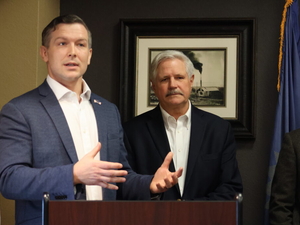
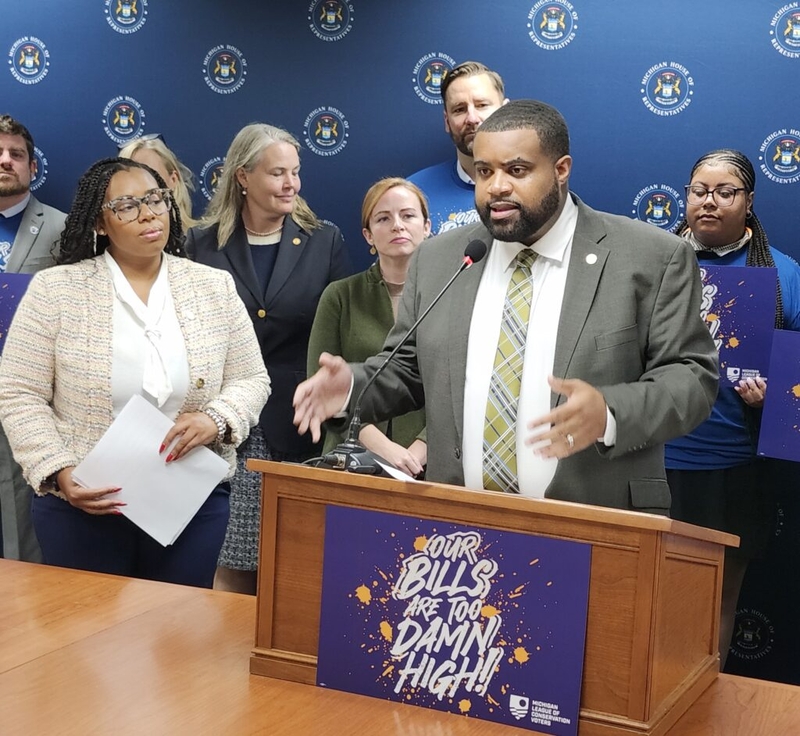
Michigan State Rep. Donavan McKinney (D-Detroit) speaks at a news conference detailing a Democrat-led effort to create a utility ratepayer's bill of rights. Sept. 9, 2025 | Photo by Ben Solis/Michigan Advance
Environmental advocates, community leaders and members of the Michigan Legislature will gather on Detroit’s east side Sunday for food and festivities while demanding accountability from the state’s largest energy providers.
The East Side Community Network’s Stoudamire Wellness Hub will host state Sen. Stephanie Chang (D-Detroit), state Reps. Tonya Myers Phillips (D-Detroit) and Donovan McKinney (D-Detroit), and Detroit Action Political Director James Johnson alongside Detroit residents and representatives from multiple organizing groups, as they call out the state’s largest energy providers over high rates and poor reliability.
The speakers will also offer information about the ratepayer bill of rights, a slate of bills which aims to address these issues alongside concerns that political spending is stymying additional regulations on energy providers.
The “Our Bills Are Too Damn High!” block party runs Sunday from 2 p.m. to 4 p.m. with speeches set to begin at 3 p.m. In addition to remarks from lawmakers and residents calling for greater accountability from DTE Energy and Consumers Energy, Michigan’s largest energy companies, the event will feature food and performances.
In recent years, both utilities have faced repeated criticism for high energy prices and poor reliability, with the Citizens Utility Board, an energy utility watchdog, noting that the companies have “some of the highest outage durations among all investor-owned utilities in the nation.”
Ballot initiative seeks to ban political contributions from monopoly corporations, like utilities
While both companies have each pledged to improve their services, customers and advocacy groups have remained frustrated with the utilities’ near yearly requests to increase their rates, with DTE requesting a $574 million rate increase earlier this year, while Consumers Energy requested a $436 million increase for its electrical rates.
Dana St. Couer, a senior communication strategist for DTE said customers saw 70% improvement in time spent without power in 2024 due to $1.5 billion in investments in the electric grid last year coupled with less extreme weather.
In a statement on Jan. 14, Consumers Energy said the average customer spent 21 fewer minutes without power in 2024, with 93% of customers seeing their power restored within 24 hours.
Katie Carey, Consumers Energy’s director of media relations, emphasized in an email to the Michigan Advance that the company’s rate requests fund future investments.
“For example, clearing trees away from power lines is critical to our plan, addressing the #1 cause of outages. We are proposing a five-year timetable to clear all of our system’s low-voltage lines, which serve homes and businesses directly,” Carey said. “We had previously been working toward a seven-year effective cycle. We plan to clear 8,000 miles of high- and low-voltage power lines this year. We expect a 30% reduction in tree-related outage incidents by 2030.”
In the interim, lawmakers have offered their own solutions through legislation seeking greater accountability from energy providers, while providing customers additional protections.
The ratepayer bill of rights includes legislation sponsored by McKinney that would increase the outage credit customers receive on their bills to $5 an hour, gradually increasing to $15 an hour after 24 hours without service and $25 dollars per hour in interruptions longer than 72 hours.
The current credit offers customers $42 if their outages last 16 hours or longer under normal conditions, 48 hours if skies are gray and 96 hours under catastrophic weather conditions, with customers receiving an additional $42 for each day they are without power.
The package also includes Myers Phillips’ House Bill 5047, which would ensure winter shut off protections for households with seniors 65 and older, and children 16 and younger.
The ratepayers bill of rights also includes legislation to allow for the establishment of community solar energy programs, and to ban utility companies and businesses seeking government contracts from making political contributions.
Chang told the Michigan Advance on Thursday that the event is aimed at raising awareness and getting more community members engaged on issues of energy affordability and reliability, while providing those affected with concrete solutions they can take action on.
Oftentimes when there is a major storm, Chang said her office will hear from residents and see the resulting power outages firsthand. While the outage credit has increased in recent years, it does not match the impact felt by those facing the outage Chang said, pointing to individuals losing the food in their refrigerator as one example.
When looking at the ratepayer’s bill of rights as a package, Chang emphasized that these policies focus on what ratepayers need.
“When we talk about reliability, when we talk about energy policy, when we talk about outages, ultimately, it’s about people,” Chang said, noting that these outages weigh the heaviest on those who are already struggling to pay their bills and keep food on the table.”
Lansing, MI