Legislature repeals MinnesotaCare for undocumented adults
Jun 09, 2025 | 10:40 am ET
Description
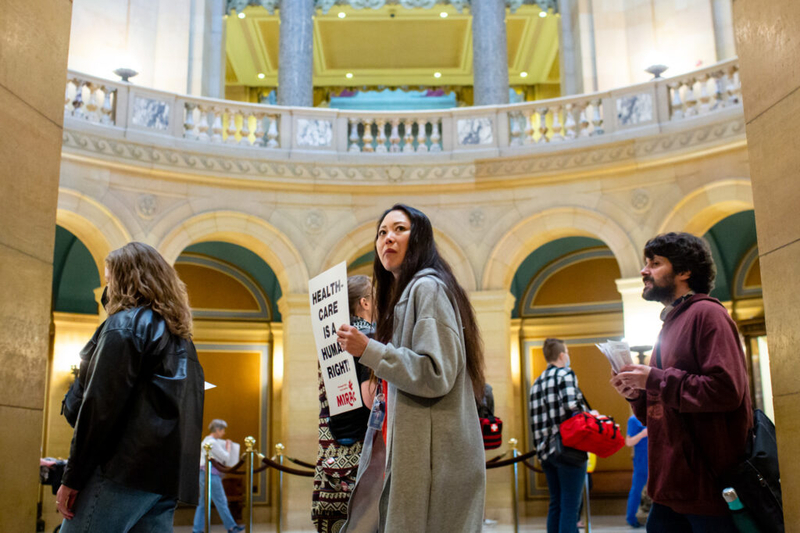
Demonstrators gather for a protest organized by the Minnesota Immigrant Rights Action Committee calling for the continuation of MinnesotaCare for undocumented adults at the Minnesota State Capitol Tuesday, May 27, 2025. (Photo by Nicole Neri/Minnesota Reformer)
Despite Democratic-Farmer-Labor control of the state Senate, the governor’s office, and half of the House, Republicans forced Democrats to roll back one of their signature accomplishments from the 2023 legislative session: health care for undocumented people.
The Legislature passed a bill Monday to repeal undocumented adults’ eligibility for MinnesotaCare, the state-subsidized health insurance program for the working poor. DFL House caucus leader Melissa Hortman joined Republicans in the House to pass the bill. In the Senate, DFL Sens. Grant Hauschild of Hermantown, Ann Rest of New Hope, Robert Kupec of Moorhead and Majority Leader Erin Murphy of St. Paul also voted for the bill.
Undocumented children will still be eligible for MinnesotaCare when Gov. Tim Walz signs the bill into law, as promised.
Republicans successfully used their leverage — the threat of a government shutdown starting July 1 — to force the Democrats’ hand on an issue that is of supreme importance to GOP lawmakers.
“The role of the church – the role of people of faith – is to care for our neighbors. Yes,” said Rep. Isaac Schultz, R-Elmdale Township, during the House floor debate. “But not in this instance, specifically.”
The change is expected to save the state around $57 million in the next two years, according to a health and human services budget spreadsheet prepared by nonpartisan legislative staff. Lawmakers are looking to cut $283 million in spending over the next two years to reduce a projected deficit starting in fiscal years 2028 and 2029.
The DFL pulled out all nearly of the stops to avoid cutting health care access for undocumented adults.
During negotiations, DFL leaders offered Republicans concessions related to paid leave, earned sick and safe time, and noncompete agreements — but Republicans didn’t budge, said Sen. Alice Mann, DFL-Edina.
“They turned all of those things down, because all they wanted…was to make sure that the 17,000 people were left out to die, that we worsen our health care system and that we decrease our tax revenue,” Mann said at a press conference Monday decrying the move.
When Gov. Tim Walz and legislative leaders announced a budget deal — contingent on repealing MinnesotaCare eligibility for undocumented adults — on May 15, lawmakers with the People of Color Indigenous Caucus protested outside the door. They told reporters later that they were blindsided by the deal.
After the announcement, POCI caucus members brought alternatives to legislative leaders, said Rep. Liish Kozlowski, DFL-Duluth. The POCI caucus suggested capping undocumented enrollment in MinnesotaCare, raising premiums, allowing children currently enrolled to retain coverage instead of aging out, or making exceptions for elderly people or those with chronic conditions.
None of those options made it into the bill, and an amendment containing many of the provisions supported by the POCI caucus was voted down on the House floor.
Republicans have repeatedly exaggerated the cost of providing health care to undocumented people enrolled in MinnesotaCare. Enrollment has exceeded the state’s expectations, however, with more than 17,000 undocumented people currently enrolled. Meanwhile, per-person spending on the undocumented population has been lower than expected, according to the Department of Human Services.
Federal politics and funding have complicated the issue: A budget bill passed by the GOP-controlled U.S. House would cut funding to states that provide health care to undocumented people, including Minnesota. It could cost the state $3 billion over the next decade.
And while the federal government pays for some of the cost of MinnesotaCare, it doesn’t contribute any money for undocumented enrollees.

Saint Paul, MN