Oklahoma ethics agency to consider regulating use of AI in political campaigns
Jun 05, 2026 | 2:55 pm ET
Description
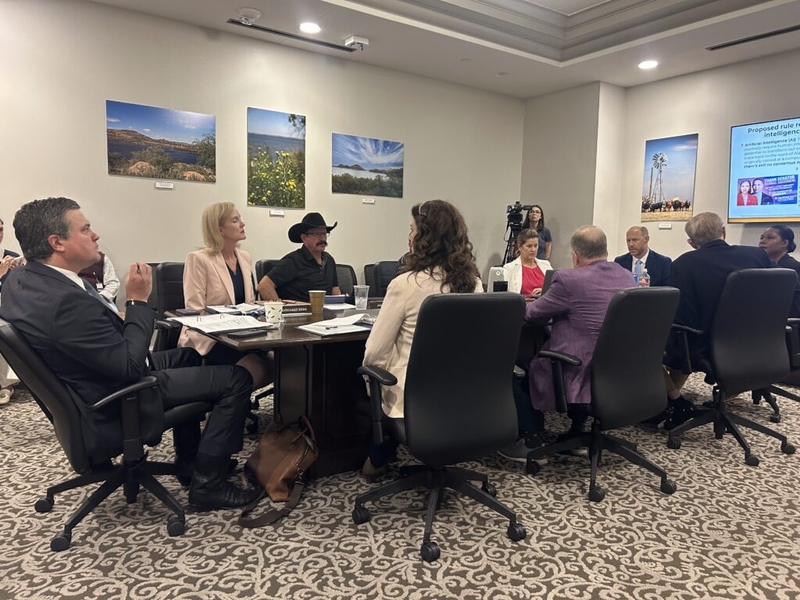
The Oklahoma Ethics Commission meets on June 5, 2026 at the state Capitol in Oklahoma City. (Photo by Courtney Bell/Oklahoma Voice)
OKLAHOMA CITY — A state ethics board will consider ways to require disclosure when artificial intelligence is used in Oklahoma’s political campaigns.
The Ethics Commission officially kickstarted their rulemaking process Friday. The agency will explore options for regulating the tool, such as defining AI, requiring disclaimers when it’s used, exemptions for parody or satire and addressing concerns about First Amendment rights or protected political speech.
Executive Director Lee Anne Bruce Boone said they would likely work “in tandem” with state lawmakers as there are parts of this issue that are outside the commission’s jurisdiction and need to be addressed in state law.
Most of the commission seemed to support some form of guardrails for using AI in political messaging, but it’s unclear what final rules will look like yet.
The use of generative AI in Oklahoma political ads have recently come under fire. Gov. Kevin Stitt last month threatened to call a special session to ask lawmakers to regulate the use of the tool. Stitt’s statement was prompted by an AI-generated ad that falsely portrayed Republican gubernatorial candidate Mike Mazzei hugging former Democratic presidential candidate Hillary Clinton.
“I don’t want to speak for the entire commission by any means, but my comment is that I would like it to be as stringent, limiting and prohibitive as possible in terms of what’s drafted,” said Justin Meek, chair of the commission.
Sample language included in a presentation given at the commission’s Friday meeting for potential rules included requiring some form of disclaimer or disclosure when:
- Political messaging contains synthetic media;
- Deceptive media is published within 90 days of an election and is intended to harm a candidate or deceive voters;
- Synthetic media is intended to influence an election outcome or solicit campaign contributions; or
- Deepfakes used to impersonate candidates.
There should also be requirements for what disclosure looks like in terms of the size of text, time it’s shown or the speed it’s read at, said Commissioner Howard Johnson.
Commissioner Adam Weintraub said he is unable to see “anything positive” developed from generative AI technology when it comes to political campaigning.
“The (examples) we had in Oklahoma at this campaign season, have just been malicious, is the only word that comes to mind,” Weintraub said. “So, as I’m looking at the sample language, I like the idea of requiring synthetic media to be disclosed.”
He said he’s “deeply curious” about what states like Maryland are doing to regulate AI.
Thirty-six states have enacted laws regulating the use of deepfakes in political messaging, according to a presentation given at Friday’s meeting.
Some states include time restrictions in their legislation, such as banning deepfakes within a certain number of days prior to an election. The commission analyzed a law in Maryland that restricts the spread of election misinformation, including through deepfakes, year round.
Some states’ legislation has faced legal challenges. In January, a federal judge struck down a law in Hawaii banning misleading or reckless digitally-altered election content that portrayed people saying or doing things they never did.
Another federal judge struck down a California law in August banning deceptive deepfake content during elections based on federal rules for online platforms.
A presentation from the Oklahoma ethics board said rules or laws requiring disclosure of AI are less likely to see legal challenges because there are fewer concerns about free speech violations.
“We want to be ahead of this and not behind it as we move into next legislative session,” said Bruce Boone, the commission’s executive director.
Oklahoma City, OK