Year-round ethanol blend bill passed by US House faces uncertain Senate path
May 22, 2026 | 3:20 pm ET
Description
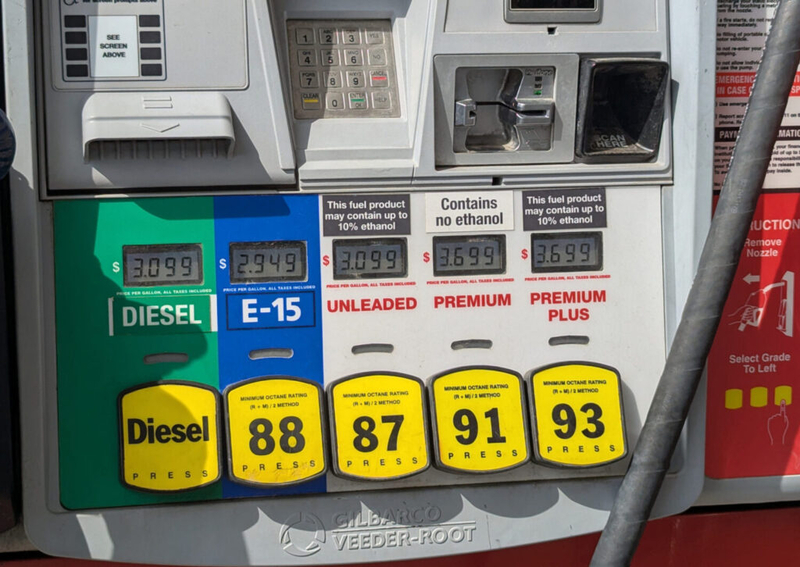
Fuel options at a Sioux Falls, South Dakota, gas station on Aug. 22, 2025. The nationwide average price of a gallon of gas was $4.55 May 22, 2026, up from $3.20 a year ago. The steep increase has turned some lawmakers' attention alternative fuels like ethanol. (Photo by John Hult/South Dakota Searchlight)
Proponents of ethanol, including lawmakers from corn-growing states, say year-round sales of a gasoline blend containing 15% of the biofuel would give consumers a less expensive alternative to fill their gas tanks, boost energy supplies and benefit agricultural interests.
So why hasn’t Congress allowed it?
There’s credible skepticism about those claims — and opposition from the strange bedfellows of environmental advocates and lawmakers from states where oil production and refining are major industries. As a result, expanding the availability of E15, as the blend is called, has become a congressional brawl with no predictable result.
The outcome of this debate, which will continue in June when Congress returns from its Memorial Day recess, largely depends on whether the push for year-round E15 use can get 60 U.S. Senate votes after the U.S. House this month passed legislation allowing it and the White House has signaled its support.
“I don’t know if it can get 60, to be honest with you,” Senate Environment and Public Works Committee Chair Shelley Moore Capito, a Republican from West Virginia, said in an interview.
Senate Majority Leader John Thune offered some hope.
“We're looking at ways to move it,” he told reporters. “We have people here who represent states that also have refineries, and that's a factor in this conversation.”
Iran war boosts support
Federal regulations have restricted E15 from being sold from June 1 to Sept. 15 because of its effects on air quality.
But the turmoil triggered by the war in Iran has been an important boost to Congress’ efforts to pass year-round E15 legislation.
AAA reported that the national average for a gallon of regular gasoline cost $4.55 a gallon Friday, up from $3.20 a year earlier.
The Environmental Protection Agency issued waivers this year to allow extended sales of the blend. E15, often sold at gas stations as Unleaded 88, will be widely available this summer as "the result of ongoing issues in the Middle East, among other events,” EPA said in a statement.
‘Unique agreement’
One’s view of the issue “depends on which study you look at,” Senate Agriculture Chairman John Boozman, an Arkansas Republican, said in an interview.
On one side is a historically influential coalition of agricultural, retail and petroleum interests.
“This legislation reflects a unique area of agreement across the fuel and agriculture supply chain,” organizations representing those industries said in a May 11 letter.
“While our industries do not always see eye to eye, we are united in the belief that these policy reforms provide needed certainty, preserve consumer choice, and support agriculture and energy economies alike,” they said.
The Renewable Fuels Association says E15 has been “fully approved for use in cars, pickups, vans and other light-duty vehicles” made after 2000.
Consumers can save 10 to 30 cents a gallon compared to 87-octane regular gasoline, industry members say. In Pennsylvania last weekend, Unleaded 88 was in some cases selling for 50 cents a gallon less.
The E15 critics
Many environmental groups maintain production of ethanol costs more than regular gasoline, and those costs are passed on to consumers not only at the pump, but in various agricultural products.
“Expanding ethanol sales is a shortsighted approach that ignores the environmental costs of industrial agriculture,” said Patrick Drupp, Sierra Club's director of climate policy.
He said much of the corn used to produce E15 is grown in Midwestern states “already facing severe aquifer depletion and water shortages, and expanding ethanol production would only intensify the strain on their water supplies, farmland, and ecosystems.”
Eight environmental groups wrote an open letter May 8, concerned that “We should not commit additional land, resources, or taxpayer dollars to policies that undermine our climate goals, strain our natural systems, and increase costs for American families.”
The groups, which include the World Resources Institute and the Sierra Club, countered the notion that consumers would benefit.
“Production expenses for corn ethanol typically exceed those of gasoline, except during periods of unusually high oil prices—and even then, ethanol prices tend to rise in tandem with global energy markets,” they said.
That would mean even higher prices not only for fuel but for food, the organizations wrote.
One analysis that takes neither side is the nonpartisan Congressional Budget Office, which said in a May 12 analysis that because E15 needs separate or specialized tanks and pumps, “retailers wanting to sell E15 would confront the additional expense of installing new equipment.”
And, it said, “some refiners will incur additional costs as they adjust their refinery processes to produce the appropriate gasoline to be blended into E15.”
What will Congress do?
The congressional coalitions for and against year-round E15 are as unusual as the outside groups supporting and opposing it.
The House’s 218-203 vote on May 13 saw 122 Republicans, 95 Democrats and one independent voting yes, while 113 Republicans and 90 Democrats voted no.
The yes coalition largely united rural lawmakers with more urban members who see the change as helping consumers.
“This debate is about much more than fuel,” Rep. Mariannette Miller-Meeks, an Iowa Republican, said. “Agriculture is hurting right now,”
Joining her was New Jersey’s Rep. Frank Pallone, the top Democrat on the House Energy and Commerce Committee.
The bill “lowers prices for American drivers, supports farmers, and fosters investment in cleaner transportation fuel,” he said.
On the other side was Rep. Chip Roy, R-Texas.
“If we need to do something to support farmers, let's have a direct conversation about it. Expanding E15 is just the wrong direction to go,” he said.
The same sort of party split looms in the Senate.
After the House vote, Sen. Deb Fischer, R-Neb., who’s fought for the change for years, hailed the approval as “a major step toward securing stability and certainty for American producers and consumers – without any government mandates.”
Thune, of South Dakota, has been sympathetic to year-round E15.
At a news conference this week he called E15 “a way of creating additional demand for agricultural commodities in this country and creating additional supply when it comes to fuels.
“And when that happens, at least in my part of the country, that means that when you buy ethanol at the pump, it's significantly lower in price,” he said.
He faces a powerful skeptic in the Senate: Majority Whip John Barrasso of Wyoming, the Senate’s second-ranking Republican..
“Congress is currently discussing new mandates – mandates that would force more and more ethanol into our fuels,” he said in a Senate floor speech the day after the House vote.
“I oppose the year-round E15 mandate,” he said. “I oppose it because it hurts small oil refineries and all of the people who work at them.”
Small refineries
There are about 30 small refineries across the country, usually in inland areas, and about half could face problems under the House bill.
Small refineries are those that produce less than 75,000 barrels of oil per day, compared to 300,000 barrels or more at larger facilities.
The small refineries can petition for an EPA exemption from the annual renewable fuel obligations based on “disproportionate economic hardship.”
For 2025, there were 33 exemption petitions filed. Approximately 17 of those facilities would be ineligible under the proposed legislation because they are owned by companies with more than one refinery. Instead of focusing on the single facility, the bill requires aggregation of all facilities together.
The House bill would allow a 75% exemption instead of the current full exemption. It could also reduce the number of small refineries currently eligible for an exemption by half.
Most small refineries would find themselves operationally constrained without the ability to receive exemptions, as they would have to use much of their cash flow to comply with the annual mandates, said Peter Whitfield, partner at Sidley Austin, a law firm that represents the Small Refineries of America, in an interview
Many senators want assurances small refineries won’t be hurt.
“I’m interested in the small refinery piece,” Capito said.
That concern is yet another reason, at the moment, Capito said she is doubtful the House bill could get the 60 votes needed in the Senate.
All States Newsroom content is free to republish. Read our republishing policy for more information.