WV Treasurer Pack wants to know more about state auditor hiring a sitting senator as contractor
Jun 03, 2026 | 4:30 pm ET
Description
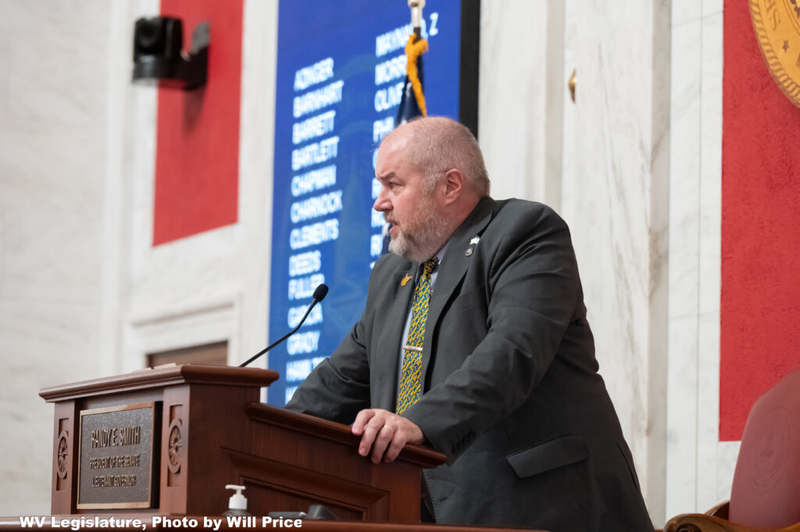
Sen. Jay Taylor, R-Taylor, stands at the podium in the West Virginia Senate chambers during the final day of the regular legislative session on March 14, 2026. (Photo by Will Price/West Virginia Legislative Photography)
West Virginia State Treasurer Larry Pack hand delivered a letter Wednesday to State Auditor Mark Hunt requesting more information to clarify the legality surrounding Sen. Jay Taylor’s contract employment at the Auditor’s Office.
Pack’s inquiry comes almost two weeks after reporting by Kyle Vass in Dragline revealed that Hunt hired Taylor, R-Taylor, as a contractor for his office despite legal red flags raised by Attorney General J.B. McCuskey.
In his letter to Hunt on Wednesday, Pack requested invoices submitted by Taylor during his contract role, time sheets showing hours worked, copies of any “deliverables” completed by Taylor, documents showing Taylor’s current status in the Auditor’s Office and any state or municipal licenses held by Taylor as a contractor.
He also requested any documents showing that Taylor was hired as a contractor instead of as an employee. Pack — echoing McCuskey’s warnings from October — wrote that doing the latter “would be expressly forbidden” under the state Constitution.
Pack told West Virginia Watch on Wednesday that the Dragline story “raised some eyebrows” at his office. Now, he said, he’s seeking more information to ensure that the relationship between Taylor and the Auditor’s Office is appropriate.
“Just from the Treasurer’s standpoint, we have a duty to protect taxpayers’ money. West Virginians work hard to pay their taxes and we need to make sure we’re being good stewards of those funds,” Pack said. “I spent 20 years as a (Certified Public Accountant) and I’m very well versed in contractors versus employees. The opinion from (McCuskey) and the other public reporting here raises a lot of questions. We wrote this letter to try and get some answers so we can discern if this is an appropriate use of taxpayer money.”
Background regarding Taylor’s role at the WV Auditor’s Office
According to documents obtained and reported by Dragline, Hunt sent a short request to McCuskey on Oct. 16, 2025 asking for a written opinion “as to whether there are any prohibitions” against hiring a sitting member of the Legislature as a contractor or an employee at an agency within the state’s executive branch (like the Auditor’s Office).
McCuskey responded on Oct. 27, 2025. He said that a lawmaker “cannot, under any circumstances,” be hired as an employee. Without further information, he said, the office was “unable to offer an opinion” on whether a contractor position would be a violation of any state laws or policies. McCuskey continued by citing several examples of state code that could be legally sticky for contractors.
Per emails published by Dragline, Taylor was given an email address with the Auditor’s Office and conducted official business with the title “Budget-Finance Specialist” in his email signature during his tenure there. He regularly checked in with Auditor Office supervisors and others in the Local Government Services Division, where he operated.
Taylor, reached by phone on Wednesday, said he thought it was “ridiculous” for so much focus to be paid on a two-month, one-time contract gig.
“This was a one-time thing. I knew it was a one-time thing. This is just — golly, I mean we’re talking about $5,000 over two months. Take out taxes and such and that’s basically minimum wage,” Taylor said. “We’re not talking about a lot of money here; this wasn’t a lucrative thing. It’s kind of funny that we’re spending so much time on this for such a not lucrative thing.”
Pack said the amount of money spent didn’t matter.
“I grew up in Hernshaw, West Virginia and $5,000 is a lot of money to a lot of people,” Pack said. “But the amount really doesn’t matter — we’re asking these questions to see if taxpayer money, whatever amount, was paid appropriately or inappropriately. That’s that.”
Taylor said during his stint in the Auditor’s Office, he helped with an office move, did paperwork and filled in while some positions remained vacant. He said he knew he could not be hired as a “regular employee” and did not want to be.
When he accepted the contract, Taylor said Hunt told him that he had checked with McCuskey and was told that “everything was all good.”
“I wasn’t a part of that request, I didn’t see the response, I was told everything was good and I believed it,” Taylor said. “I trust Mark (Hunt). I know we didn’t do anything wrong here.”
Taylor calls inquiries into contractual employment ‘politics’
In a news release after the Dragline story was published, state Democratic Party Chairman Mike Pushkin warned of the precedent that could be set if a lawmaker was allowed to hold “lucrative” employment within the executive branch while still elected.
On Monday, Pushkin further called on Taylor to explain why the $5,000 he received wasn’t included on a financial disclosure statement sent to the Ethics Commission in February. On Wednesday, Taylor said the payment came in January and was after the reporting deadline. The payment, he said, will be included on his next report.
Hunt — who sent his own release responding to Pushkin on Wednesday, hours before Pack’s letter was delivered to his office — said criticisms over Taylor’s hiring amounted to “political theater” from Democrats.
“We will not be distracted by partisan attacks from those who seek to undermine our efforts to reform and strengthen West Virginia’s financial stewardship,” Hunt said in the statement.
Representatives for Hunt did not respond to requests for comment regarding the letter from Pack — a Republican — by press time Wednesday.
Taylor, per emails, was sending work emails from his state email address through November until at least Dec. 15.
One month later, West Virginia’s 2026 regular legislative session began. There, Taylor — as a state senator — sponsored and introduced legislation directly tied to the Auditor’s Office and his contacts there, including his direct supervisor. He contacted his former colleagues through his personal email address and they worked together on draft legislation requiring county boards of education to submit annual financial reports to the Auditor’s Office.
On Feb. 12, Taylor filed Senate Bill 929 for introduction in the Legislature. A key provision of the bill would have brought county boards of education under oversight by the state auditor. The bill unanimously passed the Senate on March 3, but stalled in the House and did not become law.
Taylor, speaking Wednesday, said his sponsorship of SB 929 was not a conflict of interest. He said he learned a lot through his two months working with the auditor’s Local Government Services Division and wanted to translate some of that knowledge into helpful legislation.
“I learned a lot about how these things work and I thought it would be a good thing to have that oversight, that check and balance,” Taylor said. “That’s why I introduced that bill.”
He compared his contractual work with the Auditor’s Office to his previous work as a substitute teacher.
“That’s taxpayer money and no one ever said anything about (my substitute teaching). They don’t say anything about the teachers in the Legislature, or all the lawyers or other workers who hold state contracts,” Taylor said. “I really don’t understand why we’re wasting time on this.”
He, like Hunt, said he believed the inquiry into his hiring and the work he did was politics in play.
“This is straight politics. That’s all this is. I understand it, it’s OK, but that’s all this is,” Taylor said.
He didn’t expand on what political motivations he suspected Pack might have had in sending the request for more information.
Pack vehemently denied politics playing a role in his query.
“There’s nothing political about this. This is me doing my job,” Pack said. “I was elected to ensure taxpayer dollars go to the right place. That’s what I’m doing here and what I will always do. Politics don’t matter here.”
Charleston, WV