Gov. Cox says his Utah Supreme Court picks were the most qualified. Critics disagree
Jun 03, 2026 | 4:30 pm ET
Description
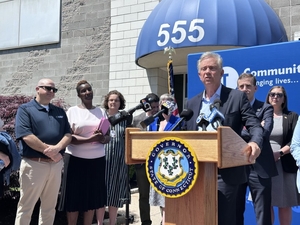
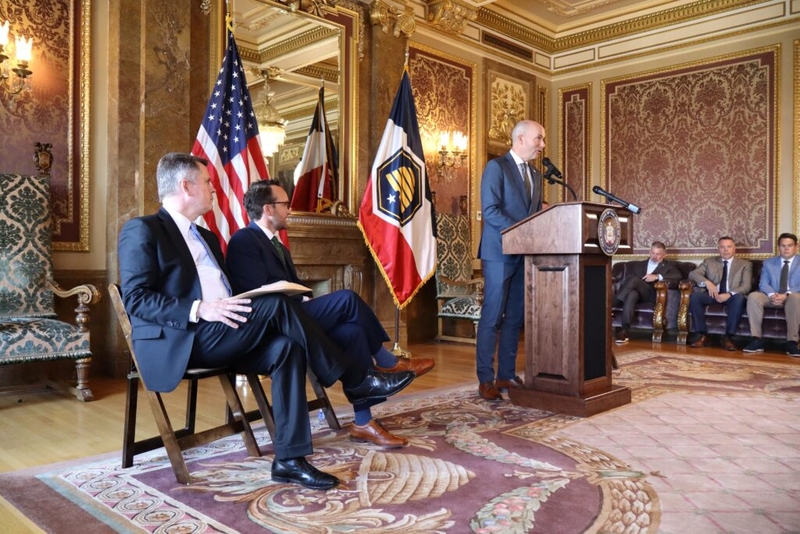
Utah Gov. Spencer Cox announced he nominated Jay Jorgensen and Stephen Dent to fill two new seats on the Utah Supreme Court during a news conference at the Utah Capitol in Salt Lake City on June 2, 2026. (Katie McKellar/Utah News Dispatch)
After Gov. Spencer Cox on Tuesday announced his picks to fill two new seats on the expanded Utah Supreme Court — Stephen Dent, a federal prosecutor, and Jay Jorgensen, an attorney for The Church of Jesus Christ of Latter-day Saints — the advocacy nonprofit Co-Equal Utah expressed concerns about the two nominees’ experience.
“We are deeply concerned about these nominees not because of their politics, but because neither man has served as a justice court judge, a district court judge, or an appellate judge at any level, in any jurisdiction,” the nonprofit said in a prepared statement. “Governor Cox told Utahns that merit would guide these appointments. We took him at his word. These nominations do not keep that promise.”
The nonprofit, which is made up of a coalition of attorneys and other legal professionals, describes itself as a nonpartisan organization “working to protect Utah’s courts from political interference.” Its website lists four names — Nathan Alder, Teneille Brown, Christina Jepson and Brian Jones — as volunteer organizers.
Cox makes 2 picks to fill expanded Utah Supreme Court: A church attorney and a prosecutor
The group criticized Cox for selecting Jorgensen and Dent — who are both subject to confirmation by the full Utah Senate, with a vote expected June 17 — over other applicants who had judicial experience.
“The Utah Supreme Court is not an entry-level position. It is the court of last resort for every Utahn,” Co-Equal Utah said. “The governor has bypassed sitting judges with years of trial and appellate experience to place two individuals with no judicial record directly on the state’s highest court. Utahns deserve to know why.”
Cox, during a news conference announcing his appointees, said he selected Jorgensen and Dent out of a pool of 12 candidates forwarded to him by the Appellate Judicial Nominating Commission as the most qualified names that “rose to the top” after he and his team “conducted our own thorough vetting process.”
“We reviewed everything these nominees have written, argued, or decided, and we spent hours in interviews, discussing temperament, respect for the rule of law, judicial philosophy, and many other important questions,” Cox said. “That rigorous process gives me tremendous confidence that the appointees I’ve chosen will serve the people of Utah with integrity, humility, and independence, and that they will apply the law faithfully according to the Constitution and the oath that they will be taking.”
Cox also said during interviews he “pushed really hard” on Jorgensen and Dent “to make sure that they aren’t partisan hacks, to make sure that they care deeply about the law, and that their job is to hold me accountable … and hold the Legislature accountable to the constitution and the laws of this state.”

‘The context here cannot be ignored’
Co-Equal Utah said in its statement that “the context here cannot be ignored” — including that the Legislature expanded the Utah Supreme Court by two seats amid ongoing tension between the two branches after the courts have handed down several rulings that have upset Republican lawmakers, including in the state’s redistricting legal battle.
At the same time, the Utah Republican Party is campaigning to urge voters not to retain Justice Jill Pohlman (appointed by Cox in 2022), and Justice Diana Hagen (also appointed by Cox in 2022) resigned “under political pressure,” Co-Equal Utah said.
Hagen’s recent resignation came after the Utah House, in response to a public records request from KSL, released a previously dismissed complaint alleging she had an extramarital affair with an attorney involved in the state’s redistricting case. The Judicial Conduct Commission dismissed the complaint as lacking evidence and credibility, but Cox and Utah’s top Republican legislative leaders called for an independent investigation into the claims.
Hagen denied the allegations, but to avoid dragging her family into the independent investigation, she resigned last month.
“And now, Governor Cox will have appointed five of seven justices within a single year – a court substantially remade while redistricting, ballot initiative, and other key lawsuits against the legislature … remain live,” Co-Equal Utah said.
Saying it’s not court packing, governor supports expanding Utah’s appeals courts
To concerns of court packing, Legislative leaders and Cox have argued the court expansion wasn’t political, but meant to get “more eyes” on complex state issues, speed up decision-making and also bring Utah in line with other similarly-sized states’ supreme courts.
Critics, including the Utah State Bar, argued legislators should have concentrated more funding on the district court level, where Chief Justice Matthew Durrant has said there is the greatest need, and that a seven-member court could actually slow down decisions rather than speed them up.
Cox on Tuesday called on the new Utah Supreme Court — of which he’ll have appointed six out of seven justices after he fills two more open seats left by Durrant, who is retiring, and Hagen’s resignation — to speed up decision making by writing shorter opinions. He said he’s heard many district court judges complaining “a lot” about Utah Supreme Court opinions, not because they were wrongly decided, “but because they’re way too long.”
“Simple is better,” Cox said. “Not just so our district court judges can read it quickly, because they’re overwhelmed constantly, but so average Utahns can read these cases.”
Why no women?
Co-Equal Utah also noted that “women, objectively more qualified than the two men nominated, applied for these seats.”
Across three recent judicial court vacancies, including the two new Utah Supreme Court seats, all 19 finalists selected by judicial nominating commissions have been men, the nonprofit said.
When asked why no women were included in the list of finalists for the two Utah Supreme Court appointments announced Tuesday, Cox told reporters that of the 25 people who applied for the positions, “only four women applied.”
“It was one of the, maybe the lowest we’ve had,” Cox said. “I don’t know why they didn’t apply. I wish more had applied.”
Two of the four female applicants, Cox said, “were not qualified at all to get through. They applied for everything and (had) never gotten through anything. So you immediately discount those. And by the way, there’s some men that do that too, I’m not being critical.”
“So really, there were two (women) that could have even made the panel,” Cox said. “Two out of 25. And one of those probably should have. But … that’s a very, very, very low number.”
Cox didn’t name the woman who he said perhaps “should have” qualified as a finalist. He also said he’s “hoping more women will apply” for the next two open Utah Supreme Court seats being vacated by Hagen and Durrant.
“But I also want to just really push back on this whole narrative,” Cox added, noting that the state didn’t get its first female Utah Supreme Court justice until 1982, then it took more than two decades for a second female justice to get appointed, then another 15 years for the third.
“And then I (appointed) two in one year,” Cox said, pointing to his appointments of Pohlman and Hagen in 2022. “So, like, I mean, I don’t know, if that makes me a misogynist, I guess I’ll own it. But I think that’s an insane narrative. I just do. Because it doesn’t fit.”
Amid affair allegations, Utah Supreme Court Justice Diana Hagen resigns
Cox added that he doesn’t “care if you’re a male or a female if you apply.”
“I don’t go into this looking at your chromosomes when I’m making an appointment,” he said. “I’m trying to find the best legal minds who will represent the state of Utah. And I think that’s all that should matter.”
When he picked Pohlman and Hagen, he said “I was very clear that I did not pick them because they were female. I picked them because they were the best in the pool, and that’s the case this time around. And that will be the case next time around.”
The next two appointments could be “two women, it could be two men, it could be a man and a woman,” Cox said, “and all I will tell you is I promise you, I promise the people of Utah, that they will be the best attorneys in the pool, the best people to serve this state.”
“Because that’s my oath,” Cox added. “I didn’t take a gender-specific oath. I took an oath to the Constitution of the United States and the constitution of this state, and I’m going to uphold that oath.”
Cox added that he’s “grateful that we have incredible attorneys out there,” but the last time he looked there were three male attorneys for every one female attorney.
“So if we want more women judges, we need more women to go to law school, and we need more women to practice law,” he said, though he noted that in recent years “there are more women going to law school than men right now, and so over time that mix is just going to change.”
Cox, during Tuesday’s news conference, also said “I think we have more women” on the seven-member Appellate Judicial Nominating Commission than men — but that statement was incorrect. Four men and three women serve on that commission.
“They were the ones that sent me these guys, and they did a great job, because that’s what they’re tasked with doing as well,” Cox said. “They’re tasked with finding the very best minds out there.”
Co-Equal Utah called on the Senate Judicial Confirmation Committee — which will be holding its own vetting process of Jorgensen and Dent in coming weeks — to “conduct a thorough, public evaluation of both nominees’ qualifications, specifically their fitness to decide constitutional questions at the highest level without prior judicial experience.”
“Confirmation hearings should be a genuine review,” the group said, “not a formality.”
Salt Lake City, UT