While people struggle to get by, Congress works to coddle crypto
May 18, 2026 | 8:00 am ET
Description
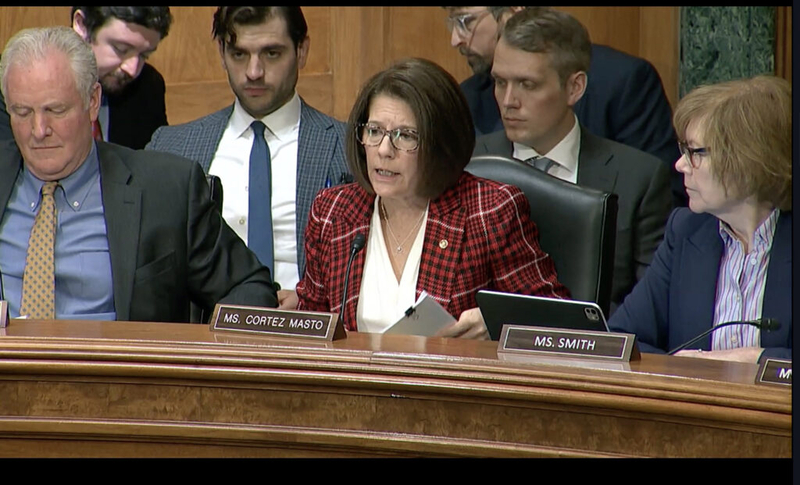
Sens. Chris Van Hollen (D-MD), Catherine Cortez Masto (D-NV), and Tina Smith (D-MN) during a Senate Banking Committee markup of the Clarity Act May 14, 2026. Cortez Masto voted against the bill in committee, but indicated her desire to ultimately support the cryptocurrency legislation. (Screengrab of video released by Cortez Masto's office)
The digital currency industry has high hopes for legislation that does two things: It declares the cryptocurrency industry needn’t adhere to reporting and transparency requirements that apply to other legitimate investments, because c’mon it’s crypto, yippeee! And at the same time, it declares crypto a totally legitimate investment for everyone and anyone, so jump in, everybody!
The prospect of endangering the entire financial system by intertwining it with “assets” like, for example, highly volatile and yet magnificently useless Melania meme coins, has prompted many congressional Democrats to oppose the bill. Many Democrats are also against the bill because it does nothing to stop Melania, her husband, and/or their offspring/cronies from personally, which is to say corruptly, continuing to amass billions of dollars from foreign interests and shady characters in exchange for most favored treatment from your U.S. government — treatment that may work against the national interest instead of for it.
The U.S. Senate Banking Committee, which includes Nevada Democratic Sen. Catherine Cortez Masto, approved the digital currency industry’s most sought-after legislation Thursday. The bill passed out of committee and was sent to the Senate floor on a 15 to 9 vote, with support from all the committee’s Republicans and two of its Democrats, Arizona’s Ruben Gallegos and Maryland’s Angela Alsobrooks.
Cortez Masto issued a statement explaining her committee vote against the legislation, saying the Clarity Act, as its called, “undermines law enforcement’s ability to trace illicit finance and recover victims’ money, while at the same time creating a more challenging environment to prosecute criminals for knowingly transmitting illicit funds.”
Cortez Masto introduced some amendments to address those concerns, but they were not approved Thursday by the Republican-controlled committee.
Despite her vote against the bill in committee Thursday, in her statement Cortez Masto indicated her desire to ultimately support the legislative cornerstone of the Trump-crypto agenda when it gets to the Senate floor.
“It’s clear we need to pass market structure legislation, and I’ve worked for months with colleagues on both sides of the aisle to negotiate a bill that provides clear rules of the road for a growing industry,” Cortez Masto said.
“I’m committed to finding solutions that allow us to take on bad actors – the criminals not the everyday coders – while giving the millions of U.S. crypto users the certainty they need,” she said.
And during the bill’s mark-up Cortez Masto joined with Gallegos, Alsobrooks, and Democrats Mark Warner of Virginia and Raphael Warnock of Georgia to vote for amendments sponsored by Republican committee members.
“At least eight Democratic votes will be needed to pass the bill on the Senate floor,” a Washington lobbyist for an investment firm wrote after the vote, The Hill reported. “Several of the necessary votes will have to come from some of the committee Democrats who voted ‘no’ today.”
Cortez Masto never passes up an opportunity to lean in on her law & order branding. And the illicit funds and fraud warnings underlying her unsuccessful amendments are shared by other Democrats.
But the concerns of most opponents of the legislation are not confined to crooks, or at least not just the ones Cortez Masto is referencing.
Massachusetts Sen. Elizabeth Warren, the ranking Democrat on the Banking Committee, is leading the Senate’s opposition to the Trump-crypto agenda. While itemizing some key objections to the Clarity Act in remarks at the start of Thursday’s hearing, Warren nodded to concerns about fraud like those expressed by Cortez Masto.
Additionally, Warren said the bill:
- “would blow a hole in our securities laws that have protected investors since 1929. Most Americans don’t want their pensions at risk so that a few crypto billionaires can juice their own profits.”
- “puts our financial system at risk by repeating the mistakes of 2008—letting the banks load up on risky debts, letting them scrape off the profits, and then when it all comes crashing down, come back to the American taxpayer for a bailout.”
- “puts our national security at greater risk. Just 3 days ago … the Treasury Department issued an alert warning that Iran is exploiting crypto businesses to move their money around.”
- “doesn’t lift even the tiniest finger to address the Trump Administration’s crypto-related corruption. Since taking office last year, President Trump and his family have amassed a staggering $1.4 billion in gains from crypto deals alone. … This kind of corruption … will keep right on growing if Congress fails to rein it in.”
Every Democrat in Nevada’s congressional delegation has voted for one portion or another of the Trump-crypto agenda. It would not be at all surprising if Cortez Masto and her fellow Nevadan, Jacky Rosen, make up 25% of the eight Senate Democrats the industry and Trump need to pass their bill.
Nevada is sometimes referred to as ground zero for the mortgage-backed derivatives disaster and accompanying 2008 global financial crisis that Warren referred to and that blew up the economy nearly 20 years ago. Members of Congress from Nevada should be especially wary of approving weak federal regulations that promotes the growth of sketchy financial products because an industry told them to.
But perhaps to them, 2008 seems like a long time ago.
It’s also possible they’re terrified.
The crypto industry raised more campaign money than any other industry in the 2024 campaign cycle, scaring the heebie-jeebies out of Democrats in the process. Crypto’s campaign attack spending is credited with playing a huge role in defeating Democratic Sen. Sherrod Brown in Ohio in 2024.
This year, tech money is financing both crypto and AI PACs forging perhaps the most intimidating combined campaign financing threat to politicians in the history of this or any other nation. And there is every reason to believe they’ll do it again in 2028, and beyond.
In her remarks Thursday, Warren said there were a lot of things the Banking Committee could have been working on instead of the cryptocurrency industry’s bill — things like capping credit card interest rates, reining in exorbitant bank overdraft fees, or “stopping rampant fraud and theft on payment platforms.”
And a Politico/Public First poll last week found that cryptocurrency is literally the last thing on the minds of U.S. voters.
Yet as a result of reaching across the aisle (to borrow a term beloved by Nevada congressional Democrats), legislative coddling of the digital currency industry is a policy priority. Just not one that will make life more affordable.
Portions of this commentary were originally published in the Daily Current newsletter, which is free, and which you can subscribe to here.
Las Vegas, NV