Does geothermal have a future in Alaska?
Jun 10, 2026 | 4:40 pm ET
Description
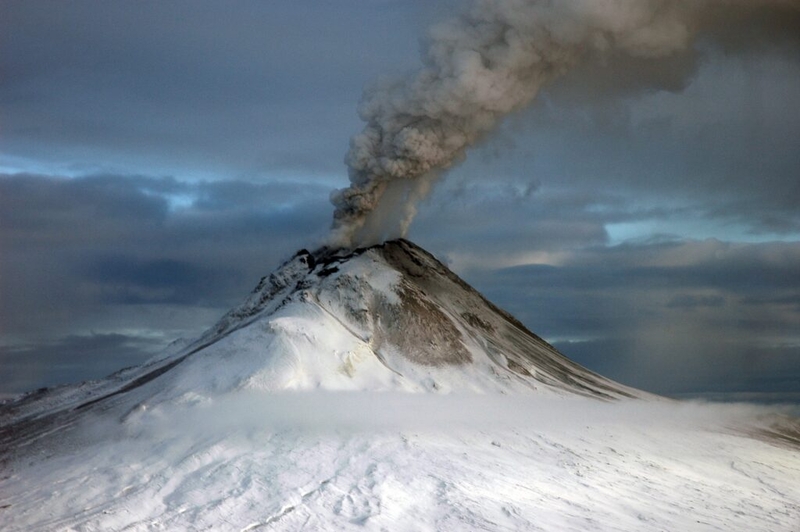
Smoke rises from Augustine volcano during its last eruption in 2006. Experts have been studying the volcano to better understand the hazards it poses to Alaskans. (Photo courtesy of U.S. Geological Survey)
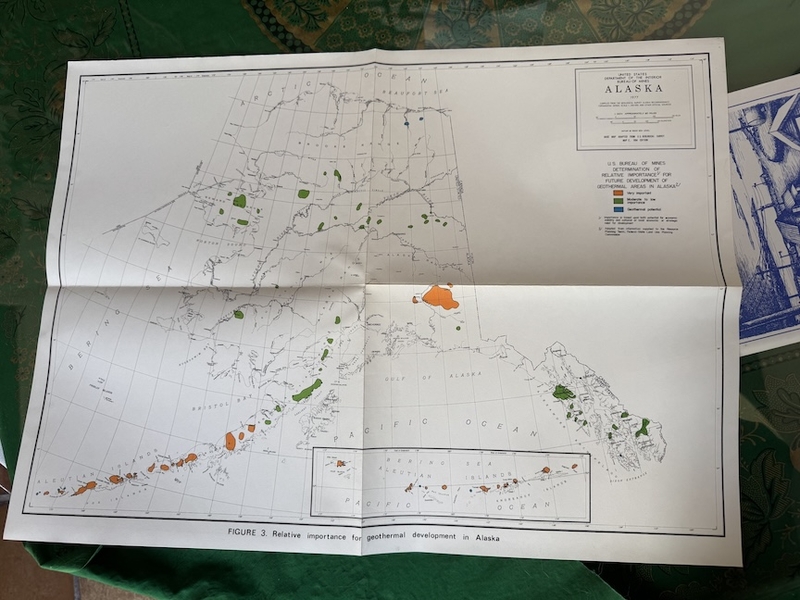
In my office hangs an old black-and-white USGS geothermal map of Alaska from the 1980s. Most of the map is nearly blank — white space with just a few major rivers and roads transecting the landscape. The only color delineates Alaska’s known geothermal systems and their relative importance for future development: green for low to moderate importance, orange for high importance.
None of the geothermal sites are labeled, but the patterns are familiar. Small green circles are sprinkled like freckles across a wide swath of the Interior, all of them moderate temperature hot springs located near ancient granite intrusions. These systems are powered by heat slowly released from radioactive elements within the rock over geologic time. One represents Chena Hot Springs, where I helped develop Alaska’s only operating geothermal power plant two decades ago.
More green dots mark known hot springs in Southeast Alaska, each emerging along major fault systems that act like natural plumbing networks, allowing water to circulate deep underground, absorb heat, and rise back toward the surface.
A chain of irregular orange patches follow along the Aleutian Islands from the volcanoes of Cook Inlet, along the Alaska Peninsula, and all the way out to Attu, delineating the tectonic boundary where the Pacific Plate slowly descends beneath the North American Plate. As the slab sinks deeper into the mantle, water released from the subducting crust triggers melting in the overlying rock. Some of that molten rock rises back toward the surface in columns of magma, feeding the iconic stratovolcanoes that delineate the northern boundary of the Pacific Rim of Fire.
But when my eyes drift across the map, none of those features hold my attention for very long. Instead, I find myself drawn to an enormous orange blob just east of Glennallen, its edge lying only a couple dozen miles from the Richardson Highway. I once took out a ruler and measured it. It covers an area roughly the size of Massachusetts and easily dwarfs every other geothermal feature in Alaska.
At that scale, it is not a geothermal prospect. It is more like an entire geothermal province hidden in plain sight. Clearly, the authors of the map believed this place mattered. So why does no one ever talk about it?
Geothermal energy is having a moment
Much of my early professional career revolved around geothermal energy, and back then it was not considered very cool. The excitement was around wind and solar, while geothermal was viewed as a mature technology. Most people assumed we already knew where the major resources were located, and many of the best prospects had already been developed. The field felt a little like it was on cruise control.
That has changed dramatically.
Advances in drilling and stimulation technologies pioneered by the oil and gas industry have generated excitement about their potential application to geothermal energy, while improvements in high-temperature materials and subsurface imaging are opening resource frontiers that would have seemed impractical just a decade ago.
As a result, venture capital is pouring into geothermal startups. Former oilfield service companies are reinventing themselves as geothermal developers. Research in the field is booming, with efforts ranging from Enhanced Geothermal Systems, or EGS, to superhot geothermal and a host of other approaches aimed at expanding where and how geothermal energy can be developed. The old assumption that geothermal only works in a handful of special places is being challenged from multiple directions at once.
And plenty of people are catching the geothermal bug. It consistently scores well in public opinion surveys, and readers frequently bring it up in the comments on my energy articles — often as the preferred alternative to whatever technology I happen to be discussing. The appeal is easy to understand. It promises reliable, around-the-clock energy with a small physical footprint and very low emissions.
I get that. I really do. I also love geothermal energy. But one thing I have learned over the years is that not all heat is created equal. More often than not, when people point to a spot on a map and ask, “Why don’t we develop geothermal there?” the answer has very little to do with temperature and everything to do with geology.
The fundamental misunderstanding about geothermal
Everyone knows that the deeper you go into the Earth’s crust, the hotter it gets. But heat alone does not make a usable geothermal system. To put that energy to work, you have to bring it to the surface, and that requires fluid flow.
Essentially, the challenge is finding — or creating — an underground heat exchanger capable of moving large volumes of fluid through hot rock and back to the surface, where that energy can be used to generate electricity or heat homes and businesses.
Heat deep underground is not very useful if you cannot get it to the surface. It is a bit like having a boiler in your house but no plumbing or ductwork to move the warmth where you want it. Sure, the boiler room might be warm, but without circulation the rest of the house stays cold. Geothermal systems need plumbing too.
In the oil and gas industry, the development of fracking technology has been a game changer, dramatically increasing production by creating artificial fracture networks that allow trapped oil and gas to move more easily through the subsurface. That success has generated a lot of interest in applying similar techniques to geothermal through EGS. If engineers can create permeability in oil and gas reservoirs, why not do the same thing in hot rock and harvest the heat instead?
There are three major challenges with this concept.
First, geothermal systems need to move far more fluid to produce meaningful amounts of energy. The amount of energy that can be extracted from a gallon of hot water is much smaller than the chemical energy stored in a gallon of oil. To compensate, geothermal systems require extensive fracture networks and very large volumes of fluid circulating through the subsurface.
Second, those fractures need to stay open. That is where you run into a challenge that oil and gas developers know well: gravity. The deeper you go, the more overlying rock there is pressing down on the formation. That pressure is constantly trying to squeeze those fractures shut. At some point, drilling deeper can begin to produce diminishing returns.
Third, much of the deep crust consists of dense metamorphic and crystalline rocks with very little natural porosity or fluid storage capacity. That is an important distinction from oil and gas reservoirs. Hydrocarbons accumulate and are trapped in porous rocks, so fracking largely works by enhancing pathways that allow those trapped fluids to migrate more efficiently toward a well.
In other words, the heat might be there at depth. The plumbing often is not.
That does not mean EGS will not work. The early results are encouraging, and the potential is huge. But if you were looking for a place to start, you would probably begin where nature has already stacked the deck in your favor — places where high temperatures sit unusually close to the surface.
Superhot geothermal
Iceland is one of those places. The island sits on top of a spreading zone in the Earth’s crust, where North America and Europe are slowly pulling apart. New crust is continually being created, the crust itself is relatively thin, and magma can lurk very close to the surface.
Near the Krafla geothermal power plant in northern Iceland, drillers working on the Iceland Deep Drilling Project unexpectedly struck magma in 2009 at a depth of only about 2 kilometers. While they were looking for high temperatures, they were not expecting to drill directly into molten rock. Despite the challenges, they were able to complete the well and briefly produce steam at temperatures exceeding 450°C.
At very high temperatures and pressures, approaching so-called supercritical conditions, geothermal fluids begin to behave differently and can carry far more energy than ordinary hot water. Under the right conditions, a single well could potentially produce several times the power of a conventional geothermal well. The Krafla experience provided a glimpse of that potential and helped accelerate interest in what is now known as superhot geothermal.
The challenge is that these conditions are brutal on drilling equipment and well materials. Temperatures can exceed the limits of cements, steel alloys, and downhole sensors, while corrosive fluids can attack everything from well casing to valves and surface equipment. Only recently have advances in drilling technology and high-temperature materials made it realistic to pursue geothermal development in such extreme environments.
For geothermal engineers, these ultra-high-temperature systems are something akin to Formula One race cars — technically challenging, expensive, and potentially capable of extraordinary performance.
Iceland has been pioneering this work for decades, but Alaska has one of the field’s most respected experts in John Eichelberger, who has worked alongside Icelandic researchers studying these magma-adjacent systems. When I asked John a few years ago where he would pursue superhot geothermal in Alaska, he answered instantly: Mount Augustine, a volcanic island in lower Cook Inlet.
Recently, at the Alaska Sustainable Energy Conference, I got a better sense of why.
Paul Craig, co-founder of GeoAlaska, and his partner Antony Penino hold the geothermal lease rights to the site. During a break, Paul pulled me aside and showed me an image from a magnetotelluric survey estimating the location and size of the magma body beneath the volcano. The way he carried it around reminded me of a proud first-time parent showing off ultrasound photos.
The image showed the fuzzy but distinct black and white outline of an interpreted magma body beneath the volcano. Based on the survey, it appears to lie less than a mile beneath the surface — potentially even shallower than the magma encountered by the Icelanders at Krafla. It was easy to see why he would be excited.
But a shallow magma body does not automatically make a geothermal project viable. Like the other volcanoes in Cook Inlet, Augustine sits within a compressional tectonic environment where rocks are being squeezed together rather than pulled apart. That is one reason there are surprisingly few hot springs, fumaroles, or other obvious signs of active hydrothermal circulation associated with these systems.
There is also the significant detail that Augustine is an active volcano and a very remote one at that. It would take a very expensive extension cord to get power from the island to the Railbelt grid. In other words, developing a geothermal project at Augustine is not a slam dunk. Still, it’s an enticing prospect.
If Augustine represents a place where very high temperatures may lie close to the surface, that big orange blob in the Copper Basin on my map may represent something equally important: natural permeability.
And in geothermal, the plumbing problem is often the harder one to solve.
The forgotten province
That enormous orange shape east of Glennallen corresponds to one of the stranger and lesser-known geologic systems in Alaska: the Klawasi mud volcanoes and deep crustal fluid systems of the Copper Basin and Wrangell region.
I have started thinking of it as the “Copper Basin geothermal province” because this is clearly not a single geothermal site like Mount Augustine. It is an enormous region that appears to contain many of the hallmarks of a large hydrothermal system. In terms of unexplored geothermal potential, it may be one of the most significant underappreciated geothermal regions in all of North America.
What makes the area especially interesting is its tectonic setting.
While much of southern Alaska, including Augustine, exists within a compressional environment, the Copper Basin and Wrangell region sit within a complicated network of major strike-slip faults where sections of crust are sliding sideways past one another. In certain places, bends and offsets along those faults create localized zones where the crust is also being pulled apart slightly — what geologists call transtensional faulting.
That distinction matters because these kinds of fault systems can create exactly the sort of permeability geothermal systems need. They act as giant crustal plumbing networks, allowing water to move downward through fractures, encounter heat at depth, and then circulate back upward toward the surface.
Historically, many of the world’s most productive geothermal systems formed in precisely these kinds of tectonic environments where heat and permeability intersect.
The geology is only part of what makes the Copper Basin intriguing. The other part is the old real-estate adage: location, location, location. The western edge of the province is adjacent to the corridor proposed for the long-discussed “Roadbelt” transmission concept — a line that could someday provide redundancy to the Railbelt grid by linking the Mat-Su region, Glennallen, Tok, Delta Junction and Fairbanks while also connecting the Copper Valley Electric Association system.
This is a big part of why the area attracted serious attention during the energy crises of the 1970s and early 1980s, around the same time my map was produced. The geologists evaluating Alaska’s geothermal potential were not simply looking for heat. They were looking for resources that could realistically be developed and connected to the people who might use them.
And initial studies on the ground were promising — geologists documented large carbon dioxide emissions, warm mud temperatures, unusual gas chemistry and helium signatures suggesting at least some contribution from deep crustal or magmatic sources. In other words, they found good reason to believe there could be a dynamic and actively circulating deep crustal plumbing system.
Yet despite those intriguing findings, no serious exploration program ever followed. Why?
A province without a program
Part of the answer is that geothermal exploration is both expensive and inherently risky. Before a drill bit ever touches the ground, much of what lies beneath the surface remains an inference — geophysics, fluid chemistry, structural interpretation and educated guesswork. Exploration wells are expensive, and many fail to find an economically viable resource.
As a result, even projects with compelling targets — like Mount Augustine — face major challenges attracting the capital needed for a multimillion-dollar exploration or resource-confirmation drilling program.
But the challenge in the Copper Basin also extends to land ownership, jurisdiction and leadership. Unlike Augustine, where a defined geothermal prospect on state lands has been leased to a private developer, the Copper Basin geothermal area spans a complicated patchwork of federal, state and Native-owned lands. Portions lie within or adjacent to federally protected lands, while others fall within state lands or lands owned by Ahtna, a Glenallen-based Alaska Native Regional Corporation. Any serious effort to evaluate the resource would almost certainly require cooperation among multiple landowners, agencies, researchers, utilities and local stakeholders.
That complexity may help explain why the prospect has never developed a project champion. Large energy projects rarely move forward simply because a resource exists. More often, they move forward because someone believes in the opportunity and is willing to do the hard work of assembling partnerships, pursuing funding, navigating permitting and keeping the idea alive long enough to determine whether it is worth developing.
In other words, the Copper Basin may have the right geology. What it is lacking is an organization or coalition willing to take ownership of the next step.
And yet, the timing may never have been better. Alaska is actively searching for long-term energy options as uncertainty grows around the future of Railbelt gas supply. At the same time, the Department of Energy is investing hundreds of millions of dollars in geothermal exploration and demonstration projects. If there was ever a time to bring together Ahtna, state agencies, utilities, researchers and federal partners to take a fresh look at the Copper Basin using modern tools and techniques, this may be it.
Whether the Copper Basin ultimately proves to be a major geothermal resource or not, the potential upside is significant enough that we owe it to ourselves to find out.
Forty years ago, the geologists who assembled the map hanging in my office looked at the available evidence and colored an enormous swath of the Copper Basin bright orange.
That was a provocative choice. In the years since, relatively little has been done to either confirm or refute that interpretation.
Perhaps it is finally time to find out whether they were right.
Juneau