What’s wrong with higher ed? Panelists at intellectual freedom center blame liberals
Dec 05, 2025 | 11:09 pm ET
Description
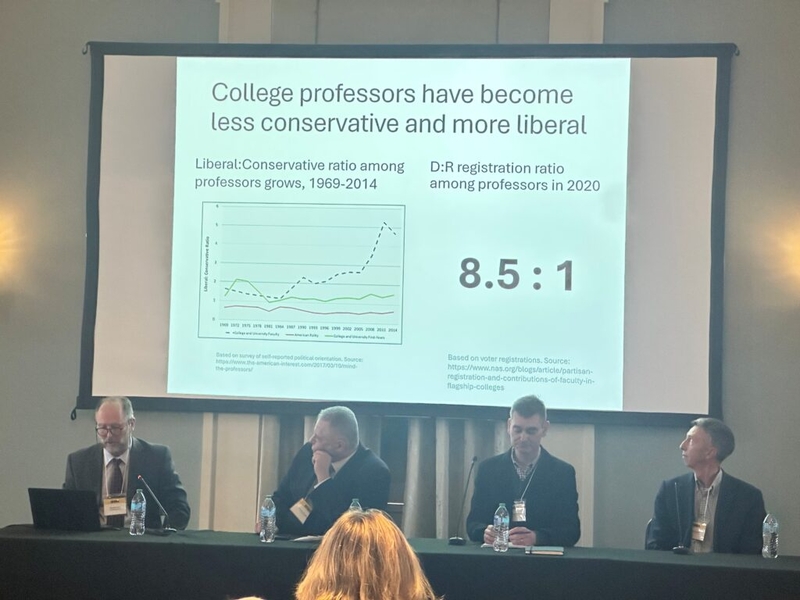
(From left) Nicola Persico, Northwestern University managerial economics and decision sciences professor, University of Iowa Center for Intellectual Freedom Interim Director Luciano de Castro, Concordia University professor Zachary Patterson and Texas A&M University engineering professor John Criscione speak during a panel discussion on Dec. 5, 2025. (Photo by Brooklyn Draisey/Iowa Capital Dispatch)
The first day of the University of Iowa Center for Intellectual Freedom’s two-day inaugural event sought to answer two questions — what is wrong with higher education, and what caused these problems — with discussion from academics and activists involved with the center or invited by its interim director.
There wasn’t much debate among panelists and audience members, with the group seeming to agree that the root of the problems facing higher education comes from liberals and the ideas they bring with them.
“The critical thing here to understand is … what has actually gone wrong? Well, a lot of things have gone wrong,” said panelist and American Enterprise Institute senior fellow Joshua Katz. “Who’s responsible? Well, a lot of people are responsible.”
Created by a law passed in the last legislative session, the UI Center for Intellectual Freedom is an entity governed by the Iowa Board of Regents with the goal of expanding intellectual diversity and civics education at the university. The center’s 26-person advisory council is in charge of finding a permanent director to replace de Castro and will advise on academic and other matters.
Kicking off the affair was the “Centers Strategy Colloquium,” which will continue Saturday with discussion of past efforts to create centers similar to the UI’s and the work going on now within the center. While the event was public, only panelists and those invited to attend were allowed to ask questions during the sessions.
The “Reforming Universities Summit” will take place Saturday afternoon with remarks from Iowa Gov. Kim Reynolds, former regent and current U.S. Assistant Secretary for Postsecondary Education David Barker and others. Sessions will cover the question of whether universities can be reformed and “possible actions and next steps,” with a “Capstone Session” ending the event.
Center Interim Director Luciano de Castro said in a previous interview the center, and the events it holds, are “the democratic process” in action, as Iowa voters made their opinions clear in electing the lawmakers who voted to create the center and shape its mission. Ideas and thoughts brought up during the inaugural event will be “extremely valuable to orient what we do in the center,” de Castro said.
‘What is wrong with universities?’
Main problems identified by panelists related to the actions faculty do or do not take when it comes to fostering debate not only among students, but among their colleagues and in higher education as well, and what universities base their work and priorities on.
Nicola Persico, a managerial economics and decision sciences professor at Northwestern University, provided the “context” that liberals outweigh conservatives in both faculty and administration and that faculty are more likely to say a liberal person would fit in their department than a conservative one. The only “problem” he identified stems from these facts, that faculty are self-censoring in the classroom, in research discussions and online.
Texas A&M University engineering professor John Criscione said faculty need to be “guardians at the gate” to protect higher education’s mission of supporting the exchanging and debate of ideas and the pursuit of truth, especially as “propagandists” seek to take control of powerful institutions at the junction of youth teaching and adult beliefs.
Universities are prioritizing productivity above anything else, he said, when they should be prioritizing the search for truth.
“I think universities really need to change society for the better. There’s no question on that …,” Criscione said. “Our mechanism, our approach to doing that, I think, is pursuing the truth, discovering knowledge, disseminating knowledge, that will change society, that will improve it. If we pick a particular approach, we decide society needs to change in this way, I don’t think we can have credibility.”
‘How did we end up here?’
Panelists had plenty of people, and the ideas they introduced to higher education, to blame for where the industry is now.
Katz separated those responsible for higher education’s issues into two categories — “sheep” and “crazies.” The sheep are “almost everybody,” he said, with the crazies at the fringes of both ends of the political and ideological spectrums. Nearly all university faculty fall into the sheep category, and if they follow a bad idea things can, and have, gone very wrong.
Crazies used to be a small minority of academic units, Katz said, but now there are more of them and they are “malevolent.”
“Don’t hire crazies, don’t be a sheep, and let’s hope that the Center for Intellectual Freedom at the University of Iowa can fix whatever problems there are,” Katz said.
It’s not just the people that have caused problems in higher education, said Texas A&M University finance professor Adam Kolasinski, but the belief they bring with them that “the very fabric of society” is biased against certain people and groups and the “moral crusade” they want to undertake.
“Far left ideology” has been present in U.S. higher education for a very long time, Kolasinski said, but one touchstone moment in the movement was “the rise of critical race theory in law schools” in the late 1970s and early 1980s. He said the “liberal left” had continuing frustration that results of the Civil Rights Movement weren’t followed with as big of changes for minority communities as was hoped, which led to “crackdowns on speech they did not approve of” and “over-discrimination against whites.”
“Left liberals” also have the “fundamental misunderstanding of human nature in the post-war era” that poverty is mostly, or solely, caused by external factors rather than internal ones, he said. This belief led to race-conscious hiring practices, censoring of voices who did not disagree and a “hierarchy of oppression” that brought forward diversity, equity and inclusion programming.
Academics have been pushed out or silenced for going against these ideas, Kolasinski said. He provided the example of former U.S. Treasury Secretary Larry Summers, who stepped down from his Harvard University presidency after suggesting women were less represented in STEM fields because of “intrinsic aptitude.”
Summers, who was teaching at Harvard and held the position of director of the Mossavar-Rahmani Center for Business and Government at the Harvard Kennedy School, has stepped away from the university again due to his ties with convicted sex offender Jeffrey Epstein.
When asked how to deal with faculty pushing “critical” study and ideologies, Katz said more discussions need to be had around tenure. He added that the “only way to fix anything, at least within two generations,” is to get rid of the employees who shouldn’t have been hired in the first place. Kolasinksi agreed and said if universities can get university leaders who would “stand up against” these faculty members, then “the kooks will be marginalized.”
Some panelists pointed to decades and centuries of past philosophical changes that have led to this point, with Iván Marinovic, associate professor of accounting at Stanford University, suggesting that much of higher education “rejects reason as traditionally understood” and is skeptical and suspicious of “western values.”
“The traditional aim of inquiry has been replaced by a commitment to political activism and a very narrow vision of social justice,” Marinovic said. “The world is interpreted through a rigid oppressor, oppressed framework, reducing persons primarily to their race, gender and sexual orientation.”
The way to fix this problem, he said, is to once again open higher education to “the whole breadth of reason,” including moral, religious and metaphysical inquiry and the approach to deep questions with “intellectual honesty and hope.”
Clara Reynen, a University of Iowa graduate student and Unity Chair in the Campaign to Organize Graduate Students, said she was concerned about what she heard during the panel discussions and thought speakers didn’t “provide any sort of solid, consistent argument to support the creation of the center.”
“Contrary to some of the panelists,” Reynen said, she does believe in self-censoring in her role as an instructor unless a student asks directly, as she is teaching course materials and not her personal feelings.
Other students she’s spoken to have expressed disappointment in the center’s structure, as its director will have near-total control of hiring professors, inviting guest speakers and other actions.
“I think that it’s very clear that folks here are not actually interested in freedom of expression,” Reynen said. “If they were, they would be doing things to make sure that our university did have more equitable access for everybody, and weren’t just appointing from within.”
De Castro ended the event for the evening with a note of “optimism” about the truth and those seeking it.
“Truth has quality that only the truth has, which is the correspondence to reality, and just because of that, you can have for a long time things that are wrong, things that go in the wrong direction, but truth remains, and eventually will prevail,” de Castro said.

Des Moines, IA