What would get Gen Z to vote in California’s primary? These candidates are trying
May 28, 2026 | 8:00 am ET
Description
In summary
Historical voter turnout data show that voters aged 29 and younger disproportionately sit out primary elections in California compared to the general voting population. Still, a few governor candidates have been targeting young voters in their campaigns, particularly through social media and college organizations.
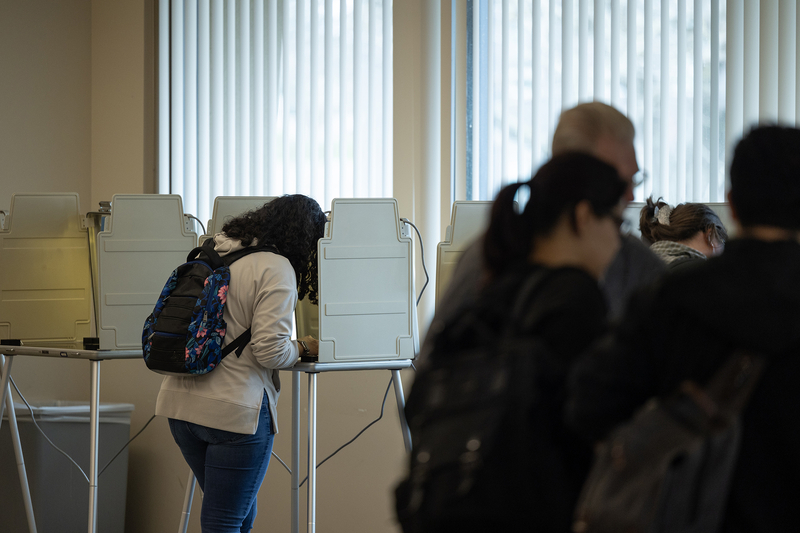
Despite making up one-fifth of the state’s voting population, most Gen Z Californians won’t vote in the June 2 primary, which is stacked with several gubernatorial candidates.
The primary election tees up the ballot in November, which will also host other high-profile races and issues, such as the rest of the executive candidates, as well as propositions like the billionaire’s tax.
Generation Z, or those aged 14 to 29, makes up nearly 21% of eligible California voters, but their historical turnout is disproportionately low compared to the general voting population.
Young voters aren’t necessarily checked out. Rinu Nair, the president of the History and Civic Engagement Club at De Anza College in Cupertino, said that the student club’s meeting on the gubernatorial race drew the most participants of any meeting this year: 20. But students were often disillusioned by each candidate having a history of controversial actions.
“There’s an interest, but also that feeling of, ‘Am I doing what I want to do? Can my vote even make a change?’” Nair said. “(Young people) don’t feel represented in politics but they feel like it’s a duty they have to do.”
In a statewide survey published by the UC Berkeley Institute of Governmental Studies in May, voters aged 18 to 29 polled similarly to all voters on reasons why they may not vote in the primary election. But a few reasons jumped out in particular.
Of young voters who said they were unlikely to vote, 47% said they are not well-informed enough on the issues and candidates, compared to 38% of total unlikely voters. Another difference was that 31% of young voters said they were too busy, compared to 19% of all unlikely voters.
Cost of living and inflation, healthcare and housing costs are the top three issues Gen Z voters are tracking leading up to the 2026 midterms, according to 2026 survey data from the Center for Information and Research on Civic Learning and Engagement, a nonpartisan research organization based at Tufts University in Boston. Jobs and unemployment and immigration ranked fourth and fifth among survey respondents respectively.
How candidates are – or aren’t – addressing the youth vote
CalMatters reached out to gubernatorial candidate front-runners to learn more about their methods for engaging youth voters. Steve Hilton, Chad Bianco, Tony Thurmond and Matt Mahan’s teams did not respond.
Antonio Villaraigosa said in an interview that he hired a diverse staff of people primarily aged 22 to 26 to help him connect better with youth voters. Katie Porter and Tom Steyer said they have visited many college campuses across the state in an effort to connect with young voters.
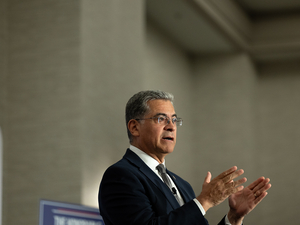
Maiya De La Rosa, the president of California Young Democrats, a youth organizing group affiliated with the state Democratic Party, said that Xavier Becerra has visited and formed relationships with more Young Democrats chapters across the state than any other candidate, having visited 30 chapters since July 2025. She said that the organization endorsed him because of that strong relationship as well as his policies.
The California College Democrats, an organization of students that mobilizes around Democratic candidates and advocates progressive policies, similarly endorsed Becerra in March.
“He’s made a really big effort to put college students at the front of his campaign,” said Daniel Guerrero, the organization’s president and incoming senior at UC San Diego. “We believed in his message, and it’s been really rewarding to see everyone else see what we saw in him, especially in the young community.”
Steyer and Becerra have both been using short videos and partnerships with content creators to reach young audiences. Both are caught up in a controversy over content creators allegedly failing to disclose that campaigns had paid for their endorsements. The influencers often posted endorsements without disclaimers that they had been paid.
According to each candidate’s endorsement pages (except Hilton, who does not have one), Becerra has the most endorsements from youth groups – 15 total, mostly consisting of Young Democrats and College Democrats chapters.
Steyer has three youth group endorsements and Thurmond has one. Peter Opitz, a representative for Porter, said she is endorsed by UAW and Teamsters, which contain unions that represent workers and educators in higher education.
A strong social media presence has been integral to reaching young voters – and any voter – in a race where it’s difficult to stand out.
Even so, California Assemblymember Alex Lee, who has endorsed Steyer, said in an interview that he believes social media strategy comes second to good policy, and that Democrats often get criticized for being boring online.
“Zohran Mamdani’s popular not because he’s good at Instagram alone, but because he campaigned on free childcare, housing and a rent freeze,” Lee said, who was 25 years old when he was elected. “You can pump so much money into viral cringe, but it will not resonate with people.”

At a televised debate held at Pomona College in April, as candidates squabbled for speaking time, hundreds of students tuned in from a nearby dining hall where the debate was being livestreamed. They giggled at Steve Hilton’s British accent, hollered over the shade thrown on stage and kept a close eye on the crowded field for standouts.
Throughout the debate, as candidates like Villaraigosa directed their responses to “the young students at Pomona,” groans erupted from students watching the livestream. Rising junior at Pomona College Sarah Russo said the candidates’ comments felt overly performative.
“It belittled us and infantilized us,” Russo said in a talkback session with other students after the debate.
Incoming Pomona College junior Alex Benach said no one candidate really stood out. “The whole field of candidates trying to have that viral moment watered [the debate] down,” they said.
Despite the debate being held at a college campus, students attending said that the candidates failed to address key priorities for youth in college, including the job market, AI and federal crackdowns on campuses for alleged anti-semitism and equity issues.
Youth turnout is low, but young voters are hardly apathetic
No matter the kind of election – gubernatorial or general – youth turnout is historically lower than other age groups, said Mindy Romero, director of the Center for Inclusive Democracy at the University of Southern California, a hub for civic and electoral engagement research. In the 2024 general election, 42.5% of eligible voters aged 18 to 24 cast a ballot, compared to 62% of all eligible voters in California, according to a July 2025 report from the center.
While young people do not show up to vote as much as older voters, it’s “not because they’re apathetic,” emphasized Romero. Rather, it is because youth feel disconnected from the political process.
From the 2010 to 2018 primary elections in California, eligible youth voter turnout ranged from as low as 3.6% in 2014 to 17.1% in 2016, according to California Civic Engagement Project data. In comparison, total eligible voter turnout ranged from 18.4% in 2014 and 33.5% in 2016.
Likely voter modeling often shows campaigns that youth voters aren’t worth investing in due to historically low turnout. However, that same lack of investment is what can lead to low youth turnout itself – and create what Romero calls a “vicious cycle” of campaigns failing to engage youth voters because they believe it’s not worth it.

When they do focus on young voters, candidates primarily target college campuses, usually skewing towards four-year university students, which means non-college goers, low-income voters and people of color are less likely to receive their outreach, according to Romero.
“The political and social context in which young people have come of age has made them not see government as a helpful thing that they have a say in, but rather a government that is not as responsive, gridlocked, and about spewing hate and not serving,” Romero said. “Generally speaking, young people don’t have a lot of positive to look to. They’ve seen only negative.”
Young people also may be more skeptical after seeing such negativity, whereas older generations have memories of a more civil past, giving them the perspective of a government that could function in a non-partisan way.
“Young people are tapped in politically, that’s undeniable,” said Christopher Smith, a student at Evergreen Valley College who attended a Steyer event. “Anybody who claims that is not true is not listening to young people enough.”
Romero suggested that the competitiveness of the race could push more young people to vote, but the turnout would still be unrepresentative of the actual youth population. In the UC Berkeley IGS Poll, 56% of respondents across all age, race and party demographics said that a low youth turnout was a “major concern” for a representative democracy in California.
The UC Berkeley IGS poll also showed that 48% of young voters who said they were unlikely to vote said access to an “unbiased and trusted source of election news” would increase their chances of voting. A quarter of them said more convenient voting would also increase that likelihood.
Andrew Luong, a De Anza College student at the Steyer rally, said he feels that it’s partially on young people to educate themselves and vote. “In the governor’s race, I know young people care about it, but don’t care to learn more about it,” he said.
Among young Democrats, De La Rosa said she has seen youth voter engagement increase “significantly.” She recalled how when she was president of California College Democrats in 2020, phone banking events would turn out about 20 people. Now, in a phone banking event for Becerra, 60 people came.


Young progressive leaders say some youth are looking for a candidate to stand up to Trump.
“In a time where young people have been at the forefront of the attacks from the Trump administration, having someone who’s been there and has already gone up to bat to fight the Trump administration is really, really important,” Guerrero said.
Where candidates stand on Gaza, affordability
In April, Steyer made his first stop of “A California You Can Afford” bus tour a few blocks away from San Jose State University, where he made his progressive bid to a majority middle-aged crowd.
A handful of people who appeared below 30 years old were present. That’s not to say young people don’t support him – a Democratic Party poll conducted May 14 through 16 shows he and Becerra both garnered the support of 23% of respondents aged 18 to 34. Meanwhile, 17% of respondents aged 18 to 34 said they still were undecided.
CalMatters spoke to college students at the bus tour, many of whom said that the genocide in Gaza was a moral touchpoint for them.
Nair attended the event to learn more about Steyer. She said that she’s still unsure of who to vote for.
“The fact that he wasn’t willing to take a solid stance on the Gaza question, that was more than enough for me,” Nair said. “I do hold my politicians to a higher standard than some do, and that was enough for me to not feel convinced.”
Smith said that young voters especially care whether a candidate believes Israel has committed genocide.
In exclusive video interviews with CalMatters, eight candidates currently in the race were asked whether they considered Israel’s actions in the war in Gaza a genocide. None of the candidates went that far. Porter and Becerra criticized Netanyahu’s actions, while Hilton simply responded “no.”
In these interviews, CalMatters also asked candidates what is the single biggest thing they would do to make life more affordable in California. Five of the eight candidates said they would focus on combatting high housing costs, primarily with plans to make it easier to build. Hilton and Villaraigosa said they would first bring down the price of gas, while Bianco said overregulation was California’s primary affordability issue.
When asked about their greatest hope for youth in particular, the most common answer among candidates was making sure California remains a state where people want to settle permanently.
Kahani Malhotra and Chrissa Olson are contributors with the College Journalism Network, a collaboration between CalMatters and student journalists from across California. CalMatters higher education coverage is supported by a grant from the College Futures Foundation.
Sacramento