Kalshi acknowledges gambling problem, seeks professional help
May 28, 2026 | 9:00 am ET
Description
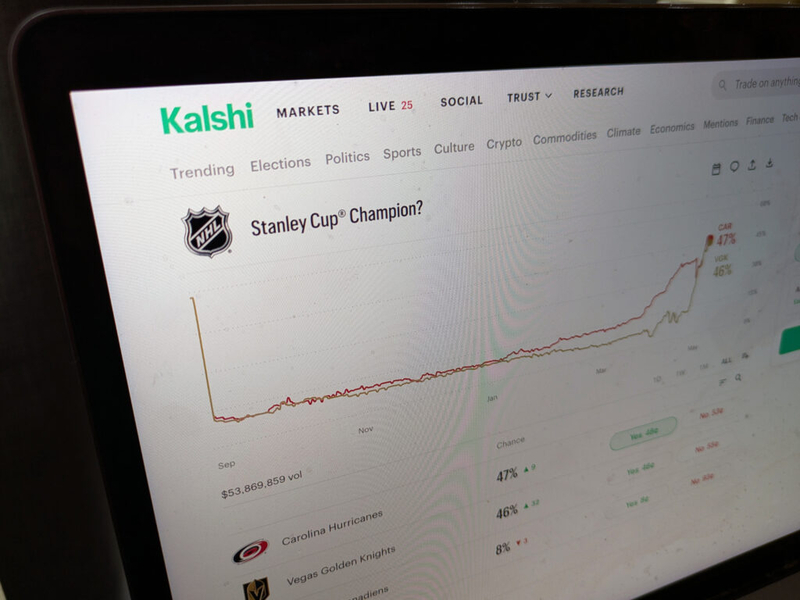
(Photo: April Corbin Girnus/Nevada Current)
The prediction platform that takes bets on everything from who will win the Stanley Cup to when Taylor Swift will tie the knot is joining forces with the National Council on Problem Gambling, which seeks to minimize the effects and prevalence of gambling addiction.
The National Council formed the Financial Services and Trading subcategory and Kalshi is its first member, funding a $2 million, two-year investment to “support a strategic initiative focused on trader health and safety,” says a news release from the council.
Kalshi, a company valued at $22 billion, is contributing to the National Council about half of what Nevada allocates to problem gambling each year.
State funding “isn’t adequate in normal time and certainly not enough to address the rise in harm,” especially among the 18-34 year-old demographic, says Trey Delap, executive director of the Nevada Council on Problem Gambling. That age group is the source of about half of the callers to the U.S. National Gambling Helpline.
Nevada is one of 16 states fighting Kalshi’s attempts to circumvent state gaming laws by claiming federal authority to take sports bets without state licenses.
This month, Minnesota became the first state to outlaw Kalshi and other prediction market platforms. The Commodity Futures Trading Commission, which claims to have exclusive jurisdiction over the markets, filed a suit to stop the law from going into effect.
“Kalshi will join NCPG’s Leadership Circle, recognizing its role as a leading partner contributing to the organization’s operational strength, long-term sustainability, and capacity for innovation,” says the National Council’s news release.
“I can’t speak to Kalshi’s legal strategy. But from our perspective, this is about public perception and timing,” says Delap of the Nevada Council, which submitted amici (friend of the court) briefs in the Nevada Gaming Control Board’s legal battle with Kalshi before the Ninth Circuit Court of Appeals.
“When a major national partnership is announced while significant regulatory and legal questions are being litigated, it can create real public confusion,” Delaps said. “It risks looking less like neutral harm reduction and more like an endorsement of the platform itself. That concern – and the potential to circumvent established state level consumer protection — is exactly why we believe a more thoughtful and transparent dialogue is necessary.”
The move comes as a surprise to the Nevada Council on Problem Gambling and other state affiliates that learned of the edgy partnership via news release. The Nevada Council notified its national counterpart of its concerns last week.
“As emerging event-based trading products continue expanding nationally, we believe it is important to recognize that the social, financial, and behavioral health costs associated with these activities may ultimately be borne locally, even where regulatory authority and economic participation occur outside traditional state gaming frameworks,” Delap of the Nevada Council wrote to the national organization.
The age of its clientele could be a point of contention in Kalshi’s relationship with the National Council. Prediction markets, including Kalshi, allow 18 year-olds to place bets, while the National Council supports a universal minimum gambling age of 21.
“At Kalshi, we believe in the power of prediction markets, and we are sensitive to the fact that they, like any financial trading products, come with risks,” Kalshi’s CEO and founder Tarek Mansour said in a news release. “As prediction markets continue to evolve, we are deeply committed to setting a new standard for responsible trading by investing in the tools, education, and protections needed to promote healthy participation and customer safety and hope that over time all trading platforms with significant retail participation follow suit.”
Kalshi, which once attempted to skirt state regulation by deeming its transactions as trades rather than bets, has more recently acknowledged it, with advertisements proclaiming it takes bets in all 50 states.
President Donald Trump, who just weeks ago bemoaned the proliferation of gambling, said this week it’s “critically important” that the CFTC have exclusive jurisdiction over prediction markets, and characterized the opposition to federal regulation as “scum.”
The five members of the CFTC are appointed by the president, who along with his family, has business ties to at least three prediction market platforms.
Donald Trump Jr., the president’s son, is currently a “strategic advisor” to Kalshi and an investor in Polymarket, and Crypto.com is teaming up with Trump’s Truth Social to allow its users to make crypto bets.
UNLV Boyd Law School visiting professors Steve Light and Kathryn Rand call Kalshi’s partnership with the National Council on Problem Gambling “a logical step that has both substantive and symbolic meaning.”
Prediction markets, they note, “are looking to voluntarily address various concerns–here, at the levels of individual behavior and public health. At the same time, Kalshi is continuing to seek ways to avoid regulation, both generally and as a gambling product.”
Light and Rand say Kalshi’s strategy is “a tricky line to walk, because from a consumer perspective, the product and behavior look and feel like gambling, and an initiative focusing on ‘financial trader health and safety’ acknowledges a risk of resultant harms stemming from an activity that looks and feels like gambling.”
Las Vegas, NV