What happens behind the scenes when SC joins a multi-state GOP lawsuit
Jan 27, 2026 | 8:52 am ET
Description
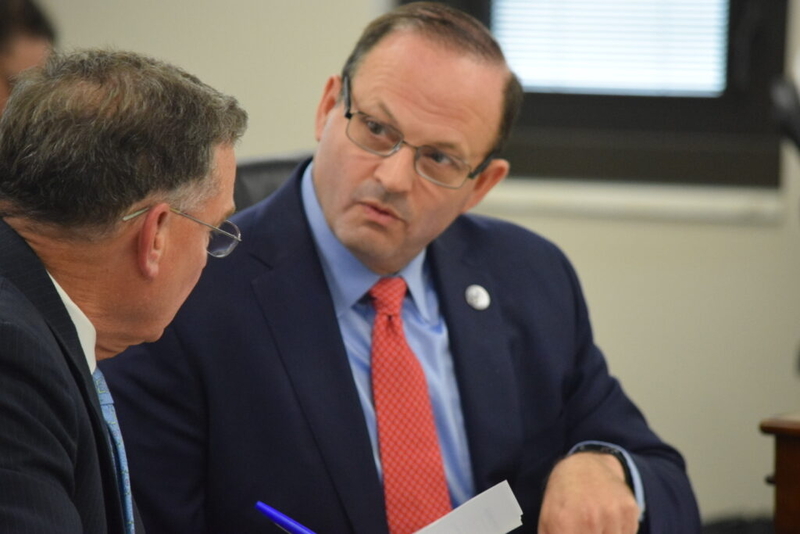
South Carolina Attorney General Alan Wilson at a Wednesday, Nov. 5, 2025, Senate hearing regarding legislative oversight of his office. (Photo by Jessica Holdman/SC Daily Gazette)
COLUMBIA — Attorney General Alan Wilson “opposes woke gender ideology on government passports” or “fights against burdensome gun restrictions” or “leads fight for religious liberty,” the announcements read.
Such headlines in statements from the state’s top prosecutor are commonplace — sometimes multiple times a week.
In the past year alone, Wilson’s office announced joining other Republicans or declared victory on more than 60 multi-state lawsuits. That includes filings earlier this month in a pair of lawsuits challenging blue states’ gun laws — a New Jersey law banning guns from parks, beaches and “public gatherings;” and a California law requiring background checks for every ammunition sale.
Other past lawsuits involve transgender treatments for people in prison, access to bathrooms, and President Donald Trump’s executive orders on birthright citizenship and deploying National Guard troops to major cities.
Almost all of the multi-state efforts announced by Wilson in the past year involve Republicans only, though at least two cases were bipartisan: Democratic attorneys general also signed friend-of-the-court briefs supporting laws in Florida and Virginia aimed at protecting children from the harms of social media.
Keeping the watch for litigation the Palmetto State may want to get involved in falls to a four-person team in the state attorney general’s office, though only two of those slots are currently filled. It’s the state solicitor general and his deputies who spend their days combing through court filings and on biweekly phone meetings with similar teams in attorneys general offices across the country.
“There’s a small staff of attorneys that that’s all they do,” Wilson recently told the SC Daily Gazette. “They’re constantly keeping me read in on things we may need to engage in.”
A question of cost
The topic of these multi-state and national suits came up during a November legislative hearing reviewing Wilson and his team.
“Like everybody else, I see the news that Attorney General Wilson is holding a press conference. He’s suing the Biden administration. He’s backing up the Trump administration. He’s involved in litigation involving the border or whatever it might be,” said Senate Minority Leader Brad Hutto, D-Orangeburg. “You’re choosing to get involved in that litigation and it seems very political on its face.”
He asked: How much do these endeavors cost and who pays for them?
“I would argue that the expense to the state for us not to challenge some of these things is greater than the expense of bringing a case,” Wilson responded.
Generally, Wilson said, the costs are the salaries of those employees, two of which top $100,000, according to the state employee salary database.
The time it takes to draft, edit and circulate briefs for all of the states to sign on to is split among those involved.
“We’re constantly talking to our sister states,” the former chairman of the Republican Attorneys General Association told the Daily Gazette.
It was Wilson who, in 2013 — about 2 ½ years after he took office — created the solicitor general position.
Wilson tapped Bob Cook, who at the time was a 36-year veteran of the attorney general’s office. Cook remained in the role until just this past May, when Wilson promoted one of Cook’s deputies to the position. Cook, who became solicitor general emeritus, remains a senior legal adviser.
Decisions for the next AG
Whether the practice will continue with South Carolina’s next attorney general remains to be seen.
Three Republicans are vying for the GOP nomination to replace Wilson. No Democrat has announced a bid.
Republican state Sen. Stephen Goldfinch made clear when he entered the race — two weeks after Wilson announced his own bid for the Governor’s Mansion — that he believes South Carolina should sue the federal government, as Wilson did with the Obama and Biden administrations, and fight Democrat-led initiatives in court.
First Circuit Solicitor David Pascoe said he’d keep a team in place to help monitor federal issues but would prioritize matters directly impacting the Palmetto State.
“I’m a South Carolina first person,” he said Monday. “If it affects us, I won’t need to see what other states do. I will punch back. If not, then it’s going to be on my backburner.”
Eighth Circuit Solicitor David Stumbo also said the solicitor general team and multi-state cooperation are necessary.
“When pushing back on federal oversight, pooling resources with like-minded attorneys general around the country is very important,” he said Tuesday.
But, like Pascoe, Stumbo indicated he’d join fewer cases. The deciding factor would be whether cases significantly impact South Carolinians, either directly or indirectly: “If it doesn’t. it’s probably best left alone,” he said.
When to sign on
There are several reasons for inserting South Carolina into a court fight, he said.
“Though critics would claim it’s to make headlines,” Wilson said.
The first reason, according to Wilson, is that South Carolina might have a similar law or want to avoid a federal rule that contradicts existing state law. If South Carolina doesn’t join a challenge elsewhere, it won’t benefit from any rulings granting temporary protections while the litigation makes its way through the courts.
“If we don’t get involved, we get left out, having to litigate it by ourselves,” Wilson said.
The Title IX example
Wilson pointed to a series of cases filed in federal court to stop the Biden administration’s changes to Title IX rules, which extended the definition of sex discrimination in the 1972 law to include sexual orientation and gender identity. Democrats praised the changes as needed protections for LGBTQ+ students. Republicans’ complaints included what it meant for school bathrooms.
Within days of the rules’ release in April 2024, state Superintendent Ellen Weaver urged school districts to disregard them. The Senate voted to require the opposite — inserting into the state budget a law threatening to withhold classroom aid from school districts that let transgender students use multi-stall restrooms and locker rooms corresponding to their gender identity.
And Wilson joined with Alabama, Florida and Georgia in a lawsuit to stop the rules. In all, 26 states filed or joined multiple lawsuits.
If South Carolina hadn’t signed on to one of the cases, schools in the state would have been required to follow the changes, Wilson said. But a federal appeals ruling blocked them for all South Carolina schools a day before they were set to take effect Aug. 1, 2024. Five months later, a federal judge in Kentucky threw out the changes for all schools nationwide, saying the pronoun requirements violated free speech rights and all 1,500 pages overstepped the president’s authority.
As for the state budget rule, a federal lawsuit challenging it is on pause pending a U.S. Supreme Court ruling on laws in West Virginia and Idaho on transgender athletes. That ruling could also impact South Carolina’s similar law on school sports passed in 2022. Wilson was among 28 GOP attorneys general to sign on to briefs in both suits.
Rulings on other states’ laws impacting SC
The second reason for signing on to an outside case, Wilson said, is when a lawsuit in another state appears to be moving through the courts more quickly than a South Carolina case. Any decision might aid the state in its own legal battle, Wilson said.
As an example, he pointed to his office’s decision to file a brief in a Tennessee case over the Volunteer State’s law banning puberty blockers and hormone treatments for transgender minors. The U.S. Supreme Court ruled 6-3 last June that the Tennessee law does not violate the 14th Amendment.
ACLU drops challenge to SC law that stopped transition-related medical treatments
The American Civil Liberties Union initially said it would continue to fight a similar but more expansive South Carolina law that also affected adults.
Months later, however, the ACLU’s attorneys reluctantly dropped its lawsuit on behalf of South Carolina families. The decision followed the U.S. Supreme Court asking a lower court to reconsider rulings requiring government-funded health plans in North Carolina and West Virginia to cover transgender treatments. Wilson was among 24 GOP attorneys general to weigh in on those cases.
Other reasons
South Carolina might also sign on in cases involving “a broad issue of great importance” and while it may not be immediately obvious “these national suits involve local interests,” Wilson said.
Wilson gave legislators the example of a Texas case. Wilson co-led a brief, signed by 21 GOP states, supporting Texas’ ability to police its southern border.
“That was viewed by many as a political distinction. But I also did it because we have fentanyl pouring into this state like Niagara Falls,” Wilson said. “And so, when I bring national lawsuits, I’m bringing these lawsuits because I would rather fight them in other states than wait for them to pop up here in South Carolina.”
Senate Majority Leader Shane Massey told reporters he thought the attorney general’s explanation sounded reasonable.
“It also makes sense to me that, if you can get involved in somebody else’s lawsuit and you can spend a little bit of money to get the answer, then you don’t have to spend a lot of money to get the answer in your own lawsuit,” the Edgefield Republican said.
A different take
But a spokesman for the ACLU said Wilson should be more careful about what suits he joins, particularly if they don’t affect South Carolina and may actually harm South Carolinians.
Paul Bowers pointed to a Texas case Wilson signed on to that challenged a Biden administration rule adding gender dysphoria to a list of disabilities. But the lawsuit’s wording threatened to strike an entire section of a 1973 law protecting people with disabilities from discrimination.
After public backlash, Wilson was among 17 Republican state attorneys general who submitted a new brief last February to clarify their position.
“It’s emblematic of the types of cases the attorney general gets involved,” Bowers said. “It in can range from merely performative to the actively harmful.”
Wilson also was the lead author on a brief signed by the Republican attorneys general of 14 other states in a brief blasting a $500 million penalty levied against Trump in New York for a civil business fraud case brought by that state’s Democratic attorney general.
The GOP attorneys general claimed many of their states conduct business in New York City and “need confidence that their customary business dealings in New York will not subject them to devastating fines,” Wilson’s brief read. He declared victory when an appeals court dismissed the fine as excessive.
And in December 2020, Wilson joined 16 other GOP attorneys general in a friend-of-the court brief supporting a Texas lawsuit that challenged pandemic changes to absentee and mail-in voting in four states. The brief questioned the legality of changes not approved by those states’ legislators.
Bowers said it was all about discrediting Biden’s win.
“That was subverting democracy. It’s to our state’s shame we were signed onto it,” Bowers said.
Who leads
Which state or states lead court filings on a national issue is often negotiated among the participating attorneys, Wilson said. It’s often based on who has prior experience on an issue.
For example, Wilson found himself taking the lead on labor union issues after former Gov. Nikki Haley fought off efforts by machinists to unionize at Boeing’s North Charleston plant.
As a colonel in the South Carolina National Guard, Wilson is also often tapped to lead on lawsuits involving the military, he told the Daily Gazette.
When South Carolina leads the sign-on in a case, it’s up to attorneys in Wilson’s office to write the first draft of what’s called a friend-of-the-court brief. The draft is then circulated to other participating states for possible edits.
“The bandwidth is shared so it’s not like we’re sitting there wasting a thousand man hours,” Wilson said. “It’s mostly done over emails and phone calls.”
Most of the time, South Carolina isn’t actually sending lawyers to court hearings across the country. The time commitment is in the form of doing legal research to pinpoint the best arguments.
“I have 90 lawyers on my staff advising me on what we need to be doing,” Wilson said. “I do not make these decisions in a vacuum or by myself in a room. These are career attorneys with no political agenda.”
Sometimes the states are in total agreement, and the only involvement is a simple signature.
Either way, Wilson said, it’s his job to ensure South Carolina has a seat at the table.
“As the attorney general, I am the state’s legal officer,” he told the Daily Gazette. “When I look at myself in the mirror in the morning, I don’t want to have any guilt about not adequately protecting the state.”
Columbia